

TL;DR
We recommend Indian business pivot coaching that begins with purpose when your direction is unclear, and business-building support when a defined offer needs market traction. This comparison gives you a six-factor diagnostic, a verified shortlist, a staged validation path, and practical checks before you pay for coaching.
India had 2,07,137 recognised startups by 31 December 2025, according to the Startup India report. We built this comparison for entrepreneurs whose next move needs both conviction and commercial evidence.
We recommend purpose-first Indian business pivot coaching when you are still deciding what to build, whom to serve, and why it matters. Choose business-building support when those choices are settled but your offer, positioning, sales, or delivery are weak. When both are uncertain, clarify direction first, test a paid offer second, and grow only after evidence appears.
We compare the two routes, show how to diagnose the actual bottleneck, and provide a shortlist and validation path for Indian service founders, speakers, trainers, and coaches.
Should You Start with Purpose Coaching or Business-Building Support?
A pivot can fail because the founder has not chosen a meaningful direction, or because a good direction has not yet become a viable offer. Those are different problems. Purpose work helps us interrogate the first one. Business-building work helps us fix the second.
| Decision Area | Purpose-First Coaching | Business-Building Support |
|---|---|---|
| Core Question | What should I build, for whom, and why? | How do I package, position, sell, and deliver this direction? |
| Outputs | Values, strengths, impact criteria, direction hypothesis | Niche, offer, proof, positioning, acquisition, delivery plan |
| Methods | Reflection, structured questions, decision criteria | Market interviews, offer design, messaging, sales experiments |
| Success Measures | A decision the founder can explain and test | Evidence of demand and repeatable delivery |
| Stopping Point | A testable direction exists | A validated model is ready for deliberate growth |
Purpose coaching is useful when every possible niche feels plausible, but none feels owned. It is not a substitute for testing whether a buyer will pay. Business-building support is useful when the buyer, problem, and expertise are broadly clear, but the founder needs a sharper offer or better commercial execution.
A credential can be one useful verification signal, not a promise of commercial results. The ICF’s current PCC standard requires at least 125 hours of coach-specific education and 500 coaching hours, while its ACC route requires 60 education hours and 100 coaching hours. That explains professional coaching preparation, not whether a coach has the exact operating experience your pivot needs. Our guide to business coaching and our revenue bottleneck guide help separate those expectations.
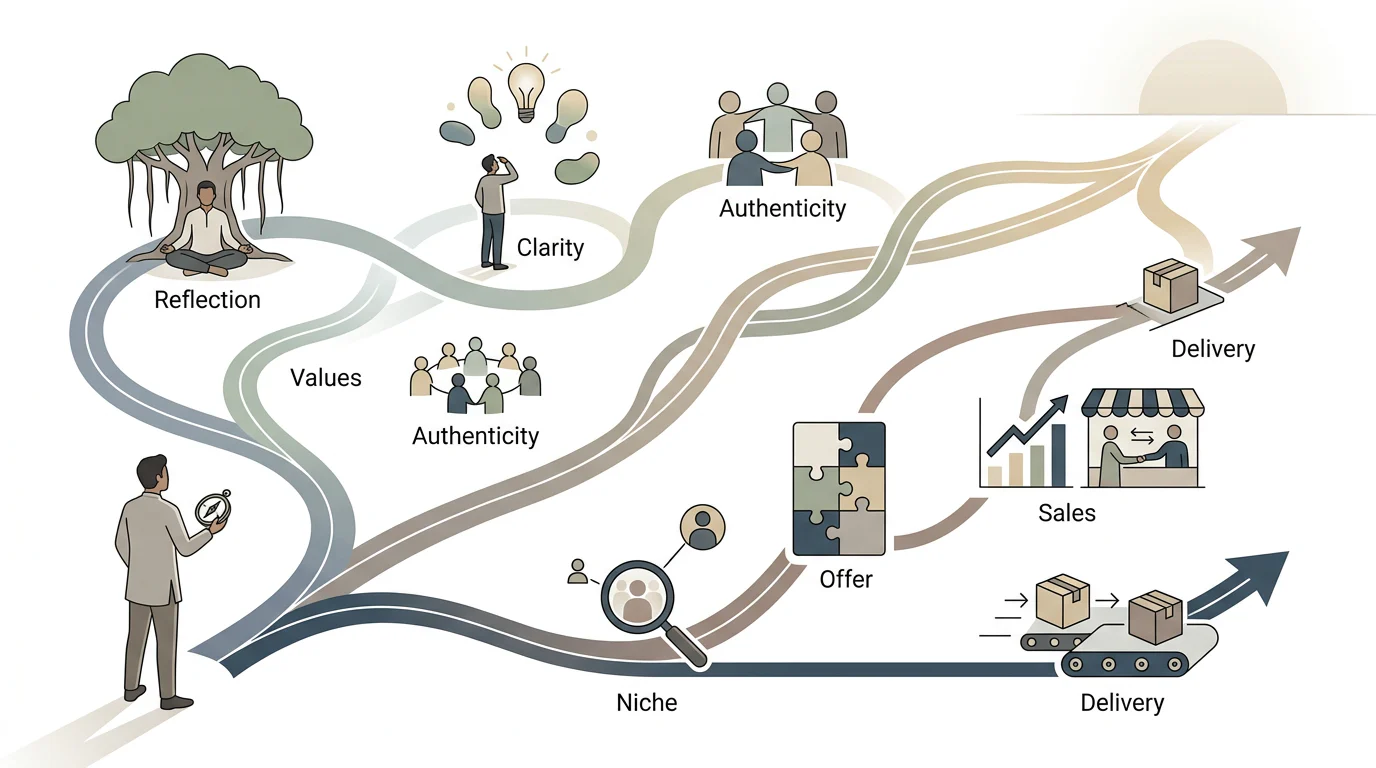
Is Your Pivot Problem Purpose, Positioning, Sales, or Execution?
We recommend diagnosing before choosing a person or programme. A founder who changes a logo when the offer is weak, or buys sales support while unable to name the work they want to do, spends effort on the wrong layer.
Do Your Values and Desired Impact Point to One Direction?
Start with values and desired impact. Ask what you will not trade away, what change you want to create, and which kind of client problem you want to keep solving. If those answers remain unstable, start with purpose work and use our purpose guide to turn reflection into decision criteria.
Does Your Expertise Solve a Defined Audience Problem?
Next, test expertise against a real audience. Relevant experience is not enough by itself. You need a specific buyer who recognises the problem, can describe its cost, and is willing to discuss a solution. When the expertise is clear but the audience is vague, use a sequenced approach: clarify the direction, then run a focused niche diagnostic.
Can the Pivot Survive Financially While You Test It?
Financial runway is the factor founders often skip because it feels less inspiring than a new purpose statement. Calculate personal obligations, current income, experiment costs, and the minimum income your new route must produce. Do not adopt a universal runway number, because dependants, savings, and risk tolerance vary sharply.
For eligible recognised startups, the Seed Fund Scheme allows up to ₹20 lakh for proof-of-concept, prototype, or product-trial validation, and up to ₹50 lakh for market entry, commercialisation, or scaling. That is a specific scheme with eligibility conditions, not a reason to skip validation.
What Evidence Says Buyers Want It Now?
Evidence of demand is an observable buyer action: a paid pilot, accepted proposal, repeat booking, pre-order, referral, or a clear conversion rate. Compliments, views, and followers may reveal interest, but they do not prove that an offer works.
Route yourself to purpose-first support when values and direction are unresolved. Route yourself to business-first support when the buyer and problem are known but the commercial model is weak. Choose sequenced support when both the direction and the evidence are incomplete. If the decision is individual and commercially focused, compare the formats in our private support guide.
Which Indian Business Pivot Coaches Fit Each Route?
We do not treat a shortlist as a universal ranking. We compare stated public evidence, then encourage readers to verify scope, delivery, current fees, and conflicts before deciding. An Indian business pivot coach should fit the current bottleneck, not merely have a large public profile.
| Candidate | Starting Route | Publicly Stated Evidence | Format Or Price Data | What To Confirm |
|---|---|---|---|---|
| Rohini Mundra | Purpose-first or sequenced | Our public work connects purpose, passion, profit, private coaching, group guidance, personal brand, and authority building | Confirm current format, availability, and fee directly | Whether the written scope includes the commercial work you need |
| Sundar Visvanathan, PCC | Transition and leadership-led | An ICF profile lists 35 years of corporate experience, change work, strategy, operations, and business development | Public price and programme detail are not stated | Fit for founder transition versus a defined offer-building need |
| Keshab Chandra Goswami, ACC, PCC | Business-first | An ICF profile lists strategic planning and business owners as clients | Self-listed at US$150 to US$249 hourly, in-person or video | Whether the work includes speaker, trainer, or coach business-building |
| Shweta Handa-Gupta, MCC | Business and leadership-led | An ICF profile identifies work with founders, promoters, and CEOs | Public fee and delivery format are not stated | Whether the engagement is appropriate for an early service pivot |
Our own published descriptions are most relevant when your work must connect purpose, personal authority, and an expert-business direction. Before joining any support route, review our programme scope and ask for the current written details rather than inferring them from testimonials or an event page.
Use the same comparison criteria for every option: ideal client, method, delivery format, commercial depth, evidence, credentials, price transparency, and conflicts of interest. “Not publicly stated” is a useful finding. It tells you exactly what to ask before paying.
How Do You Turn a Purpose Hypothesis into a Growth Plan?
A good pivot is a series of smaller decisions, not one dramatic leap. We suggest moving from direction to evidence before spending heavily on branding, technology, or scale.
Stage One: Write a Purpose Hypothesis
State the work you want to do, the people you want to help, the strengths you will use, and the values that shape the work. Treat this as a hypothesis, not a lifelong declaration. The goal is a decision clear enough to test.
Stage Two: Choose a Narrow Niche
Name one audience, one urgent problem, and one credible reason you can help. Your niche can later expand, but early specificity makes buyer conversations and offers more useful. Our first offer guide can help turn expertise into a practical starting point.
Stage Three: Test a Minimum Offer
Offer one paid pilot, workshop, advisory sprint, or speaking engagement with a clear problem and outcome. Record objections, conversion, delivery effort, and client feedback. Do not scale a concept that has only attracted praise.
Stage Four and Five: Position What Worked, Then Grow Deliberately
Use successful buyer language to shape positioning, proof, and sales conversations. Only then add acquisition systems, partnerships, broader visibility, or capacity. If corporate training is part of the route, our training sales guide can help you prepare an offer buyers can evaluate.

How Do Three Common Pivots Change the Choice?
The right route changes with the pivot you are making. We see different risks in an employment exit, a service-business change, and a move from expertise into speaking or coaching.
| Pivot | Start Here | First Proof To Seek | Avoid |
|---|---|---|---|
| Leaving Employment | Purpose-first or sequenced support | A narrow paid pilot before resignation | Treating a course purchase as financial readiness |
| Changing A Service Business | Business-first if direction is clear | Repeatable demand for the revised offer | Rebranding before diagnosing sales, positioning, or capacity |
| Turning Expertise Into Speaking Or Coaching | Sequenced support | A booked talk, paid workshop, or client pilot | Assuming visibility proves willingness to pay |
For an employment exit, protect runway and test the offer before making income irreversible. For an existing service business, do not confuse a capacity problem with a purpose problem. For speaking or coaching, build proof around an audience problem, not around a broad claim of inspiration. Our speaking guide explains how to move from one talk toward booking evidence.
Be especially cautious with guaranteed outcomes, unsupported scale claims, and programmes that create urgency before showing scope. India’s 2024 coaching guidelines address false guarantees and material information in coaching advertising. A meaningful pivot needs better questions, not louder promises.
Work with Rohini Mundra on Your Business Pivot
At Rohini Mundra, we work with entrepreneurs, speakers, trainers, and new coaches who want their next business move to reflect both conviction and commercial reality. We begin by identifying whether your immediate constraint is direction, niche, visibility, offer design, or a stalled path from expertise to paid work. Our purpose, passion, and profit lens is useful when the choice itself is unsettled. When your choice is clear, we can help you turn it into an audience-specific message, a testable offer, and an action plan that respects your capacity. We will be direct about the work our public pages describe and the details you should confirm before committing, including format, scope, availability, and terms. Bring the decision, the evidence you already have, and the question you cannot yet answer. If you are ready to decide what comes first in your pivot, start a fit conversation with Rohini Mundra.
FAQs on Indian Business Pivot Coaching
Should I Start with Purpose Coaching or Business-Building Support?
Choose purpose coaching when your direction and desired impact remain unsettled. Choose business-building support when you have an offer but buyers, sales, or delivery remain weak.
What Counts as Evidence of Demand?
Use a paid pilot, proposal acceptance, repeat booking, pre-order, or another observable buyer commitment. Likes, compliments, and audience size may signal interest, but do not prove demand.
What Should I Verify Before Hiring a Coach?
Ask for scope, client fit, delivery format, price, credentials, conflicts, cancellation terms, and evidence. Credentials verify coaching standards, not automatic commercial expertise for your specific pivot.
Can a Coach Guarantee Revenue or Bookings?
No. Coaching can clarify decisions and support action, but results depend on the client, market, offer, and execution. Guaranteed revenue, bookings, or scale are warning signs.
When Should I Scale My New Offer?
Scale after a paid or otherwise verified test demonstrates a real audience problem and workable delivery. Then build positioning, sales systems, capacity planning, and deliberate growth.