From One Talk to Booking Proof, Become a Motivational Speaker in India
A buyer-ready speaking system: one defined talk, a proof pack and an outreach process with documented terms.
- Time
- Ongoing
- Difficulty
- Advanced
- Cost
- Variable
- Steps
- 8
Before you start, have
- A topic grounded in your experience or expertise
- A defined audience and intended audience outcome
- A place to practise and at least one person who can give feedback
- A phone or camera for recording
- An email address and access to event or organiser contacts
- Your availability and boundaries for fees, travel and recording
Heads up: Do not treat TEDx as a paid booking channel. TEDx speakers may neither pay nor be paid, and local events choose speakers independently.
Heads up: Do not use a speaking stage to make unsubstantiated claims or to promise outcomes that your evidence cannot support.
Heads up: Do not accept recording, travel or fee assumptions without written agreement.
By Rohini Mundra, Founder · Updated 17 Sept 2026
In brief
Become a motivational speaker by building a single audience-specific talk, testing it in practice, then turning each delivery into buyer-ready proof. A paid speaking business needs more than stage skill: event organisers may request relevant outcomes, a sample video, prior delivery evidence and clear logistics.
Define one audience and outcome
Write one sentence that identifies who you speak to, the problem or question they bring, and what they should be able to think, decide or do afterwards. Event selection is tied to programme goals, audience, format, timing and location in the Events Industry Council's meeting-design standards. Use five evidence checks for a coaching niche if your audience is still too broad.
You have a usable starting point when a person can tell you who the talk is for without hearing your life story.
Draft one idea-based core talk
Turn your experience into one idea the audience can apply, rather than a chronological account of your life. Build a short core version with a clear opening, the evidence or experience behind the idea, and a practical close. TEDx describes its classic format as one speaker and one idea, generally in 18 minutes or less, while concise focused ideas are often shorter in its format guidance.
The draft works when you can state its central idea in one sentence and every story supports that sentence.
Rehearse and request structured feedback
Deliver the talk aloud in a practice setting, record it, and ask your reviewer to assess whether the intended outcome landed. Toastmasters notes that every prepared Pathways speech receives an evaluation and recommends defining the speech goal before seeking feedback in its guidance on speech evaluations.
Revise the opening, transitions and close from what the recording and feedback show, not from what you intended to convey.
Record and package buyer proof
After a real or practice delivery, create a proof pack containing a sample video, a short bio that explains relevant experience, three learning outcomes and a contact route. Add the event name, date and video link only when you can substantiate a previous delivery. A current PCMA speaker submission requests these same kinds of materials.
Your pack is ready when an organiser can see what the audience will receive and watch you deliver without needing a discovery call.
Match each pitch to the event brief
Read the event theme, audience, session format, timing and submission rules before adapting your title and learning outcomes. State why your idea serves that specific audience and format. Do not force a keynote into a workshop brief or submit a sales pitch to a non-promotional programme.
A matched pitch names the organiser's audience and programme need in the first lines, then shows how your session meets it.
Send buyer-ready outreach
Contact organisers with the tailored session title, audience outcome, delivery format, sample video, short bio and availability. Ask for their submission route or speaker brief if it is not public. This turns outreach into a relevance check rather than a request to “give me a stage”.
The outreach is complete when the organiser can either assess the proposal immediately or direct you to the correct process. For a wider client-acquisition system, read how to get coaching clients in India.
Agree the commercial and logistics scope
Before accepting, confirm the session format, date, time, location or virtual set-up, fee, travel treatment, recording permissions and non-promotional boundaries in writing. Speaker processes can include availability, recording consent, travel policy and sales-pitch restrictions, as shown in PCMA's 2026 event requirements.
The booking is operationally ready when both sides can point to the same written scope and expectations.
Review the delivery and renew the proof pack
After each delivery, save the recording permission, event details, audience feedback and any approved testimonial. Use the evidence to improve the next core talk and replace weaker proof material. If you plan to add coaching or training services, connect the speaking offer to a defined business model through a clear first coaching offer.
The system is working when each completed engagement leaves you with a better talk, stronger proof or a clearer booking process.
You'll know it worked when
You have one audience-specific core talk, a recorded sample, a short bio, three learning outcomes, a tailored outreach message and written terms for any confirmed engagement.
Make the work visible before you ask for a booking
A buyer cannot assess a speaker from a broad promise alone. PCMA's 2026 speaker expression-of-interest form asks for relevance to the event, three learning outcomes, a sample video and, where available, details of earlier delivery.
Treat your talk, proof and booking information as one connected system. The work below uses buyer requirements as the standard, rather than treating confidence on stage as the whole job.
What an organiser can assess before booking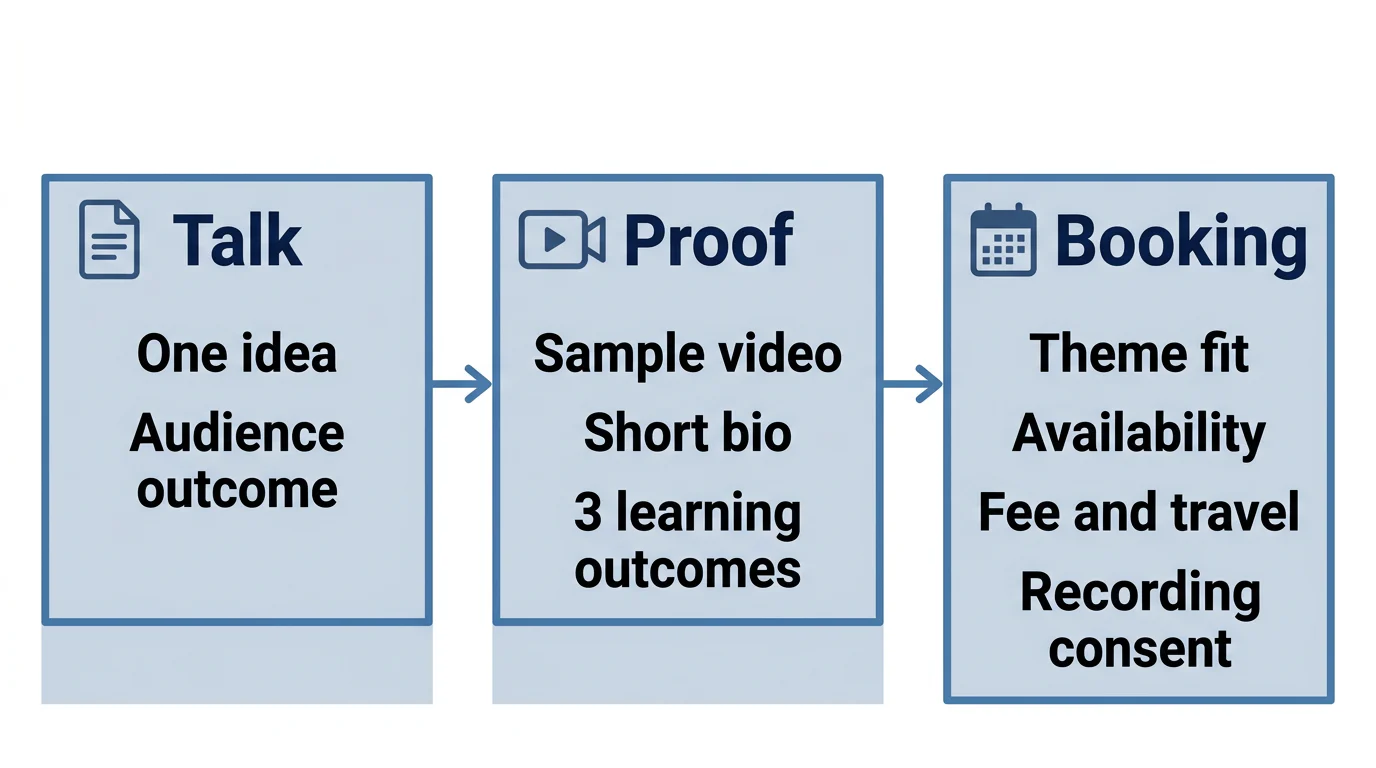
Source note: event requirements and TEDx rules cited here were checked in September 2026.