
Purpose, Passion and Profit Need Evidence for an Expert Path
A practical route from personal strength to a professional path that an audience can assess.
4 chapters · Updated Sep 16, 2026 · By Rohini Mundra
In brief
Purpose, passion and profit become useful when you connect a developed skill to a specific audience problem and test a small path before making a bigger commitment. Use evidence to choose what you can credibly help with, research to choose whom to help, and feedback to decide whether to refine, continue or pause.
Start with evidence, not a personality label
Passion can point towards work worth exploring, but it cannot by itself show what you are ready to offer another person. Begin by collecting evidence of skills you have developed through education, training or experience. The U.S. Bureau of Labor Statistics skills framework defines a skill as developed, applied, work-related and general enough to transfer across occupations.
Turn that definition into a short evidence record. For each possible strength, note the setting in which you used it, the task you handled, the people involved and the result you could observe. A person who enjoys speaking, for example, may have evidence in facilitation, presenting findings, teaching a process or listening to customer concerns. The evidence is more useful than the label because it helps identify the problem you may be able to help solve.
Avoid treating a quiz result, a job title or praise from friends as a complete answer. Those can generate ideas, but they do not replace examples of applied work. Choose a small number of strengths that you can explain clearly and honestly.
Choose one audience problem before choosing an offer
Purpose becomes easier to act on when it is connected to a problem that matters to a specific group. Rather than asking, “Who could use my skills?”, ask, “Whose situation do I understand well enough to investigate, and what is difficult for them now?” The answer should name an audience and a problem, not a broad ambition such as helping everyone feel more confident or successful.
The U.S. Small Business Administration recommends researching demand, market size, location, saturation and what potential customers pay for alternatives. For an early expert path, use those prompts as questions rather than as a prediction exercise. Find out whether people describe the problem in their own words, what they try instead, and what makes existing options incomplete.
Direct research can be modest. Surveys, questionnaires, focus groups and in-depth interviews are all methods the SBA lists. The goal is not to persuade people that they need your idea. The goal is to learn whether the problem is real, specific and worth solving before you build an offer around it.
Run a small test before treating the path as a business
Once you have a strength record and a defined audience problem, design the smallest credible way to test your proposed help. The test might be a prototype, a limited professional service, a workshop outline or a small proof of concept. It should make one assumption visible, such as whether the audience understands the problem, values the approach or wants help in that format.
Startup India describes validation as building a probable solution or prototype around assumptions and then testing them with feedback from an initial small target-audience sample. Its national report also links validation to approaching early customers, developing a minimum viable product and identifying product-market fit. Read the Startup India national report as a reminder that feedback is part of the work, not a final approval stamp.
Evidence, audience and test decisions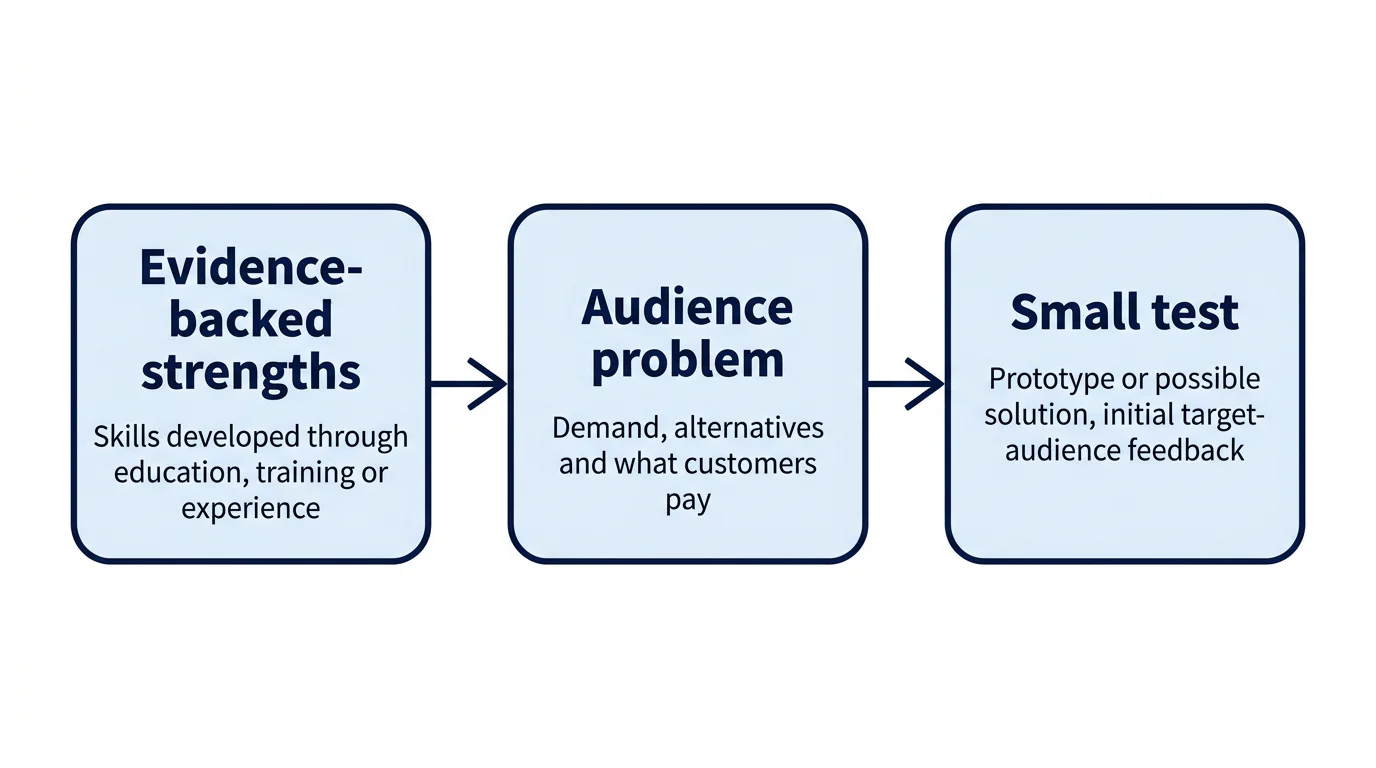
A small test is not designed to guarantee income or prove that every passion should become a business. It is designed to produce a decision. Continue when the audience problem and your contribution are becoming clearer. Refine when feedback identifies a mismatch. Pause when the evidence does not support a credible next step.
Use the result to choose a credible next move
An expert path becomes more credible when it is narrow enough to explain. State the strength you can evidence, the audience problem you are investigating and the small result you are testing. That gives people a practical way to understand your work without asking them to accept a broad claim about transformation.
The next move does not have to be a full business launch. You may improve the test, build more relevant experience, seek work inside an existing organisation, develop a clearer professional service or decide that the problem is not the right fit. Each outcome can be useful because it replaces assumption with information.
This approach is not ideal for someone who needs an immediate income result or who is looking for a shortcut to professional authority. It also cannot establish eligibility for work that requires formal qualifications, licences or supervised practice. Treat passion as direction, purpose as the reason to care about a problem and profit as one question about whether the work can continue without making a promise that the market has not yet supported.