

On this page
What is a Business coach?
A business coach is a professional partner who helps a business owner or leader clarify a business-related goal, examine options, and design actions and accountability. A coach does not primarily diagnose, prescribe a solution, teach a fixed curriculum, share personal experience as the answer, or provide therapy.
Key takeaways
- Business coaching is most useful when the client needs clearer thinking, chosen actions and accountability around a business-related goal.
- A consultant is the better fit when the main need is an expert diagnosis, a prescribed recommendation or implementation.
- Mentoring is experience-led guidance, while training transfers defined knowledge or skills.
- Coaching is not therapy, and a coach should refer needs outside the coaching scope to an appropriate professional.
- A written agreement should make the service mode, roles, confidentiality, payment and ending terms clear before work begins.
The service mode matters more than the label
A business coach can work with founders, owners, managers or leaders, but the defining feature is the method: the coach partners with the client to clarify what the client wants, explore options and design client-owned action. The International Coaching Federation’s 2025 PCC minimum skills requirements treat directing prescribed actions as inconsistent with coaching.
A consultant can still ask good questions, and a coach may bring relevant experience. The practical distinction is the primary promise. If the engagement primarily supplies the expert’s diagnosis or solution, describe it as consulting. If it primarily helps the client think, choose and follow through, describe it as coaching.
Five forms of support solve different problems
- Coaching: Use coaching to clarify a goal, examine choices and design actions the client owns.
- Consulting: Use consulting when an expert is expected to diagnose a problem or prescribe a solution.
- Mentoring: Use mentoring when guidance from an experienced businessperson is the central value. The U.S. Small Business Administration describes SCORE mentors as experienced business professionals who provide personalised guidance in its Office of Entrepreneurial Development overview.
- Training: Use training when the need is defined content, instruction or skill development. ICF’s 2024 coach educator competency model describes education as sharing content and imparting knowledge.
- Therapy: Use therapy when assessment, diagnosis or treatment of dysfunctional emotional, thinking or behaviour patterns is needed. The American Psychological Association’s psychotherapy definition describes those functions.
A worked decision for a founder
A founder has five possible needs: clarify a delegation goal, receive an operations solution, hear from someone who has managed a similar team, learn a delegation method, or obtain mental-health treatment. The founder chooses coaching for the first need because the work is to decide what to change and design follow-through.
The same founder chooses consulting if an expert must build the operations solution, mentoring if experience-led guidance is the priority, training if a defined delegation skill must be taught, and therapy if diagnosis or treatment is required. The decision is about the primary need, not which label sounds more appealing.
Questions that set a useful boundary
Ask these questions before starting:
- What part of this engagement is coaching, consulting, mentoring or training?
- What will I be expected to decide and do myself?
- What deliverables or recommendations, if any, will you provide?
- How will we agree the goal and recognise progress?
- What experience or credential is relevant to my situation?
- What are the confidentiality, payment, cancellation and ending terms?
- When would you recommend another professional or service?
The ICF’s 2025 Code of Ethics says a coaching agreement should address roles, responsibilities, confidentiality and financial arrangements. For a founder whose main challenge is choosing a direction, see Business Coaches for Service Founders with Unclear Priorities.
Put the need before the label
ICF-aligned coaching is client-led, while the other support modes meet different primary needs. Naming that need before an engagement starts helps prevent a question-led coaching conversation from being mistaken for prescribed consulting or therapeutic care.
The support mode follows the primary need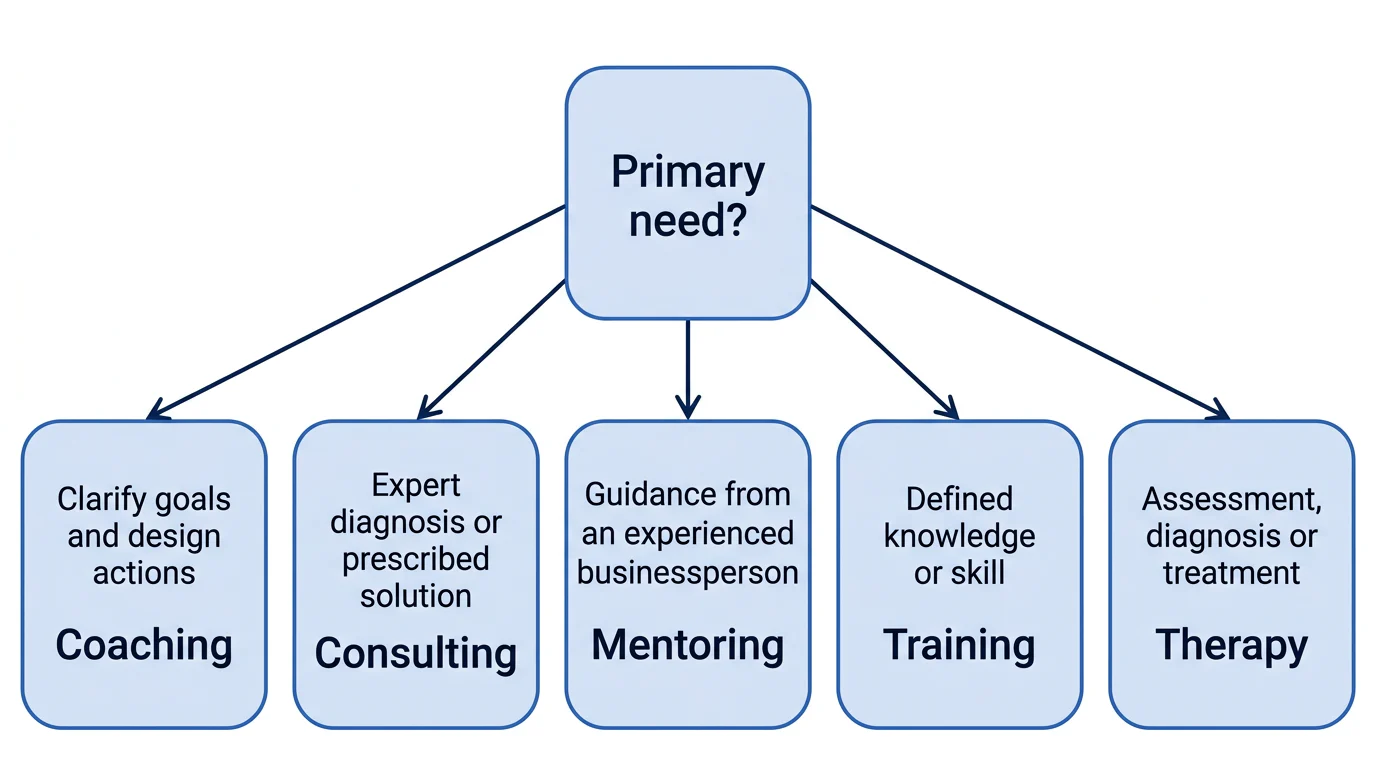
Example
Example: A founder has five possible needs, but chooses coaching only for the need to clarify a delegation decision and design personal follow-through. The founder chooses consulting, mentoring, training or therapy when one of the other four needs is primary.