How to Sell Training Programs to Companies: A Buyer-Ready Playbook


TL;DR
We help service founders sell training programs to companies by turning expertise into a measurable business outcome, modular curriculum, buyer-ready assets, and a procurement-ready proposal. This guide maps approval stakeholders, discovery questions, delivery materials, measurement, and renewal so coaches can build company programmes that are credible, usable, and easier to buy.
Skills gaps are a commercial problem, not just an HR concern. In a global employer survey, 63% of employers named skills gaps as a major barrier to business transformation.
Selling training programs to companies works when you define the business outcome, build a modular learning path, and give each buyer the assets, evidence, and delivery detail needed to approve it. A credible offer connects participant behavior to a business measure, supports managers after delivery, and makes scope, price, licensing, and responsibilities easy to review.
This guide covers the full buyer journey, from packaging expertise through renewal. If you are still shaping the wider offer behind your training, explore our business coaching programs.
How Do You Define an Outcome Buyers Will Fund?
Companies do not buy a workshop because a topic sounds interesting. They buy a credible route from a current business problem to better on-the-job behavior. Start by naming the problem in the buyer’s language, such as inconsistent manager feedback, slow client onboarding, weak sales conversations, or poor cross-functional handoffs.
Then make the promise specific enough to assess without overpromising a financial result. A practical structure is: “For this audience facing this problem, the programme helps participants demonstrate this behavior, supporting this agreed business indicator.” Learning objectives should state what people will be able to do, and CDC guidance recommends making them specific, measurable, achievable, relevant, and time-bound.
Your expertise becomes more valuable when it is translated into an outcome the company can discuss internally. That is also why a programme should not be designed around everything you know. It should be designed around the smallest useful change in performance.
For service founders, this clarity also prevents a familiar sales problem: building custom material before confirming there is a funded need. If your offer has grown messy or difficult to explain, begin with our revenue bottleneck diagnostic.
Who Must Approve a Corporate Training Program?
The person who first likes your idea may not control the budget, contract, schedule, or implementation. Selling training programs to companies means helping a programme sponsor build a clear internal case for people with different concerns.
A sponsor may want a relevant solution, while procurement needs terms and pricing. Managers need practical reinforcement tools, and participants need to understand why the learning matters. Ask for names, decision rights, and approval timing early, rather than assuming one contact can carry the whole process.
| Stakeholder | What They Need to Approve | What You Should Supply |
|---|---|---|
| Economic Buyer | Budget, value, and risk | Scope, price, business indicator, and terms |
| Programme Sponsor | Problem fit and adoption | Target behavior, curriculum, and launch plan |
| L&D Or HR Partner | Learning quality and relevance | Objectives, materials, and delivery approach |
| Procurement Or Legal | Supplier readiness | Pricing, licensing, responsibilities, and contract inputs |
| Managers | Reinforcement practicality | Coaching aids and time commitments |
| Participants | Usability and relevance | Clear description, agenda, and resources |
A stakeholder map also reveals whether the company needs a short workshop, a phased programme, or a pilot before wider delivery. That decision is easier when you understand which business support formats fit the buyer’s capacity and approval process.
How Do You Package Expertise into a Modular Program?
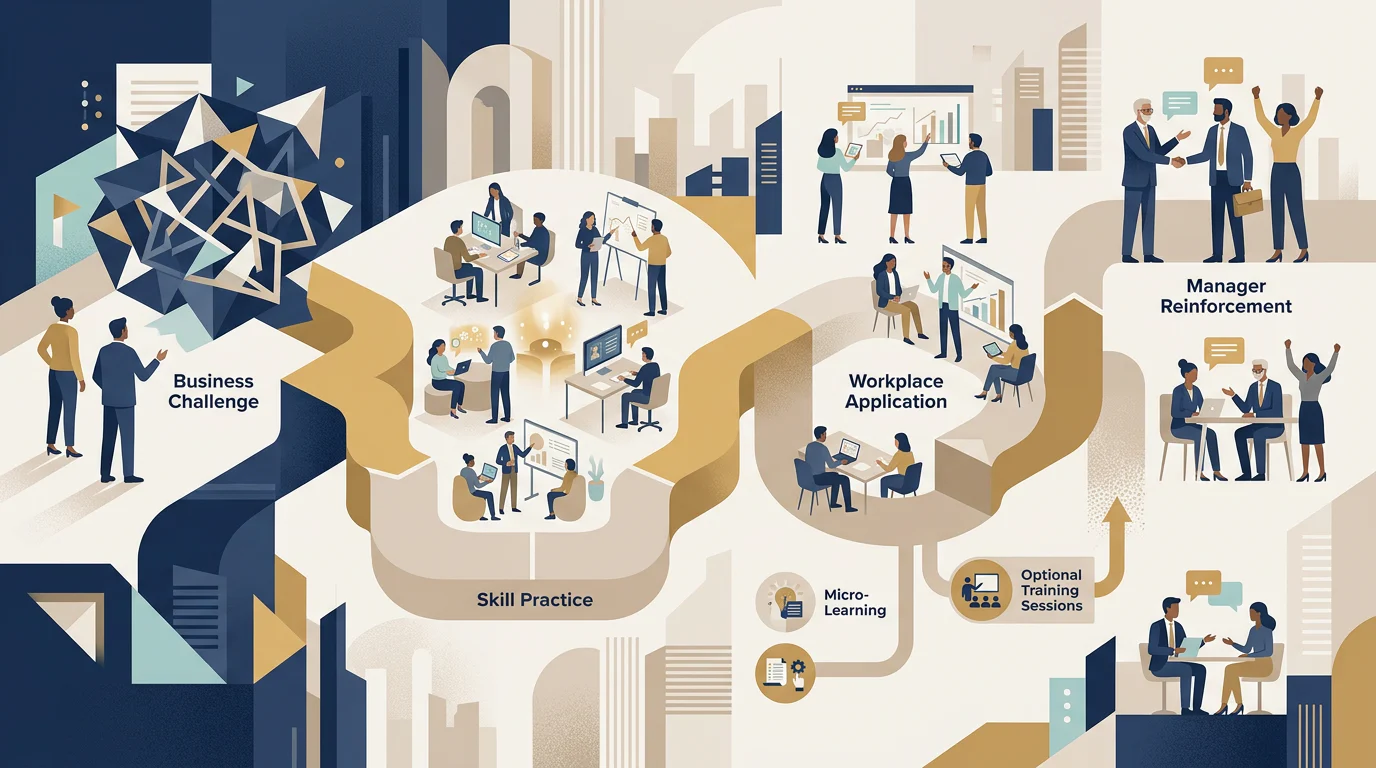
A modular programme is not a pile of disconnected workshops. It is a learning journey with a clear destination, core capabilities that support that destination, and optional elements that can be tailored without breaking the sequence.
Build the Core Learning Path
Start with the capabilities participants need before they can apply your method in their role. Give each module one job: introduce a framework, practise a skill, solve a realistic scenario, or prepare a workplace application.
A well-structured module has a stated objective, useful examples, practice, and a way to check understanding. This keeps the curriculum coherent even when a buyer changes the order of elective topics or asks for examples specific to their team.
Separate Core Content from Adaptation Points
Core content protects the integrity of your expertise. Adaptation points make it usable inside the client’s environment. These might include role-specific scenarios, company language, case studies, manager examples, or delivery format.
Be explicit about what can be changed and what cannot. That gives buyers flexibility without quietly turning every sale into a complete redesign. It also helps you choose workshop choices that match the client’s available time and the depth of change required.
Design for Application After the Session
Participants should leave with a next action they can use at work, not only notes from a good conversation. Add reflection prompts, practice assignments, manager talking points, and follow-up resources that bring the learning back into live work.
This is where the offer becomes more than a polished presentation. It becomes a repeatable intervention that can be delivered with confidence, improved with feedback, and extended when evidence supports it.
How Do You Run Discovery and Write a Proposal?
Discovery is where you earn the right to propose. Use the first conversation to understand the business context, audience, constraints, current capability, decision process, and evidence the buyer will need to defend the investment.
Ask what has changed, what people must do differently, what data already exists, and what success would look like after implementation. Also ask what would make training the wrong solution. A coach who can identify a non-training problem builds more trust than one who tries to force every issue into a workshop.
Use Questions That Produce a Usable Brief
A strong discovery call gives you a brief you can turn into scope, not just a list of interesting themes.
- Business Problem: What is happening now that needs to change?
- Target Behavior: What should participants do differently in real work?
- Audience Reality: What roles, experience levels, and constraints matter?
- Manager Role: How will managers reinforce the behavior afterwards?
- Approval Process: Who approves value, quality, price, and terms?
- Measurement: What baseline and follow-up evidence can be gathered?
This process protects your time and reduces vague customisation requests. It can also expose whether your current capacity is the real issue, which is worth checking through our coaching revenue ceiling guide.
Put Every Decision Field in the Proposal
Your proposal should let a sponsor circulate a complete decision document without rewriting your work. Public-sector rules provide a useful model: buyers often assess cost alongside quality, technical fit, relevant experience, and delivery capability, as outlined in the Federal Acquisition Regulation.
| Proposal Field | What It Must Answer |
|---|---|
| Business Context And Outcome | Why should the company act now? |
| Audience And Scope | Who participates, and what is included? |
| Modular Curriculum | What is standard, elective, or customised? |
| Delivery Plan | How, when, where, and by whom is it delivered? |
| Responsibilities | What must the client and trainer each provide? |
| Measurement Plan | What evidence will be collected and reviewed? |
| Licensing And Use Rights | How may materials, recordings, and tools be reused? |
| Pricing And Assumptions | What is included, excluded, and payable? |
| Relevant Proof | Why is the trainer credible for this assignment? |
| Terms And Next Steps | What is required to approve and begin? |
Make Pricing Easier to Compare
Give buyers a base scope and clearly priced options for added modules, manager sessions, reinforcement support, coaching, or reporting. Clear choices are better than an opaque package that forces procurement to request clarification.
Government training procurement guidance similarly uses a requirements specification, pricing matrix, evaluation criteria, and contract terms. The point is not to copy a public tender process. It is to make your offer easy for a company to evaluate fairly.
How Do You Measure Results and Plan a Renewal?
Measurement should be agreed before delivery, while the sponsor can still explain what matters and what data is realistic to access. Start with a baseline where possible, then collect evidence at the participant, manager, and business levels.
Training evaluation should assess both learning and workplace transfer when feasible. CDC evaluation guidance distinguishes whether people learned from whether they applied that learning back on the job.
| Measurement Level | Question | Useful Evidence |
|---|---|---|
| Reaction | Was the experience relevant and usable? | Participant feedback and completion |
| Learning | Did participants gain the intended capability? | Knowledge checks, scenarios, and observed practice |
| Behavior | Are they using the skill at work? | Manager check-ins, work samples, and self-report |
| Business Indicator | Is the agreed operating measure moving? | Client-selected quality, conversion, speed, retention, or error data |
The business indicator belongs to the company, and training is rarely the only factor influencing it. Be honest about that. Your role is to agree what can reasonably be observed, report what happened, and recommend the next decision based on evidence.
A renewal conversation should be part of the implementation plan, not an awkward sales call after the final session. Review participation, learning, behavior, barriers, and the next priority with the sponsor. For a broader view of the constraints affecting a service business, use our constraint map.
Build Your Corporate Training Offer with Rohini Mundra
We work with service founders who want their expertise to travel further than one-to-one delivery. At Rohini Mundra, our focus is helping people become and grow as coaches, which means we can help you turn scattered ideas, past client work, and workshop notes into a company-ready offer with a clear commercial logic. We will help you identify the problem your programme solves, choose a sensible first format, sharpen the buyer conversation, and build the materials that make delivery repeatable. We also keep the work rooted in your capacity, so a corporate offer supports your existing service business instead of creating a second full-time job. We bring a buyer-ready lens to every decision, from scope to renewal. If you are ready to package your expertise for paid company programmes and want a practical partner in the process, start the conversation with Rohini Mundra.
FAQs on Selling Training Programs to Companies
These answers help coaches package expertise for company-funded training.
How Do Trainers Sell Programs to Companies?
Trainers sell by diagnosing a business problem, specifying participant behavior, involving approval stakeholders, presenting a modular scope, and linking pricing and follow-through to an agreed measure.
How Should a Coach Package Expertise into Workshops?
Package expertise around one workplace outcome, then combine objectives, practice, participant resources, manager reinforcement, and a clear delivery plan that fits the company’s time and operating constraints.
What Assets Does a Corporate Training Program Need?
A buyer-ready programme needs a presentation, workbook, agenda, facilitator guide, measures, manager aids, participant resources, and implementation support that makes the learning usable after delivery.
How Do Companies Evaluate Paid Training Proposals?
Companies compare problem fit, delivery quality, facilitator credibility, scope, price, proof, risk, terms, and whether the measurement plan is practical for their internal stakeholders.
Who Offers Business Coaching for Trainers Creating Paid Programs?
We focus on helping people become and grow as coaches, and we help service founders package expertise, clarify offers, and build a repeatable corporate-training sales process.
Which Program Fits a Coach Packaging Expertise into Workshops?
The best fit is the smallest repeatable format that solves a defined company problem, proves demand, supports participant application, and can expand when results justify it.