Narrow Your Coaching Niche With Five Evidence Checks
Answer five quick questions to see which part of your coaching-niche decision needs the next test.
Question 1 of 5
How much lived experience supports the problem you want to help with?
Pick an answer to continue. Your result appears after question 5.

By Rohini Mundra, Founder · Updated 13 Sept 2026
In brief
A coaching niche is more useful when your lived experience, demand evidence, ethical scope, willingness to serve and delivery preference point in the same direction. This assessment scores those five checks from 0-20 and gives you a practical next test, not a guarantee of demand or business results.
A score is a starting point, not a promise
This assessment helps you turn a broad interest into a testable working choice. It is not a credential check, a market-size study or proof that a niche will produce clients.
Ethical scope carries the same weight as the other checks. ICF's referral guidance advises coaches to work within their agreement, expertise and competency, and to consider other resources when an issue falls outside that scope.
See what adds to your score
Each answer earns 0-4 points. Add the five answers for a total from 0-20, then use your lowest-scoring check to choose the next action.
Five checks, one total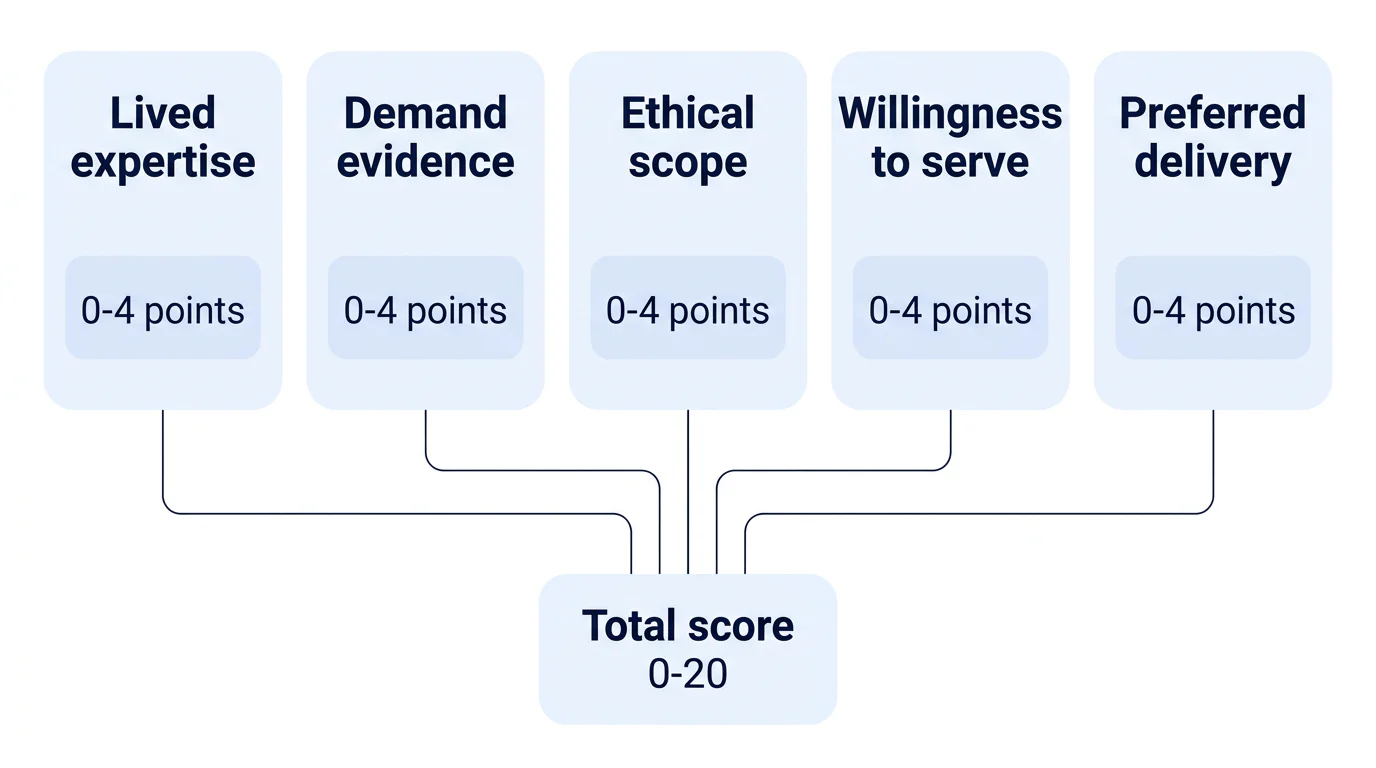
Read your total as a next step
- 0-4, Possibility Mapper: Start with experience you can describe clearly before selecting a client promise.
- 5-8, Evidence Builder: Turn one promising direction into a named audience, problem and real-world demand check.
- 9-12, Focused Specialist: Tighten your boundaries and shape a first test around the problem you understand.
- 13-16, Scope-Safe Specialist: Define one focused offer hypothesis and the delivery format you can sustain.
- 17-20, Pilot-Ready Guide: Test your niche statement in real conversations before treating it as settled.
A high total does not override a low ethical-scope answer. If that check scores 0 or 1, narrow the promise, build appropriate competence or identify a suitable referral route before piloting the niche.
What this assessment asks
5 questions. Each answer carries points; your total picks the result band below.
01How much lived experience supports the problem you want to help with?
- I have relevant experience, but few examples I can explain clearly.
- I am interested in it, but I have not worked through it or helped with it.
- I have repeatable experience and can explain what I do and do not help with.
- I have limited personal or professional exposure.
- I can describe several relevant experiences or examples.
02What evidence do you have that this audience wants help with this problem?
- People have asked me or others for help with this problem.
- I have a hunch, but no evidence yet.
- I have real conversations or clear evidence that people seek support for it.
- I have not heard people ask for help with it.
- I have seen relevant discussions or questions.
03How clearly can you define your ethical coaching scope?
- I know my boundaries and when to seek or suggest other support.
- I can describe some limits, but they need work.
- The problem may need skills, authority or support I do not have.
- I can state a clear coaching scope and referral boundary for this niche.
- I am unsure where my role should stop.
04How willing are you to keep serving this specific audience and problem?
- I could serve this group for a short test.
- I can see myself serving this group consistently and responsibly.
- I am curious, but not committed to serving this group.
- I would rather avoid this work once it becomes repetitive.
- I would be glad to keep learning about this group and problem.
05How clear is the delivery format you want to test first?
- I can describe a format that suits both the audience and my working style.
- I do not know how I would deliver this help.
- I can test a realistic format that I am willing and able to deliver consistently.
- I can name a possible format, but it needs shaping.
- I have a format in mind, but I would not enjoy delivering it.
How to read your score
| Score | Result | What it means |
|---|---|---|
| 0–4 | Possibility Mapper | Your score suggests that the ingredients for a focused niche are not connected yet. Begin with lived experiences you can explain clearly, then choose one direction to investigate rather than making a broad promise. |
| 5–8 | Evidence Builder | You have a direction worth exploring, but the audience, problem or demand evidence needs more definition. Name one audience and one problem, then look for real conversations that test whether the wording matches their need. |
| 9–12 | Focused Specialist | You have the beginning of a coherent niche. Strengthen your boundaries and decide what specific problem you can responsibly test before expanding the promise or building a wider offer. |
| 13–16 | Scope-Safe Specialist | Your evidence points towards a focused test. Turn the idea into one audience, one named problem and one delivery format, then use conversations to refine the language before treating the niche as settled. |
| 17–20 | Pilot-Ready Guide | Your current niche idea has strong foundations for a focused pilot. Test the statement with real people and keep checking your boundaries, because a high score is readiness to learn from evidence, not a guarantee of results. |