
Glossary
Purpose, passion and profit

By Rohini Mundra, Founder · Updated 25 Sept 2026
Also called purpose-passion-profit framework or three P career framework
On this page
What is a Purpose, passion and profit?
Purpose, passion and profit are three separate career-decision tests. Purpose names the change or reason you want work to serve, passion names sustained interest in the work, and profit asks whether revenue exceeds costs. Profit can support continuation, but it cannot prove personal purpose or social value.
Key takeaways
- Purpose gives a career decision a direction by naming the reason or contribution the work should serve.
- Passion can identify work worth exploring, but passion does not by itself show developed skill or customer demand.
- Profit requires a specific offer, revenue and costs, so it is a commercial test rather than a personality test.
- A small test can replace a broad career assumption with feedback from a defined audience.
Keep the three questions separate
| Component | Career question | Useful evidence |
|---|---|---|
| Purpose | What difference or reason do I want my work to serve? | A clear intended beneficiary, problem or outcome. |
| Passion | What work holds my interest strongly enough to explore? | Recurring interest and energy for the activity. |
| Profit | Does this offer leave money after costs? | Revenue and costs for a specific offer. |
Purpose, passion and profit can overlap, but none automatically establishes the others. A person can care deeply about a problem without enjoying every task involved, enjoy work that has no market, or earn profit from work that does not match personal values.
Use profit as a signal, not a verdict
Profit means that revenue is greater than costs for a defined activity. A positive result can support continuing to test or improve an offer, but it cannot establish that the work is a lifelong calling, ethically valuable or the best use of a person's abilities.
A weak profit result is also information, not a personal judgement. Review the audience, problem, offer, price and delivery costs before deciding whether to refine the idea or pause it.
Test a career idea before making a larger commitment
Start with one defined audience problem and one limited offer. Record what people ask for, whether the offer is understandable, what it costs to deliver and whether anyone makes a meaningful commitment.
For a broader change in direction, business pivot coaching can help separate an unresolved purpose question from a positioning, sales or delivery problem.
Turn a career idea into evidence
Choose one audience problem, then make the smallest credible offer that could help solve it. The Purpose, Passion and Profit guide and the expert-path assessment can help turn a broad idea into a bounded next move.
From direction to evidence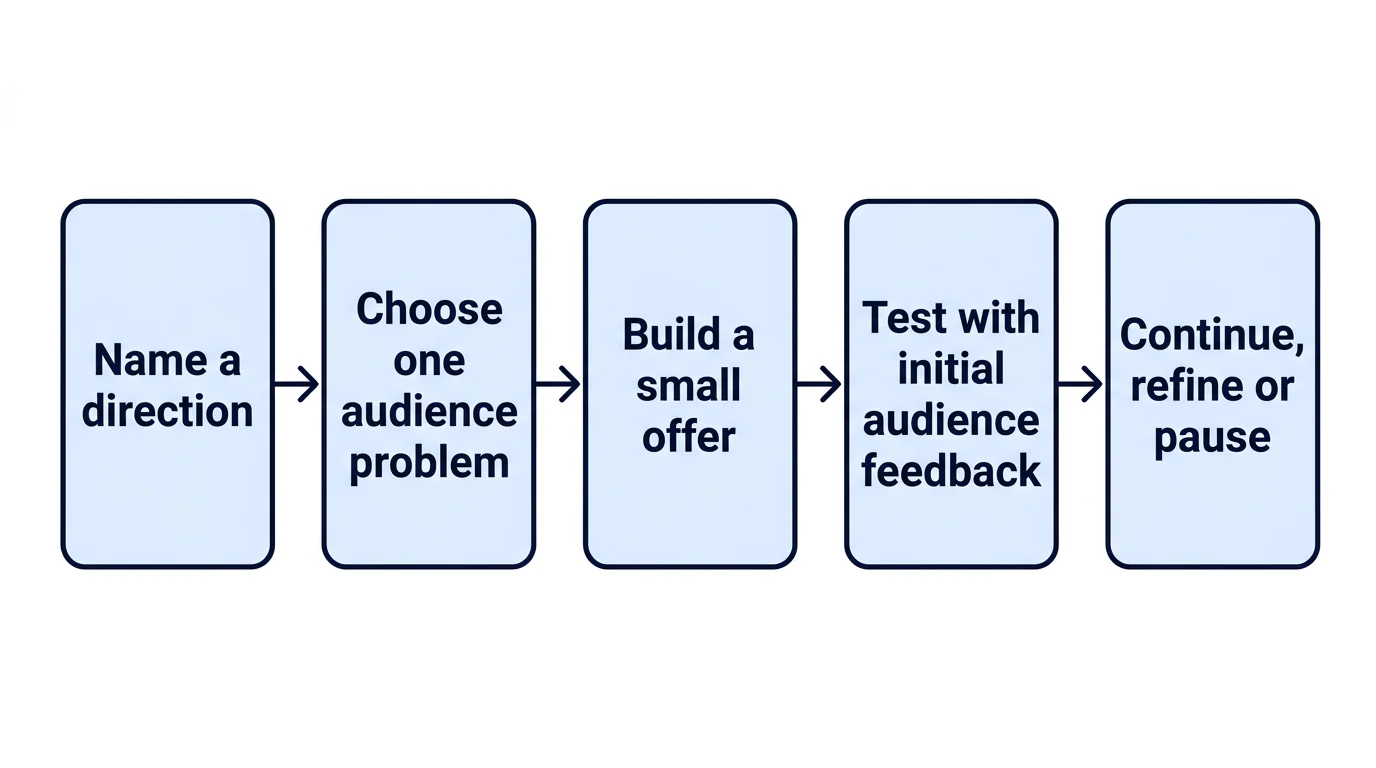
The U.S. Small Business Administration recommends examining demand, market size, location, saturation and what people pay for alternatives. Startup India describes validation as testing assumptions through a probable solution or prototype with feedback from an initial target-audience sample.
Example
Hypothetical example: A tutor runs five paid sessions at ₹2,000 each, creating ₹10,000 in revenue. If preparation, materials, travel and platform costs total ₹6,500, the offer produces ₹3,500 in profit. The tutor can use that result to assess the offer's viability, while still deciding separately whether tutoring serves the purpose and kind of work the tutor wants.