Which Expert Path Fits Your Purpose, Passion and Profit?
Choose the answer that best describes where you are now. Higher points consistently mean more readiness to test a focused expert path.
Question 1 of 5
What evidence supports the strength you want to use?
Pick an answer to continue. Your result appears after question 5.

By Rohini Mundra, Founder · Updated 22 Sept 2026
In brief
This five-question assessment helps you see how ready your current purpose, passion and profit idea is for an expert path. It scores evidence, impact, audience proximity, economic viability and willingness to test from 0 to 3, then places your 0 to 15 total in a stated result band. Your result is a guide to the next experiment, not a diagnosis or income forecast.
How the score is built
Each of the five answers is worth 0 to 3 points, so your total ranges from 0 to 15. The score bands are 0 to 3 Foundation, 4 to 7 Focus, 8 to 11 Validate, and 12 to 15 Build. Review your lowest-scoring answer as well as your total, because it identifies the first constraint to address.
Five signals behind your score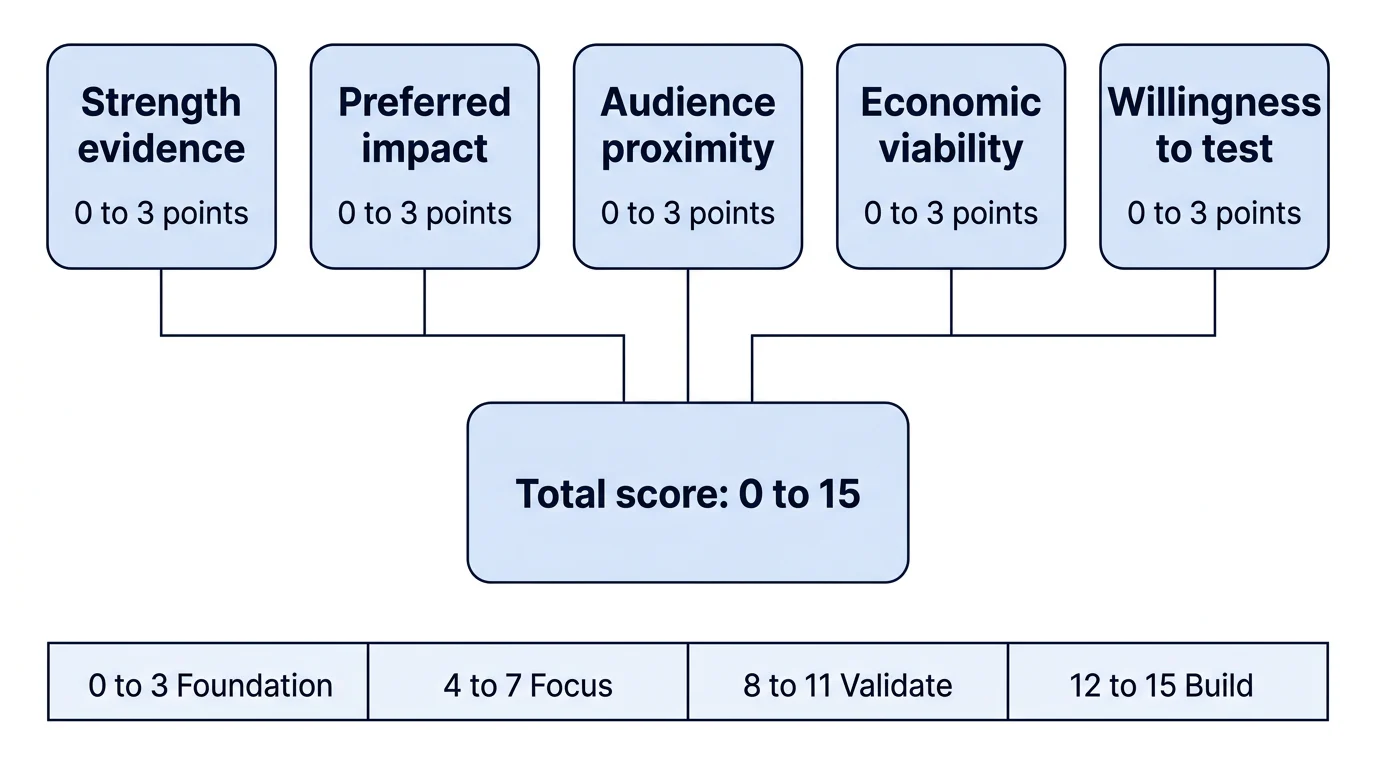
What this assessment can and cannot tell you
A purpose, passion and profit score can help you choose a small next move when your direction feels broad. It cannot establish a fixed calling, predict client demand, or guarantee income.
The questions deliberately separate having an interest from having evidence, proximity to people who may need help, an economic signal, and readiness to test. That separation helps you avoid treating enthusiasm alone as a complete expert path.
What this assessment asks
5 questions. Each answer carries points; your total picks the result band below.
01What evidence supports the strength you want to use?
- I can name one or two specific examples of this strength.
- I cannot point to a relevant example yet.
- I can show several specific examples of this strength in action.
- I have relevant experience, but no clear example prepared.
02How clearly can you describe the impact you want to make?
- I have a broad theme, but not a clear change.
- I can name the change and the people who need it.
- I cannot name the change I want to help create.
- I can name a change I want to help create for a group.
03How close are you to the people you may want to help?
- I regularly speak with, serve or work alongside this audience.
- I have not spoken with or observed this audience.
- I have had some relevant conversations or observations.
- My view is mostly based on assumptions.
04What economic signal do you have for this direction?
- I am interested, but I have not checked for demand.
- I can describe a small, specific offer or test to explore.
- I have no signal that anyone would seek or value this help.
- Someone has asked for related help or shown clear interest.
05What are you willing to do next?
- I am willing to schedule a conversation or small exercise.
- I am not ready to test anything yet.
- I am willing to run a short bounded test and record what I learn.
- I am willing to reflect or research further.
How to read your score
| Score | Result | What it means |
|---|---|---|
| 0–3 | Foundation | Your answers show that the path needs more raw evidence before it needs a brand, offer or launch plan. Start by recording specific examples of your strengths and the problems you have already helped address. Your lowest-scoring question identifies where to begin. |
| 4–7 | Focus | You have material to work with, but your direction is still broader than a testable expert path. Choose one audience and one change to explore, then use real conversations to replace assumptions with evidence. Review the question where you gave yourself the fewest points. |
| 8–11 | Validate | Your answers suggest you can move from reflection into a bounded proof exercise. Define one small way to help, identify who it is for, and record what people ask for or respond to. A low individual factor can still show the first part of the test that needs attention. |
| 12–15 | Build | Your answers indicate that you have enough clarity and readiness to shape a focused first offer. Keep the offer bounded, connect it to a defined audience and continue recording evidence as you test. A strong score supports action, but it does not guarantee demand or income. |