
Glossary
Brand Story
A brand story is a true account of why a business exists, built from facts, values and feelings. For a solo expert, it works when the founder's moment is the buyer's problem.
By Rohini Mundra, Founder · Updated 23 Oct 2026
On this page
- 01Definition
- 02What is a brand story?
- 03What do real Indian brand stories have in common?
- 04Should the founder or the customer be the hero?
- 05What is a brand story often confused with?
- 06How do you write a brand story? A five-line card
- 07How to test each line of the card
- 08Example
- 09Related terms
- 10Frequently asked
What is a brand story?
A brand story is a narrative built around the facts, values and feelings of a brand or business. It answers why the business exists and why this buyer should care.
Key takeaways
- A brand story is not a tagline (a one-line slogan), a logo or a company timeline.
- Six large Indian brand pages each state a belief and carry at least one proof line.
- A founder-led story works when the founder's moment is the buyer's problem, with one proof line a stranger can check.
- A usable brand story fits five lines (moment, problem, belief, proof, next step), and each line can be marked pass or fail.
Read the story pages of Zerodha, Zoho, Mamaearth, boAt, The Whole Truth and Tata one after another and a pattern shows. Each states a belief and carries a proof line, which is one fact a stranger can check. Most name a problem, and most put a founder, not a customer, at the centre.
That cuts against the usual advice to make the customer the hero. Mamaearth's page opens with a newborn son and a search for safe products. The Whole Truth's opens with a founder's own fitness journey. Both begin with a person, not a product.
For a coach, consultant or speaker, a person is exactly what the buyer is choosing. A buyer of a coach or consultant sees one person's credibility and has little else to compare.
This page defines a brand story, shows what those six pages do, and gives a five-line card with a pass-or-fail test for each line. The six are large brands, so applying the pattern to solo experts is an inference.
What is a brand story?
A brand story is a narrative built around the facts, values and feelings of a brand or business (Digital Marketing Institute glossary). It answers one question: why does this business exist, and why should this buyer care?
"Brand storytelling" is a different term. It is the act of telling that story across a website, talks, posts and introductions. The story is the content, and storytelling is how you deliver it.
Narrative form matters because it builds a link between the audience and the brand. In one 2004 experiment on story-style adverts, Escalas found that narrative processing related to stronger self-brand connections, which in turn related to better brand attitudes and behavioural intentions (Journal of Consumer Psychology). It tested adverts, not expert websites.
What do real Indian brand stories have in common?
Six large Indian brand pages, as stated on each page in October 2026, all state a belief and carry a proof line, and most name a problem. The table shows what each page states; the "Centre of the story" column is a reading of each page, not something the page says. The six are large brands, so the pattern says little about solo experts.
In that reading, five of the six centre a founder; boAt centres its brand and its community, the boAtheads, with its founders named. The loosest proof line is Mamaearth's "trusted by millions of families".
- Brand and where it starts
- Zerodha: 15 August 2010
- Problem named
- hurdles the founder faced as a trader
- Belief stated
- name joins "Zero" and "Rodha" (barrier): removing barriers
- Proof on the page
- more than 1.8 crore clients; over 15% of Indian retail trading volumes
- Centre of the story (reading of each page)
- Founder
- Brand and where it starts
- Zoho: 1996, as AdventNet
- Problem named
- software built by acquisition and sold on sales spend; Zoho says it builds in-house and puts customer support first
- Belief stated
- prefers building to acquiring; invests more in support and product than in sales
- Proof on the page
- never taken money from investors; 100 million+ users
- Centre of the story (reading of each page)
- Founder (Sridhar Vembu)
- Brand and where it starts
- Mamaearth: 2016, a newborn son
- Problem named
- hard-to-find safe products
- Belief stated
- products "toxin-free, effective, and made with complete honesty"
- Proof on the page
- "India's first Made Safe certified brand"
- Centre of the story (reading of each page)
- Founders
- Brand and where it starts
- boAt: 2014
- Problem named
- Indians looking for affordable, durable, fashionable audio products
- Belief stated
- a lifestyle brand for self-discovery
- Proof on the page
- No.1 personal audio brand 2020 to 2024, citing a Redseer report
- Centre of the story (reading of each page)
- Brand and community (boAtheads), with founders named
- Brand and where it starts
- The Whole Truth: founder at over 100kg when he began his fitness journey
- Problem named
- ingredients hidden in tiny print
- Belief stated
- "Good food is made of good ingredients"; radical transparency
- Proof on the page
- 40kg lost; lab reports published
- Centre of the story (reading of each page)
- Founder
- Brand and where it starts
- Tata: 1868
- Problem named
- the page frames it as building industry, education and research for India
- Belief stated
- the community "is in fact the very purpose of its existence" (Jamsetji Tata)
- Proof on the page
- India's first steel enterprise; Indian Institute of Science
- Centre of the story (reading of each page)
- Founder
Should the founder or the customer be the hero?
For a solo expert, lead with your own moment, but write it as the buyer's problem. A story that starts with your career reads as a résumé. A story that starts with the problem you lived, and your buyer lives now, reads as a reason to hire you.
Mamaearth starts with a newborn and a search for safe products. The Whole Truth starts with a founder reading tiny ingredient print. Each moment is a problem the buyer recognises. boAt shows another route: centring the brand and its community works when a community already exists. A new consultant rarely has one yet.
This is a recommendation drawn from six pages, not from a controlled test.
How do you write a brand story? A five-line card
Write one line for each prompt, then test it. Together the lines make a short story of roughly 60 to 100 words (an estimate).
The five lines of a brand story card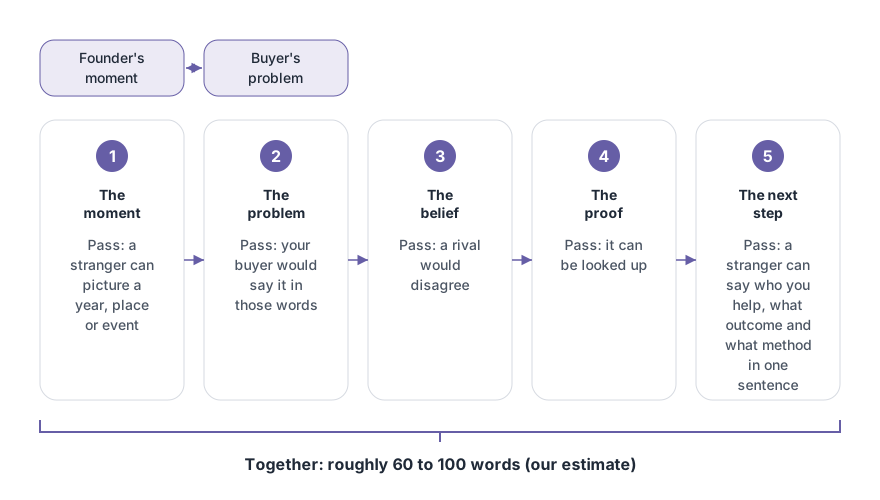
- The moment: "In [year], when I [event], I saw [what changed]."
- The problem: "[Buyers like you] were stuck with [problem, in their words]."
- The belief: "I believe [claim a competitor would not write]."
- The proof: "[A number, record or published item a stranger can check]."
- The next step: "Today I help [buyer] get [outcome] through [method]."
To tell the story aloud, see storytelling in public speaking.
How to test each line of the card
- Moment: pass if a stranger can picture a year, place or event. Fail on "I have always been passionate".
- Problem: pass if your buyer would say it in those words. Fail if the line is about your career.
- Belief: pass if a rival would disagree. Fail if it fits any business, like "quality and trust".
- Proof: pass if it can be looked up. Fail on "many happy clients".
- Next step: pass if a stranger can say who you help, what outcome they get and by what method in one sentence. Fail if it names only a service title.
Across all five lines, every moment must have really happened; invented drama fails.
Example
A founder who lost 40kg after starting at over 100kg, and who published lab reports for the product, gives a story with a moment, a problem (ingredients hidden in tiny print), a belief ("Good food is made of good ingredients") and a proof a stranger can look up. That is how The Whole Truth's page runs through the card's lines, from the founder's own moment to a checkable proof.
Frequently asked
Sources
- 1.Digital Marketing Institute: Brand story glossary entry
- 2.Escalas, "Narrative Processing: Building Consumer Connections to Brands", Journal of Consumer Psychology, 2004, 2004
- 3.Zerodha: About
- 4.Zoho: About us
- 5.Mamaearth: Our story
- 6.boAt: Who are we
- 7.The Whole Truth: Our story
- 8.Tata Group: Our heritage