
Glossary
Brand Voice
Brand voice is the consistent personality your words carry on every page, email and talk. For a coach or consultant, it works best written as rules you can check.

By Rohini Mundra, Founder · Updated 23 Oct 2026
On this page
- 01Definition
- 02Introduction
- 03What is brand voice, and how does it differ from tone and messaging?
- 04Why does a list of adjectives not give an expert a brand voice?
- 05How do you write a brand voice as rules you can check?
- 06Which terms get confused with brand voice?
- 07How Rohini Mundra handles it
- 08Example
- 09Frequently asked
What is brand voice?
Brand voice is the consistent verbal character you use whenever you communicate: the same personality on your website, in emails, on calls and on stage.
Key takeaways
- Tone is how your voice adjusts to the moment; messaging is what you want understood.
- Adjectives alone do not make a voice: a voice needs a boundary ("direct, not harsh") and rules a stranger can count.
- Four dials (formal, funny, respectful, enthusiastic) let you change tone by situation without changing who you sound like.
- Test any line with the swap-the-name test: if a competitor could sign it, rewrite it.
Introduction
Swap one coach's name for another's and many homepage headlines still read true. That is the test a brand voice has to pass, and a rank does not.
Most advice answers with a list of adjectives: friendly, bold, professional. Every coach picks the same three, and the voice stays invisible. A voice earns the name when someone can read an unsigned page and say whose it is.
This entry separates brand voice from tone and messaging, and gives you a half-page Voice Card of rules you can check line by line, each with a pass or a fail. It is written for a solo expert, whose brand voice is largely their own voice, not for a marketing team with an approvals process.
What is brand voice, and how does it differ from tone and messaging?
Tone is how that voice adjusts to the situation. Messaging is the point you want understood. The rule is simple: "You have the same voice all the time, but your tone changes" (Mailchimp content style guide).
Voice stays fixed; tone moves on four dials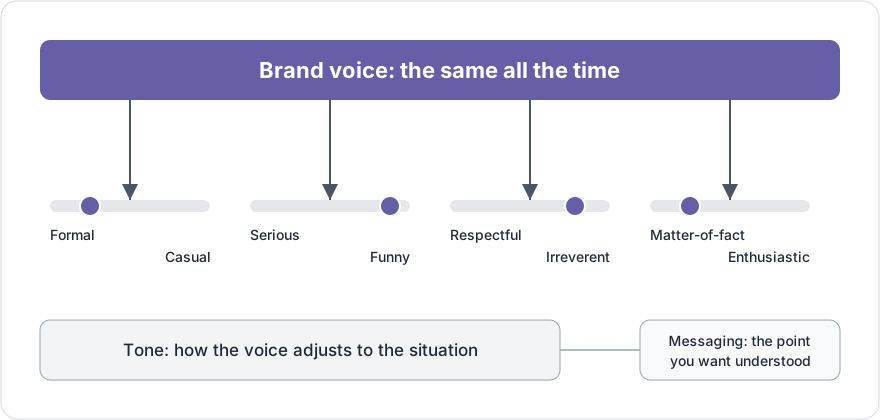
Nielsen Norman Group, a UX research firm, proposed four dimensions of tone (reviewed August 2023): formal to casual, serious to funny, respectful to irreverent, and matter-of-fact to enthusiastic. In its test of 50 US respondents, samples that varied along these dimensions were rated differently by about 0.5 to 1 point on a 5-point scale.
- Term
- Brand voice
- Question it answers
- Who do I sound like, always?
- Example for a business coach
- Direct, warm, practical
- Term
- Tone
- Question it answers
- How should I sound right now?
- Example for a business coach
- Gentler when apologising for a delay
- Term
- Messaging
- Question it answers
- What do I want understood?
- Example for a business coach
- "I help founders price services without discounting"
Why does a list of adjectives not give an expert a brand voice?
A rank word such as best, top or leading fits every competitor, so it cannot tell your page from theirs. On 23 October 2026 the title tag, meta description and main heading (the H1) were read on the homepages of eight Indian coach, trainer and speaker sites, picked from three web searches: Indian business coaches, Indian motivational speakers, and executive coaches certified by the International Coaching Federation. A site counted if best, top, leading, award-winning or most popular appeared in any of those three places. Four of the eight did.
The other four (Business Coaching India, Deekay Excellence, Symbiosis Coaching and Saurabh Kaushik) showed none of those words in what could be read. The extraction cut off the Saurabh Kaushik description after "One of India", so that page is read as unclear and might also carry a rank. Five further sites returned no readable page and were left out.
The sample is small and search-picked, so it shows a habit, not a market-wide rate. A rank also needs a record behind it; six records test an online coaching claim.
A voice written as rules uses behaviours, not labels. Mailchimp's guide gives each of its four traits (plainspoken, genuine, translators, dry humour) a behaviour and adds "If you're unsure, keep a straight face." Three to five traits, each with a boundary such as "Confident, but not arrogant", is enough (AMAA).
- Homepage read
- https://rahulmalodia.com/ (Rahul Malodia)
- Rank words found (where)
- best, top (title, description)
- Homepage read
- https://ameetparekh.com/ (Ameet Parekh)
- Rank words found (where)
- award-winning, best, top (title, H1)
- Homepage read
- https://www.sandeepmaheshwari.com/ (Sandeep Maheshwari)
- Rank words found (where)
- most popular (description)
- Homepage read
- https://sonusharma.in/ (Sonu Sharma)
- Rank words found (where)
- top, leading (description, H1)
How do you write a brand voice as rules you can check?
Fill in a six-part Voice Card. Each part has a pass and a fail.
Does each of your three traits have a boundary?
Write three traits, each paired with a "not": "direct, not harsh". Pass: every trait has its "not" and one real sentence of yours that shows it. Fail: a competitor would happily claim the trait.
Are all four dials set?
Score formal to casual, serious to funny, respectful to irreverent, and matter-of-fact to enthusiastic from 1 (left end) to 5 (right end). Pass: all four are scored, and you can point to a homepage line at that score. Fail: any dial is blank or "it depends".
Do you have three rules someone else can count?
For example: no sentence over 20 words, five words you never use, and every superlative backed by a record, as in a personal brand statement. If your clients speak a Hindi-English mix, say on the card which words you use and where. Pass: a stranger can mark your page against each rule. Fail: a rule needs your opinion, such as "sound authentic".
Does your tone shift while your voice stays put?
Write one reply each for a new enquiry, a price quote and a late delivery, moving only the dials. Pass: each of the three traits can be underlined in all three replies. Fail: any trait is missing from one reply.
Does your top line pass the swap-the-name test?
Put a competitor's name over yours. Pass: the line turns false or odd. Fail: it still reads true.
Does it pass the read-aloud test?
Read your About Me page aloud once. Pass: you rewrite none of the sentences and none exceeds 20 words. Fail: you rewrite any sentence, or any exceeds 20 words.
Which terms get confused with brand voice?
Brand identity, brand story and personal brand statement are easy to mix up with brand voice: brand identity is the full visual and verbal set, a brand story is the narrative you tell, and a personal brand statement is one line of positioning. Voice is the verbal part of identity, and it is how all three sound. Your speaker bio is one of the first places it shows.
How Rohini Mundra handles it
A voice starts with knowing who you are, and in Rohini Mundra's field the person is the brand. The card used for Rohini Mundra's own voice reads: motivational, not preachy; bold, not boastful; concise, not curt. Her own site was not among the eight checked above.
For people who already have clients, personal branding services turn the card into a site and talk. For people with no clients yet, the 40-day Brand-new Brand You programme opens with Stage 1, Decode Yourself, and its page says: "In this industry, you are the brand." See the programme prices for what it costs. To ask what fits you, email rohinimundra@rohinimundra.com.
Example
Take a business coach's card. Traits: direct, not harsh ("Your price is too low, and here is the arithmetic."); warm, not soft; practical, not preachy. Dials: formal to casual 3, serious to funny 2, respectful to irreverent 1, matter-of-fact to enthusiastic 3. Rules: sentences of 20 words or fewer, never "leading" or "unlock", every superlative linked to a record. For a late delivery the dials shift to casual 2, funny 1, enthusiastic 1, and the three traits stay.
Frequently asked
Sources
- 1.Mailchimp Content Style Guide: Voice and Tone, Mailchimp
- 2.The Four Dimensions of Tone of Voice, Nielsen Norman Group, published 17 July 2016, reviewed 16 August 2023
- 3.Brand Voice Guide, AMAA
- 4.Brand-new Brand You programme page