Storytelling in Public Speaking: Fit a Story to Your Time
Storytelling in public speaking works best when one story carries one point. As a planning guide, give it about 40% of your speaking time, then choose the story with five tests.

By Rohini Mundra, Founder · Updated 10 Oct 2026
Key takeaways
- Give the story about 40% of your speech. For a five-minute speech at 130 words a minute, that is about 260 words. The 40% is our planning guide, not an official rule.
- Choose a story that passes five tests: one point, one specific moment, real stakes, a change, and a fit with your story budget.
- A story can steer your audience's conclusion, so tell a typical case, not your best or worst one.
- Build the story in six lines (moment, want, complication, turn, result, lesson), learn the six lines instead of the sentences, and say the lesson out loud.
In this article
- 1What is storytelling in public speaking, and how much of a speech should it take?
- 2Which story should you choose when nothing interesting happens in your life?
- 3Is storytelling in a speech just a trend, or does it change what people remember?
- 4How do you shape the story in six lines?
- 5How do you tell the story without freezing or rambling?
- 6Where can you practise telling your story in front of people?
- 7Frequently asked questions
A story that feels short on paper often fills the whole speech, and the audience forgets the point it was meant to prove. The usual cause is arithmetic, not talent: nobody counted the words. A second cause is choosing the first story that comes to mind without asking what it proves. Both are fixable in an evening.
Time slots are tighter than most speakers expect. The 2026 to 2027 speech contest rulebook of Toastmasters International, the club-based public speaking organisation, requires a speech of five to seven minutes. At a comfortable pace, that leaves room for only a few hundred words of story. You do not need a dramatic life to meet that limit. You need a story that fits.
This page gives you three fixes: a story budget for your time slot, a five-question test for choosing the story, and a six-line shape to fill in. It works for a school presentation, a club speech or a team update.
What is storytelling in public speaking, and how much of a speech should it take?
Storytelling in public speaking means telling a short, true account of one person facing one problem and changing, so that the audience understands your point through an event instead of an instruction. The story budget is the number of spoken words your story may use. We recommend 40% of the speech, for speeches of three to seven minutes.
The 40% leaves most of the time for your point, the plain facts that back it, and the opening and close. A talk built entirely around one story can run longer.
The budget depends on your slot and your pace. As of October 2026, the Toastmasters speech contest rulebook for July 2026 to June 2027 disqualifies a speech under 4 minutes 30 seconds or over 7 minutes 30 seconds. A club's first speech, the Ice Breaker, runs 4 to 6 minutes.
Our model. Total words = minutes × words per minute. Story budget = total words × 0.40. We used 130 words a minute for a first-time or nervous speaker and 150 for a rehearsed one. These are our planning assumptions, not measured averages.
| Speech length | Total words at 130 / 150 a minute | Story budget at 130 / 150 a minute |
|---|---|---|
| 3 minutes | 390 / 450 | 156 / 180 |
| 4 minutes | 520 / 600 | 208 / 240 |
| 5 minutes | 650 / 750 | 260 / 300 |
| 6 minutes | 780 / 900 | 312 / 360 |
| 7 minutes | 910 / 1,050 | 364 / 420 |
A story that "feels short" when you write it is often 600 words. That takes four minutes at 150 words a minute and about four minutes 37 seconds at 130, which is a whole Ice Breaker.
Find your own pace. Read any 200 words aloud as you would on stage and time yourself. Divide 200 by your minutes to get your words per minute, then use that number in the formula instead of ours.
Which story should you choose when nothing interesting happens in your life?
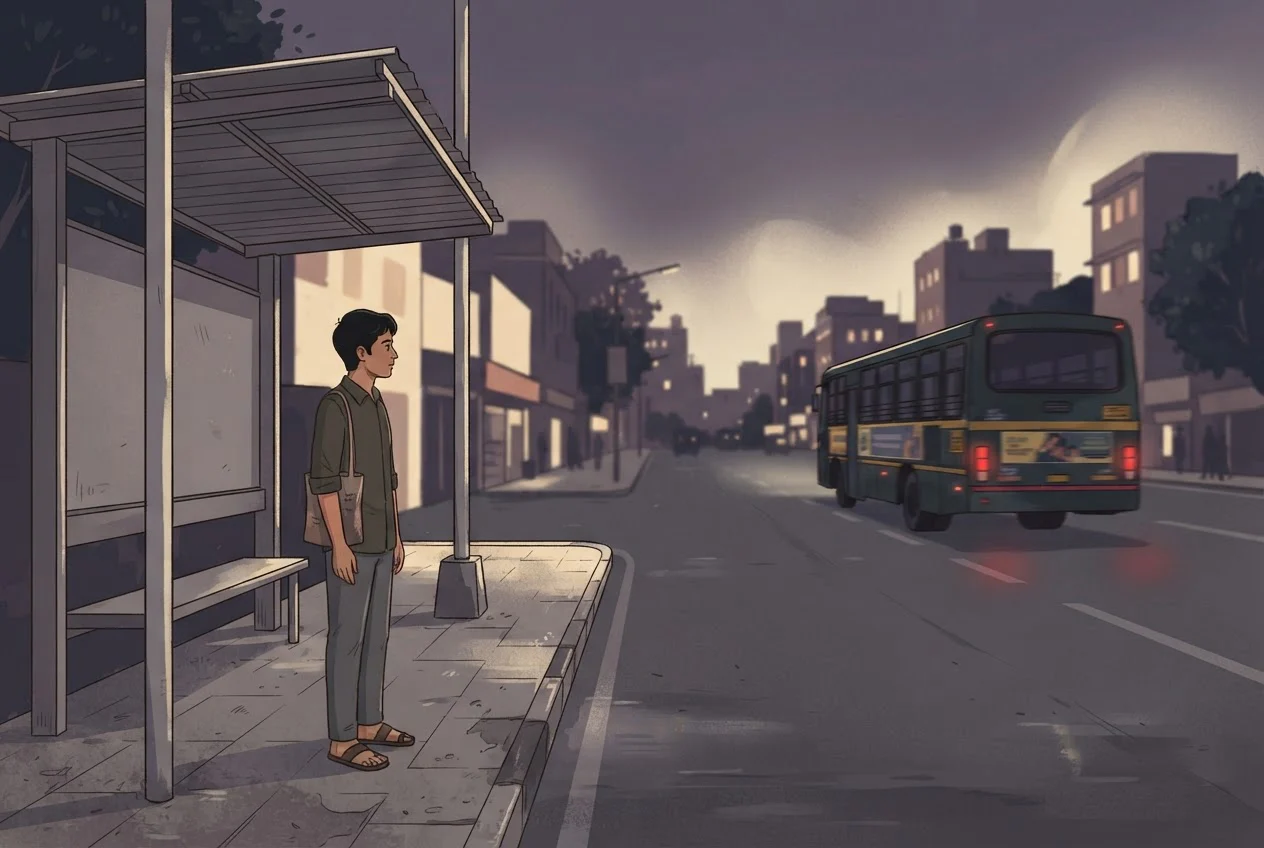
Choose the story that passes all five tests below, and treat any failure as a reason to pick another story, not to decorate this one. Ordinary events qualify. A missed bus, a failed practical or a conversation with a relative can carry a point, because the audience needs a person and a problem, not drama.
- One-point test
Write your speech's point in one sentence. You pass if you can finish "This story shows that ___" without adding "and also". Fail if you need two endings.
- Specific-moment testYou pass if you can name the place, the time of day and one other person. Fail if the story begins "I used to...".
- Stakes testYou pass if you can say in one sentence what could have been lost: a mark, a job, money, face. Fail if nothing was at risk.
- Change testYou pass if you did or believed something different afterwards. Fail if you end where you started.
- Budget testSay the story aloud and time it. You pass if it lands within the story budget in the table above. Fail if it overruns, and cut before you rehearse.
If you cannot think of a story, look in four places:
- A time you were wrong about something.
- The first time you did something difficult.
- A moment you were embarrassed.
- Something you watched someone else do. Tell it as their story, and never present it as your own.
Keep a notebook and write down a moment the day it happens. Memory smooths out the specific details that make a story work.
Keep it true. An exaggerated story is easy for an audience to sense, and it costs you the trust the story was meant to build.
Is storytelling in a speech just a trend, or does it change what people remember?
No. Storytelling is not just a trend, but it is not neutral either. In one 2024 written experiment, a narrative gave slightly better recall and more opposition to the drug described.
The researchers gave 1,309 participants drug-licensing information as bullet points or as a written narrative styled as a journalist's journey of discovery. The narrative version was slightly more engaging and improved recall. Those participants were also more opposed to licensing the drug, although they did not rate the text as more persuasive.
That experiment used written text. A spoken example is a 2019 classroom study of 194 undergraduates. A lecture that included an instructor's narrative produced more sustained attention and slightly better short-term recall than the same lecture with comparable examples.
Both results are modest, and we draw one practical rule from them.
Tell the typical case. If your point is "students who ask for help early do better", tell a story that stands for the usual outcome, not your one dramatic rescue. Then put one plain fact beside the story, so the listener has something to check it against. That pairing is our recommendation.
How do you shape the story in six lines?
Shape the story in six lines: moment, want, complication, turn, result and lesson, in that order. They follow the standard parts of a story as Toastmasters sets them out: the setup, the inciting incident (the event that creates the problem), progressive complications, the insight, the climax (the moment the problem is resolved) and resolution, and the lesson. We have turned them into shares of your story budget.
| Line | What it does | Share | Words for a 260-word story |
|---|---|---|---|
| 1. Moment | One person, one place, mid-action | 15% | 39 |
| 2. Want | What was at stake | 15% | 39 |
| 3. Complication | The one thing that made it harder | 25% | 65 |
| 4. Turn | What you realised or did | 20% | 52 |
| 5. Result | What happened next | 10% | 26 |
| 6. Lesson | One sentence, said out loud, handed to the audience | 15% | 39 |
The shares add to 100% and the words to 260. The shares are our starting point, so shift them if your story needs it.
Example outline (invented for illustration, not a real speaker):
- Moment"At seven in the morning I stood at the school gate holding a cracked water-filter model, forty minutes before the science fair judges arrived."
- Want"I had told everyone it was ready. If it failed, I would lose my place in the district round."
- Complication"The only person who could fix it was the lab assistant, and I had avoided him all week because I did not want to admit I was stuck."
- Turn"I asked. He fixed the seal in ten minutes and said he would have done it on day one."
- Result"We placed second."
- Lesson"Asking early costs ten minutes. Asking late costs the week. Tell one person today what you are stuck on."
Bridge sentences. To get in: "Let me show you what I mean." To get out: "That is why [your point]. And you can do it too: [one action]."
Placement is your choice. You can open with the story or put it mid-speech to illuminate a key point. You can also end by looping back to the story you started with. If you open with it, our guide on how to start a speech shows a four-line opening.
How do you tell the story without freezing or rambling?
Learn the six lines, not the sentences, and rehearse aloud against a timer. Telling the story as it plays out in your mind rather than from memorised words keeps it conversational and lets you recover if you lose a line.
Our routine, as a recommendation:
- Run it aloud three times, timing each run.
- Cut anything that does not change what happens next.
- Record one run on your phone and listen for the point where you drift.
- Pause for a full breath after the lesson before you move on.
If a pounding heart is what stops you, work on the fear first with our ladder and script for overcoming fear of public speaking. If you say you hate telling stories, shrink the task: two sentences about one moment, then your point, still counts as a story.
Where can you practise telling your story in front of people?
Practise in front of two or three real listeners: a friend, a family member or a club. Time the story and ask them where they lost interest. Their answer shows you which line to cut.
Our group coaching workshops-seminars are interactive sessions on communication and leadership for coaches, speakers, leaders, entrepreneurs and professionals. For dates and fees, enquire with us here.
Practise your speech story in a group coaching workshop
Frequently asked questions
Sources
- 1.Toastmasters International: Speech Contest Rulebook, July 1, 2026 to June 30, 2027
- 2.Toastmasters International: Surviving Your First Ice Breaker
- 3.Toastmasters International: The Anatomy of a Story
- 4.Toastmasters International: Bring Your Speech to Life With a Story
- 5.Toastmasters International: Weaving Stories Into Your Speeches
- 6.Can narrative help people engage with and understand information without being persuasive? An empirical study, Royal Society Open Science, 2024
- 7.PubMed record and abstract of the same study
- 8.Kromka and Goodboy, Classroom storytelling: using instructor narratives to increase student recall, affect, and attention, Communication Education, 2019 (ERIC record)