
Glossary
Brand Positioning
Brand positioning meaning: the place your brand holds in a buyer's mind compared with the alternatives they would consider. You cannot declare it. You can only test whether buyers describe it back.

By Rohini Mundra, Founder · Updated 23 Oct 2026
On this page
- 01Definition
- 02Quick facts
- 03What is the brand positioning meaning in plain words?
- 04Why can't you declare your own brand positioning?
- 05What is brand positioning confused with?
- 06How do you test your brand positioning in four checks and five conversations?
- 07What do five buyers say when you ask them?
- 08What related terms should you know?
- 09How Rohini Mundra handles it
- 10Example
- 11Related terms
- 12Frequently asked
What is brand positioning?
Brand positioning is the distinct place a brand holds in its buyers' minds, measured against the alternatives those buyers would consider. It is how buyers see you, not how you describe yourself.
Key takeaways
- A position has three parts: the alternatives the buyer compares you with, a difference the buyer cares about, and a reason to believe it.
- A tagline, a logo and a price claim each carry a position to the market. None of them is the position.
- Test yours with four checks on your first screen, then ask five buyers to say your position back. Aim for four of five to agree.
Quick facts
- Formalised by
- Jack Trout and Al Ries, between 1969 and 1981
- Defined by
- The Association for Qualitative Research (AQR), a UK professional body
- Its three parts
- Comparison set, a difference that matters, a reason to believe
- How to test it
- Four first-screen checks, then five buyer conversations
A common coach homepage headline calls its owner the best, the top or number one. That is a claim. A position is what a buyer says when a friend asks, "Who would you call for this, and why them?"
That difference matters because positioning lives in the buyer's head. Jack Trout and Al Ries formalised the idea between 1969 and 1981, treating a position as a perception held in the customer's mind, not a property of the product (Wikipedia).
So a definition only helps if you can check it. Below is the plain meaning, a pass-or-fail test for your own first screen, and a five-conversation script that shows what buyers really repeat back. Whether you are a freelancer with steady clients or a coach starting out, the order is the same: meaning first, test second, rewrite last.
What is the brand positioning meaning in plain words?
The Association for Qualitative Research (AQR), a UK professional body, defines it as how a brand differs from its competitors and where it sits in its market (AQR glossary). Positioning is how buyers see you, not how you describe yourself.
The three parts of a brand position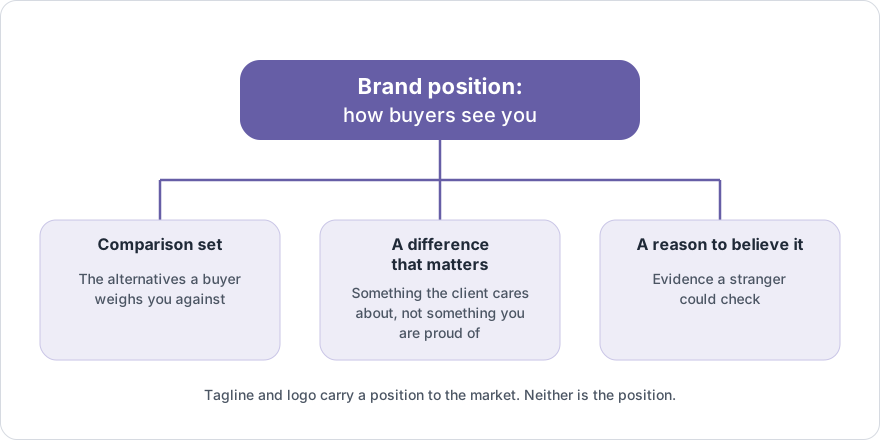
Every position has three parts:
- The comparison set. The alternatives a buyer weighs you against. If you do not choose them, the buyer does.
- A difference that matters to them. Something the client cares about, not something you are proud of.
- A reason to believe it. Evidence a stranger could check.
Here is how a well-known teaching example fills those parts: "For upscale consumers looking to make a design statement with their water choice, Voss is the only brand among all bottled waters that offers the purest, most distinctive drinking experience because it derives from an artesian source in southern Norway and is packaged in a stylish, iconic glass bottle" (HBS Online). An expert version has the same shape.
Why can't you declare your own brand positioning?
Positioning is the perception a buyer holds, and you control only the words that feed it. A headline is a draft of your position. The position is what a buyer repeats.
What is brand positioning confused with?
Brand positioning is confused with a tagline, a logo, a personal brand statement and a price claim. Each expresses or supports a position, and none is the position. The test is simple: a position still stands if you remove the logo and the tagline.
- Tagline and logo. These carry a position to the market. They cannot create one.
- Brand identity. The look, voice and tone come after the position is chosen.
- A personal brand statement. This is the positioning statement written for an individual expert, as one line. Your About page and website then carry it.
- "Cheapest" or "most affordable". A price position is best avoided by an expert, because a rival can undercut it immediately.
How do you test your brand positioning in four checks and five conversations?
Run four pass-or-fail checks on your first screen, then ask five buyers to say your position back. If at least four of the five name the same client type and the same reason, the position is working. If not, rewrite the line, not their answers. The four-of-five rule is a rule of thumb, not a published standard.
Does your headline name a specific client?
Pass: you could list five real people it describes, and it clearly excludes someone. Fail: "leaders", "individuals" or "everyone".
Does it name a problem or outcome?
Pass: it states a result the client gets. Fail: it describes only your method, your values or your journey.
Does it state a difference without a superlative?
Pass: remove "best", "top", "#1" and "leading", and the line still separates you from another coach. Fail: nothing is left.
Can a stranger check your proof?
Pass: a named client, a credential with its awarding body and level, or a dated award a stranger can look up. Fail: "100+ clients" with no names.
What do five buyers say when you ask them?
Ask three current clients, one person who chose someone else, and one stranger who fits your client type. Ask each:
- "In one sentence, what do I do, and for whom?"
- "Who else would you have considered?"
- "Why me instead of them?"
Count how many give the same client type and reason. Include someone who did not hire you, since clients alone will flatter you.
How Rohini Mundra handles it
Rohini Mundra helps speakers, trainers and coaches build a brand that clients know and trust. Brand New Brand You is a 40-day programme for new speakers, trainers and coaches, and it starts with a stage called Decode Yourself. Its page currently shows registration only; as of 23 October 2026 the listed price is ₹1,50,000, reduced from ₹1,99,000. It is built for people at the start; experts who already have clients can read about personal branding services.
Example
An invented expert position, to show the form: "For first-time sales managers at Indian software firms, I am the only coach who rehearses live client calls with the team, because I run every programme on the team's own deals."
Frequently asked
A brand positioning statement is one sentence that fixes your position for internal use. A widely taught template reads: "For [target market], [brand] is the only one among all [competitive set] that [unique value claim or primary point of difference] because [reasons to believe]" (HBS Online). Write it for yourself first, then turn it into a headline buyers can read.
Sources
- 1.Positioning (marketing), Wikipedia
- 2.Brand positioning, AQR glossary, Association for Qualitative Research
- 3.How to Craft the Perfect Brand Positioning Statement, Harvard Business School Online