Wheel of Life: Score It, Filter It, Test One Slice in 7 Days
A wheel of life is a self-scored chart of usually eight life areas. It becomes useful only when you add importance scores, choose one area, and test it for seven days.

By Rohini Mundra, Founder · Updated 10 Oct 2026

Key takeaways
- A wheel of life helps only when it ends in one chosen area: the one with importance of 7 or higher and the biggest gap between importance and satisfaction. An area with importance 6 is a second choice.
- Score three things, not one: satisfaction, importance and the gap. Low satisfaction in an area you rate as unimportant is noise, not a task.
- Feelings and hours are different evidence. Log one day in 30-minute blocks and compare it with the matching column of India's national time-use figures before deciding a low score is a motivation problem.
- Test one change for seven days and re-score only that area. A flat score after a full week of ticks means change the action, not the wheel.
In this article
- 1What is the wheel of life, and what does it measure?
- 2How do you fill in a wheel of life you can act on?
- 3Which low score should you work on first?
- 4Why do wheel of life scores so often mislead?
- 5Does your wheel match where your day actually goes?
- 6How do you test one change in seven days?
- 7When is a wheel of life not enough?
- 8How does coaching with us build on your wheel of life?
- 9Frequently asked questions
Most filled-in wheels of life end as a lumpy shape and no decision. You score eight areas, join the dots and are left looking at a shape. Free templates usually stop at the picture.
The shape records how satisfied you feel. It does not show what matters to you this year, or where your hours go. Hours are not spread evenly across eight slices: the average person in India aged 15 to 59 spends 155 minutes a day on unpaid domestic work for their household, according to the Ministry of Statistics and Programme Implementation's Time Use Survey 2024. A score alone cannot tell you which bump to fix.
This page gives you a version that ends in a decision. You score each area three ways, filter out the low scores that do not matter, check the result against a 24-hour time log, and test one change for seven days. Everything works with a pen and one sheet of paper.
What is the wheel of life, and what does it measure?
The wheel of life is a circle divided into usually eight life areas, sometimes ten. You score each area from 1 (very dissatisfied) to 10 (fully satisfied) and join the scores into a shape. It measures one thing: how satisfied you feel right now. It does not measure importance, time spent, or whether a score is good.
The wheel is commonly credited to Paul J. Meyer, founder of the Success Motivation Institute, in the 1960s, and his original version had six areas. Today's eight-area circle is a later adaptation. There is no norm to compare against, so a 6 is neither average nor bad. Treat the wheel as a prompt for honest reflection, not a test with a result.
The plain wheel stops at the shape. The next sections add the three missing pieces: importance, time, and a test.
How do you fill in a wheel of life you can act on?
Use eight areas, score each one three times on a 1 to 10 scale, and work out the gap. Take ten minutes. The gap column, not the shape, tells you where to look.
Step 1. Choose your eight areas. We adapt the usual list for Indian households:

| Area | Ask yourself |
|---|---|
| Health and energy | How are my sleep, pain, fitness and energy by 4 pm? |
| Work or business | Do I respect what I am building, and am I paid fairly for it? |
| Money | Do I feel in control of income, savings and debt? |
| Partner and home | Is home a place I can rest? |
| Parents, children and wider family | Am I meeting the duties I want to meet, without resentment? |
| Friends and community | Do I have people I can call on a bad day? |
| Growth and learning | Am I becoming more capable, or just busier? |
| Rest, fun and inner life | Do I get time that is mine, including prayer, meditation or a faith practice if that matters to you? |
We keep family separate from friends because family duty places its own demands on time, and blending the two hides that.
Step 2. Score each area three times.
| Area | Satisfaction now (1 to 10) | Importance this year (1 to 10) | Gap (importance minus satisfaction) |
|---|---|---|---|
Step 3. Run three checks.
- Order check. Pass: you wrote every importance score before looking at any satisfaction score. Fail: you did not, so cover the satisfaction column and rewrite the importance scores.
- Spread check. Pass: your highest and lowest satisfaction scores differ by at least 3 points. Fail: they differ by 2 or less, which usually means you scored what you think you should feel. Redo it, giving one area your lowest score and one your highest, then place the rest between them.
- Evidence check. Pass: for each score you can name one real moment from the last 30 days that justifies it. Fail: you cannot, so score from the most recent week you remember clearly.
Which low score should you work on first?
Work on the area with importance of 7 or higher and the biggest gap. If the biggest gap is in an area with importance 6, treat it as a second choice: run the test only if no area with importance 7 or higher has a gap of 2 or more. Park any area with importance of 5 or below, however low its satisfaction. This is our recommendation, and it stops a wheel turning into a list of everything wrong.
Here is a worked example. The numbers are illustrative, made up to show the method, not a real person's results.
| Area | Satisfaction | Importance | Gap |
|---|---|---|---|
| Health and energy | 4 | 9 | 5 |
| Work or business | 6 | 9 | 3 |
| Money | 5 | 8 | 3 |
| Partner and home | 7 | 8 | 1 |
| Parents, children and wider family | 6 | 9 | 3 |
| Friends and community | 4 | 5 | 1 |
| Growth and learning | 5 | 7 | 2 |
| Rest, fun and inner life | 3 | 7 | 4 |
Health and energy wins: importance 9, gap 5. Rest, fun and inner life is second (gap 4). Friends and community has a low score of 4 but importance of only 5, so it goes in the parked pile.
| Pattern on your wheel | What it usually means | Next move |
|---|---|---|
| Biggest gap in an area with importance 7 or higher | A real priority | Run the seven-day test |
| Biggest gap in an area with importance 6 | A second choice | Test it only if no area with importance 7 or higher has a gap of 2 or more |
| Low satisfaction, importance 5 or below | Not a priority now | Park it; look again in 90 days |
| Two linked areas both low (say work and health) | One cause behind both | Start with the area that drives the other |
| Low rest score with a heavy caring load | A time problem before a motivation problem | Start with the time log below |
Why do wheel of life scores so often mislead?
Scores mislead because they record feelings, and feelings shift with the day you score on. In our view four errors cause most of the trouble.
- Scoring "should" answers. A 7 across the board feels safe. The fix is the spread check in Step 3.
- Treating the lowest score as the priority. Low satisfaction in an area you do not care about is noise. Use the gap, not the score.
- Scoring on one bad day. The fix is the evidence check in Step 3.
- Confusing feelings with hours. A low rest score may mean you have no time, or it may mean you have time you do not enjoy. Those need different fixes. The next section shows how to tell them apart.
Does your wheel match where your day actually goes?
Your wheel may not match where your day goes, and one day's log will show it. India's government Time Use Survey shows how working-age adults spend their 1,440 minutes, which gives you something to hold your own log against.
The Ministry of Statistics and Programme Implementation ran the survey from January to December 2024 and published results on 28 March 2025. It covered 1,39,487 households and 4,54,192 people aged 6 and above. Respondents reported activities in 48 half-hour slots across a 24-hour day (Time Use in India 2024).
The table shows average minutes per day for people aged 15 to 59, two ways. "Per person" averages over everyone, including people who did none of that activity (Table 3). "Per participant" averages only over people who did it that day (Table 2).
| Activity | Per person: Men | Per person: Women | Per person: All | Per participant: Men | Per participant: Women | Per participant: All |
|---|---|---|---|---|---|---|
| Employment and related activities | 360 | 86 | 223 | 480 | 344 | 446 |
| Unpaid domestic services for household members | 26 | 283 | 155 | 86 | 305 | 251 |
| Unpaid caregiving for household members | 16 | 58 | 37 | 74 | 140 | 118 |
| Socialising, community participation and religious practice | 125 | 126 | 126 | 135 | 135 | 135 |
| Culture, leisure, mass media and sports | 148 | 129 | 139 | 156 | 145 | 151 |
| Learning | 55 | 46 | 50 | 422 | 412 | 417 |
| Self-care and maintenance | 690 | 686 | 688 | 690 | 686 | 688 |
The table leaves out two small categories (production of goods for own use, and unpaid volunteer work), so the per-person rows do not sum to 1,440.
Participation matters for reading the two views. On the survey day, 75.0% of men and 25.0% of women aged 15 to 59 did employment, and 30.4% of men and 92.9% of women did unpaid domestic work (Table 1).
Our calculations from the per-person figures, dividing minutes by 1,440:
- Women spend 283 + 58 = 341 minutes on unpaid domestic work and caregiving, which is 23.7% of the day. Men spend 26 + 16 = 42 minutes, which is 2.9%. That is about eight times as much (341 ÷ 42 = 8.1).
- Men spend 360 minutes on employment (25.0% of the day). Women spend 86 (6.0%).
- All adults aged 15 to 59 spend 139 minutes on culture, leisure, media and sports (9.7%), and that category includes exercise.
These averages describe a population, not you, and they say nothing about satisfaction. They give you a mirror, not a target.
How do you test one change in seven days?
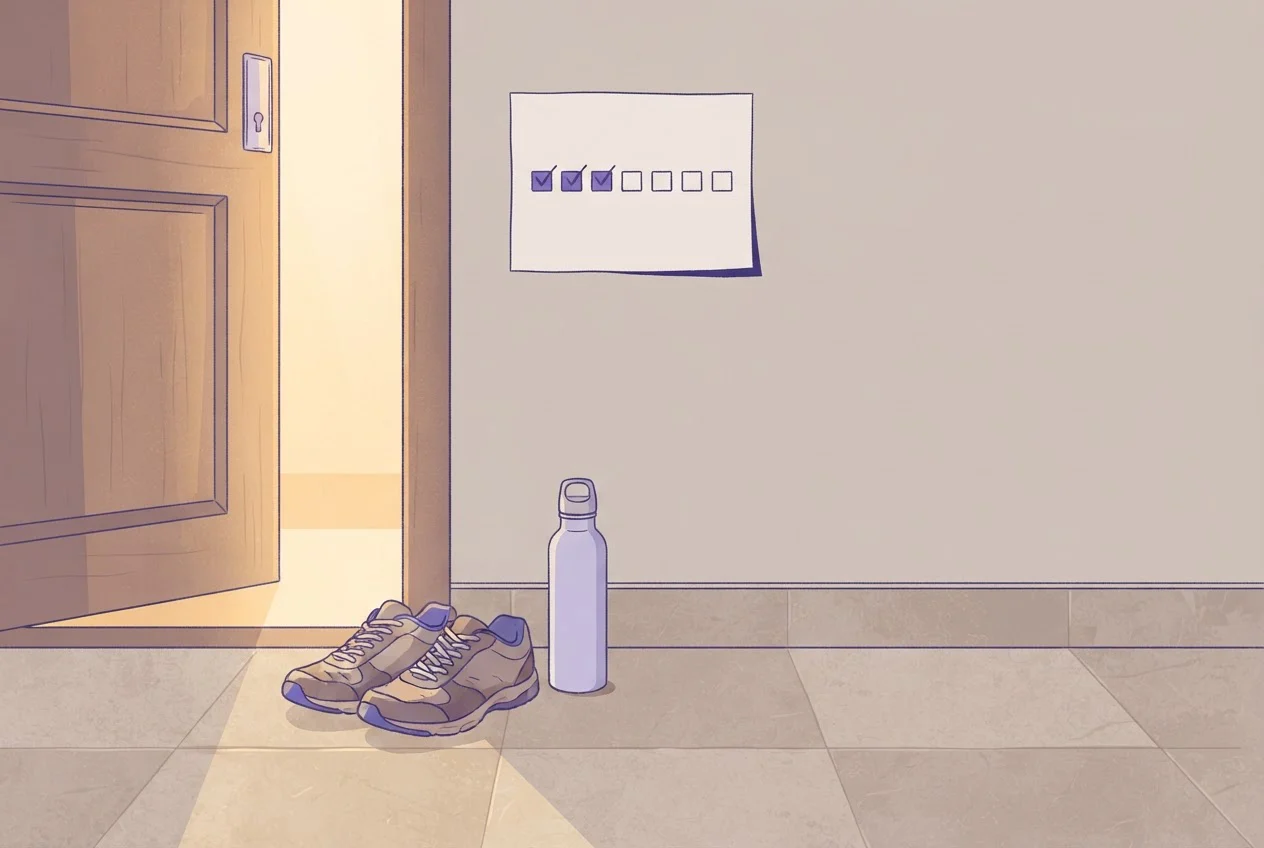
Pick one action that takes under 30 minutes, define "done" so you can tick it off, and run it for seven days. Then re-score only the chosen area. One change tests one idea; five changes tell you nothing.
- Name the action. For the health example above: a 20-minute walk before 8 am.
- Define done. Seven boxes on a sheet, one tick per day, not "try to walk more".
- Remove one obstacle in advance. Shoes by the door, or the alarm moved earlier.
- Re-score on day 7. Satisfaction only, with the evidence check from Step 3.
- Re-score again on day 30, and redo the full wheel every 90 days (our recommendation, not a fixed rule).
Pass: 6 or 7 ticks and a rise of at least 1 point in the area's satisfaction. Fail: 5 or fewer ticks (the action was too big, so shrink it), or 6 or 7 ticks with no rise (change the action and test again).
When is a wheel of life not enough?
A wheel of life is not enough when two seven-day tests on the same area both fail, or when your low scores come with persistent low mood, anxiety or loss of interest. In the second case, see a qualified clinician. The wheel is a reflection tool, not a clinical one, and coaching does not replace clinical care. Our comparison of life coach, therapist and mentor explains which to choose.
If the wheel keeps pointing at work and you cannot say what you want instead, the question is bigger than a score. Our guide to finding your purpose runs a 30-day test, and the Purpose, Passion and Profit assessment helps separate what you enjoy from what pays.
How does coaching with us build on your wheel of life?
We start where the wheel stops: with the one area you chose and what keeps it stuck. Our three-month private coaching programme moves from inner awareness, to deeper patterns, to applying calm in real situations.
The Heart of Business is our group programme, with interactive, personalised sessions and step-by-step support. Our programmes are available as single sessions or flexible packages.
Bring your scored wheel and your time log to the first conversation. We will tell you honestly whether coaching is the right next step. Ask us about current availability and fees.