Speaker Demo Reel in India: What to Film, What It Costs, How to Test It
A speaker demo reel is a short video of you speaking to a live audience, ideally two to three minutes. Check the form first, film a real room and test the opening.
By Rohini Mundra, Founder · Updated 6 Nov 2026

Key takeaways
- Application forms that ask for a video set short limits: 2 minutes at the University of Maryland PM (project management) Symposium 2026 and up to 3 minutes for the Women's Council of REALTORS. We recommend a reel of 2 to 3 minutes.
- Read the application form before you commission anything. Of seven call pages we read in November 2026, four asked for a video, one called it optional and two carried no video request.
Orange Sky Media lists standard professional editing at ₹1,000 to ₹3,000 per minute (22 October 2026), so a 3-minute reel works out at ₹3,000 to ₹9,000, indicatively. It lists corporate projects at ₹5,000 to ₹30,000 and more. Filming is priced separately.
- Film a real room on a phone first. Then test the first 20 seconds on three people who do not know you before you pay for polish.
In this article
- 1What is a speaker demo reel, and how long should it be?
- 2Do you need a speaker reel for the event you are applying to?
- 3What should a two-minute speaker reel storyboard contain?
- 4How do you get footage when nobody has filmed you yet?
- 5What does a speaker demo reel cost in India?
- 6What should you put in the brief you send editors?
- 7How do you test the first 20 seconds before you send the reel?
- 8What should you send with the reel?
- 9How do we help you before the camera starts?
- 10Frequently asked questions
You cannot make a reel until someone has filmed you speaking, and many application forms never ask for one. That loop leaves new speakers waiting for years, or paying an editor to polish footage that does not exist.
The way out starts with the application form you are actually facing. Some organisers ask for a short video and cap its length. Others never mention one. Knowing which kind you face decides how much you should spend, and when.
Below you get a way to read the form, a two-minute storyboard, a footage audit, a quote brief to send editors in India with rupee ranges, and a 20-second test you can run on three people in an afternoon. The checks come with a pass or a fail, so you know when the reel is ready to send.
At Rohini Mundra we train speakers, coaches and trainers, so we also say what to fix in the talk before the camera starts.
What is a speaker demo reel, and how long should it be?
A speaker demo reel is a short edited video of you speaking to a live audience, so an organiser can judge you without watching a full talk. We recommend 2 to 3 minutes. Of the forms we read that require a video and set a length, two ask for it: "2 Minute Video" from new speakers (University of Maryland PM Symposium 2026) and "a clip and not full length, not to exceed three minutes" (Women's Council of REALTORS).
A longer 5 to 10 minute video can appear on a form. WordCamp Asia 2027 offers first-time speakers an optional one introducing a proposed session.
Keep one more thing on hand: an unedited stretch of a full talk, uploaded as an unlisted link (viewable only by people who have the address). We recommend it for the organiser who likes the reel and wants to see you develop a whole idea.
Do you need a speaker reel for the event you are applying to?
Not always. Read the form first. We opened seven call-for-speakers or speaker-information pages in November 2026, each from the organiser, and looked for any request for a video. Several of these calls have closed, so the table shows the wording as we read it.
| Call | Video request on the page |
|---|---|
| 2-minute video, new speakers only | |
| A short clip, up to three minutes | |
| "a sample video" showing how you engage an audience | |
| A short video giving your point of view on the topic | |
| Optional 5 to 10 minute introduction, first-time speakers | |
| No video request on the call page | |
| No video request on the call page |
Four of seven ask for a video, one makes it optional and two carry no request. Of the four that ask, two give a length, and both are three minutes or less. Both India-based events in the table, UXINDIA and WeAreDevelopers Conference India, carry no video request. This is a small sample of mostly conference forms, so treat it as a pattern, not a rule.
Our inference is that a reel earns its cost when the person choosing cannot watch you any other way, such as a conference review panel or a stranger who has never heard you. If you are booked on referral, a clean bio and one good link may do more than a reel.
What should a two-minute speaker reel storyboard contain?
Put your strongest moment on stage in the first five seconds, with the audience in shot, and spend the rest of the two minutes showing range. This is our recommended structure, not an official format. We assume a stranger decides in the first 20 seconds, which is why the opening carries so much weight.
| Time | What is on screen |
|---|---|
| 0:00 to 0:05 | Your strongest moment, audience visible |
| 0:05 to 0:30 | Wide shot of the room reacting, laughter or applause audible |
| 0:30 to 1:15 | Two or three short clips that differ in mood: a story, a serious point, a live question |
| 1:15 to 1:45 | A named client or organiser line, with their written permission |
| 1:45 to 2:00 | Your name, your topic, how to reach you |
Keep on-screen text to your name and topic. Before you edit anything, run this footage audit on what you already have. Each item is a pass or a fail.
Footage audit
- Opening moment: pass if you have a 5 to 10 second clip where you finish a complete thought and some audience is visible.
- Room reaction: pass if you can see a few people and hear a reaction on a phone speaker at normal volume.
- Range: pass if you have three clips that differ in mood.
- Named endorsement: pass if you have the person's name, organisation and written permission.
- Audio: pass if every word is clear on a phone speaker.
Fail any item and you know what to film next.
How do you get footage when nobody has filmed you yet?
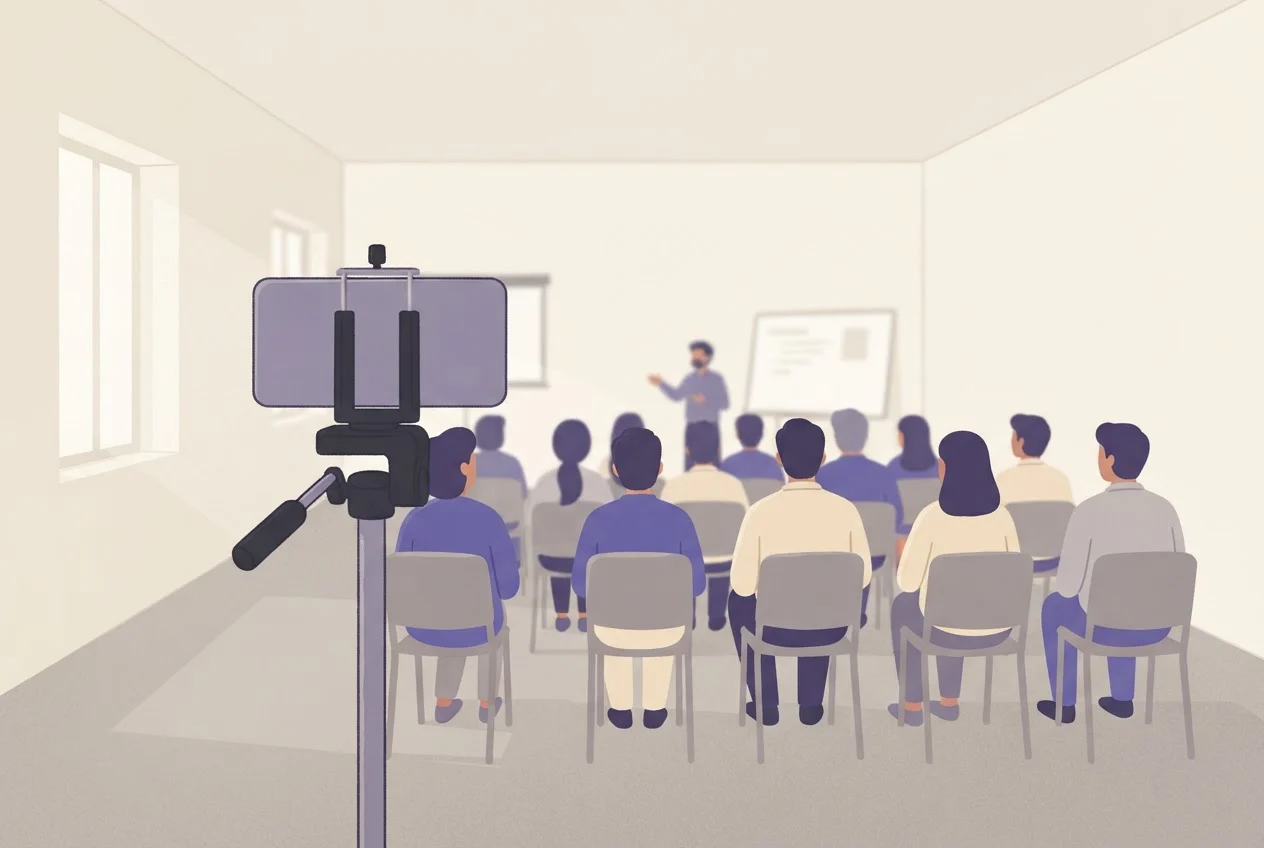
Film your next talk yourself, however small. Put a phone on a tripod at the back of the room, keep some of the audience in frame even if only their backs, and record the whole talk, not clips. We recommend this because reviewers are judging how a room responds to you, and a phone can capture that. A polished shot with no audience cannot.
If no talk is booked, run your own session for 20 to 30 colleagues or clients and record that. Our guide to how to conduct a workshop helps you plan the minutes, and how to engage an audience covers what makes a room react on camera. For the full path from a first talk to paid bookings, read From One Talk to Booking Proof. This page stays with the reel.
What does a speaker demo reel cost in India?
Indicatively, editing a 3-minute speaker demo reel in India costs about ₹3,000 to ₹9,000 at standard professional per-minute rates, and ₹5,000 to ₹30,000 or more if the editor quotes it as a corporate film, as of October 2026. This page prices the editing only. Filming, venue and travel come on top.
The published rates behind that:
- Orange Sky Media, an editing business, lists these per-minute tiers: basic ₹500 to ₹1,500, standard professional ₹1,000 to ₹3,000, advanced or cinematic ₹2,500 to ₹6,000 and above. It lists corporate and brand films at ₹5,000 to ₹30,000 and above per project (Orange Sky Media, 22 October 2026).
- HunarBox lists corporate and explainer videos at ₹8,000 to ₹25,000 per project (HunarBox, 22 October 2026).
Our working: finished minutes multiplied by the per-minute rate. For a 3-minute reel that gives ₹1,500 to ₹4,500 (basic), ₹3,000 to ₹9,000 (standard professional) and ₹7,500 to ₹18,000 (advanced). These are published ranges, not transaction data. Orange Sky itself says "There is no fixed industry-wide price per finished minute", because the price depends on raw footage volume, complexity, captions and revisions.
Cutting a reel from 60 minutes of raw footage is more work than editing 3 minutes, so expect a quote nearer the top of its tier. Our view is that a first reel does not need the cinematic tier, because reviewers are judging the room's reaction, not graphics.
What should you put in the brief you send editors?
Send the same written brief to three editors and compare totals, because one number with no scope cannot be compared. A quote passes if it addresses every item below. It fails if it gives a single price and nothing else.
- Finished length: one version, 2 to 3 minutes.
- Raw footage: total hours, file formats, and the originals returned to you.
- On-screen text: name and topic only, or captions as well.
- Music: licensed, and whether it stays under applause and laughter.
- Revisions: how many rounds are included.
- Delivery date: a named date; pass if it is in writing.
- GST (Goods and Services Tax): whether the price includes it. Some editors are registered and add it to the bill, so get the answer in writing.
How do you test the first 20 seconds before you send the reel?
Play the first 20 seconds, with sound, to three people who have never seen you speak, and ask three questions. This is our own check, not a published standard.
- What does this speaker talk about?
- Who is it for?
- Would you keep watching?
It passes if at least two of the three answer questions 1 and 2 correctly in their own words and say yes to question 3. If it fails, cut the opening and start at your strongest moment, usually the clip that got the clearest reaction.

What should you send with the reel?
Send the reel with a link to the unedited full-talk stretch and a bio the organiser can paste as it is. Our guide on how to write a speaker bio shows the four-sentence version. A reel with a named endorsement and a usable bio gives a reviewer something to check, not just something to watch.
How do we help you before the camera starts?
We train the speaker, because the reel only shows what the talk already has. The Xtraordinary Speakers Academy Masterclass teaches a four-step system for aspiring speakers, trainers and coaches. It covers goal setting, subconscious reprogramming, niche discovery and expertise development, and public speaking and communication training. You can read the details on the Masterclass page.
As of November 2026 the Masterclass is listed at ₹1,50,000 on its page. Everything we run starts with a three-day webinar. Refunds are available within three days, and none after that. See our program prices and refund terms. Ask us for next dates by writing to rohinimundra@rohinimundra.com, calling +91 7795505603, or using the enquiry form.
Get your talk ready before the camera starts
Frequently asked questions
Sources
- 1.University of Maryland PM Symposium 2026, speaker information
- 2.Women's Council of REALTORS, call for speakers
- 3.PCMA Convening APAC 2026, speaker expression of interest
- 4.Samplecon 2026, call for speakers
- 5.WordCamp Asia 2027, call for speakers
- 6.UXINDIA 2026, call for speakers
- 7.WeAreDevelopers Conference India, call for speakers
- 8.Orange Sky Media, video editing charges per minute in India, Orange Sky Media, 22 October 2026
- 9.HunarBox, video editing charges in India, HunarBox, 22 October 2026
- 10.Xtraordinary Speakers Academy Masterclass, Rohini Mundra