How to Conduct a Workshop: A Minutes Tally for Coaches
To conduct a workshop, plan the minutes participants spend doing, not the content you cover. Keep talking to a third of the session or less and end with an exercise and feedback.

By Rohini Mundra, Founder · Updated 1 Nov 2026
Key takeaways
- To conduct a workshop, write one outcome as something participants will have made, then fill the clock with exercises. Aim for presenting ("input") to take a third of the time or less.
- Group size depends on the job: up to 7 to reach a decision, 8 to 12 to learn a skill, up to 20 to 25 with one facilitator to teach a room.
- Time every exercise yourself and add 50 to 100% for a first run (our recommendation). Close with one written next step.
- In our model, a 100-seat workshop at ₹199 loses about ₹470 to payment fees through Razorpay, leaving about ₹19,430 before venue, software and your time.
In this article
- 1How do you conduct a workshop that people actually work in?
- 2Why should the presenter talk for only a third of a workshop?
- 3How many people should be in a workshop?
- 4What should you check before the day of a workshop?
- 5What does it cost to run a paid workshop in India?
- 6Where do we fit when you want to sell your own workshop?
- 7Frequently asked questions
In our experience, first workshops tend to go wrong on arithmetic, not charisma. The exercise planned for ten minutes takes twenty, the talk runs long, and the debrief that turns practice into learning is the part that gets cut. That is a planning failure, and it is fixable before anyone walks in.
The tally takes two minutes: add up the minutes you spend presenting, divide by the total length of the session, and compare the result with a third. A higher score means the session is drifting towards a lecture, and the card below shows where to move the minutes.
Below you get a two-hour agenda card, the tally that scores any agenda, group-size rules by purpose, a pass-or-fail checklist for the day, and the payment arithmetic if you plan to charge. It is written for coaches, speakers and subject experts running a first public or paid session, and the card also fits a classroom or a team session.
How do you conduct a workshop that people actually work in?
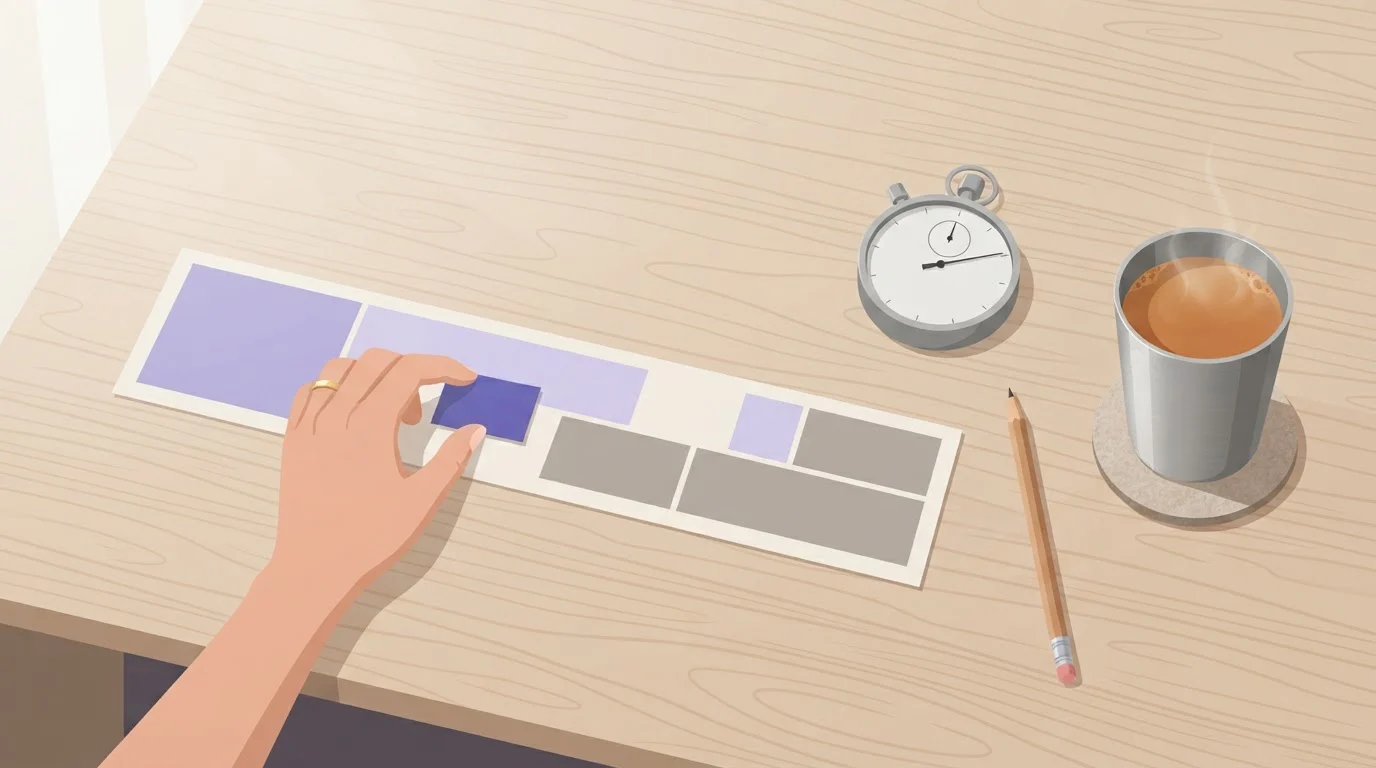
Conduct a workshop by writing one outcome in doing-verbs, then dividing the clock into input (you presenting), exercise, sharing and debrief (the group reviewing what just happened). Input stays at one third of the time or less. This card does that for two hours.
| Minutes | Block | What participants do |
|---|---|---|
| 10 | Welcome and outcome | Hear the outcome and the ground rules; say who they are |
| 25 | Input | Take in one framework, with one example |
| 30 | Individual exercise | Produce the thing named in the outcome |
| 20 | Pair or small-group share | Swap work, give and receive feedback |
| 20 | Debrief | Say what they changed and what they would still ask |
| 10 | Close and next step | Write one action to take after leaving |
| 5 | Buffer | Absorb overruns |
The blocks add up to 120 minutes.
The tally. Divide input minutes by total minutes. On the card that is 25 ÷ 120, about 21%. Pass at one third or less. Above that, move minutes from input into the exercise. For any session over two hours, add a break at least every one to two hours, as Scott Berkun's workshop guide advises.
Write the outcome first. Finish this sentence: "By the end, each person will have ___." Fill the blank with something you can see or collect, such as a one-line offer, a filled-in template or a first draft. Words like "understand" or "be aware of" fail the test. Cochrane's good-practice guide for its trainers builds each session the same way: the outcome verb decides whether you need a presentation or an exercise.
For the first five minutes of the opening, see how to start a speech.
Why should the presenter talk for only a third of a workshop?
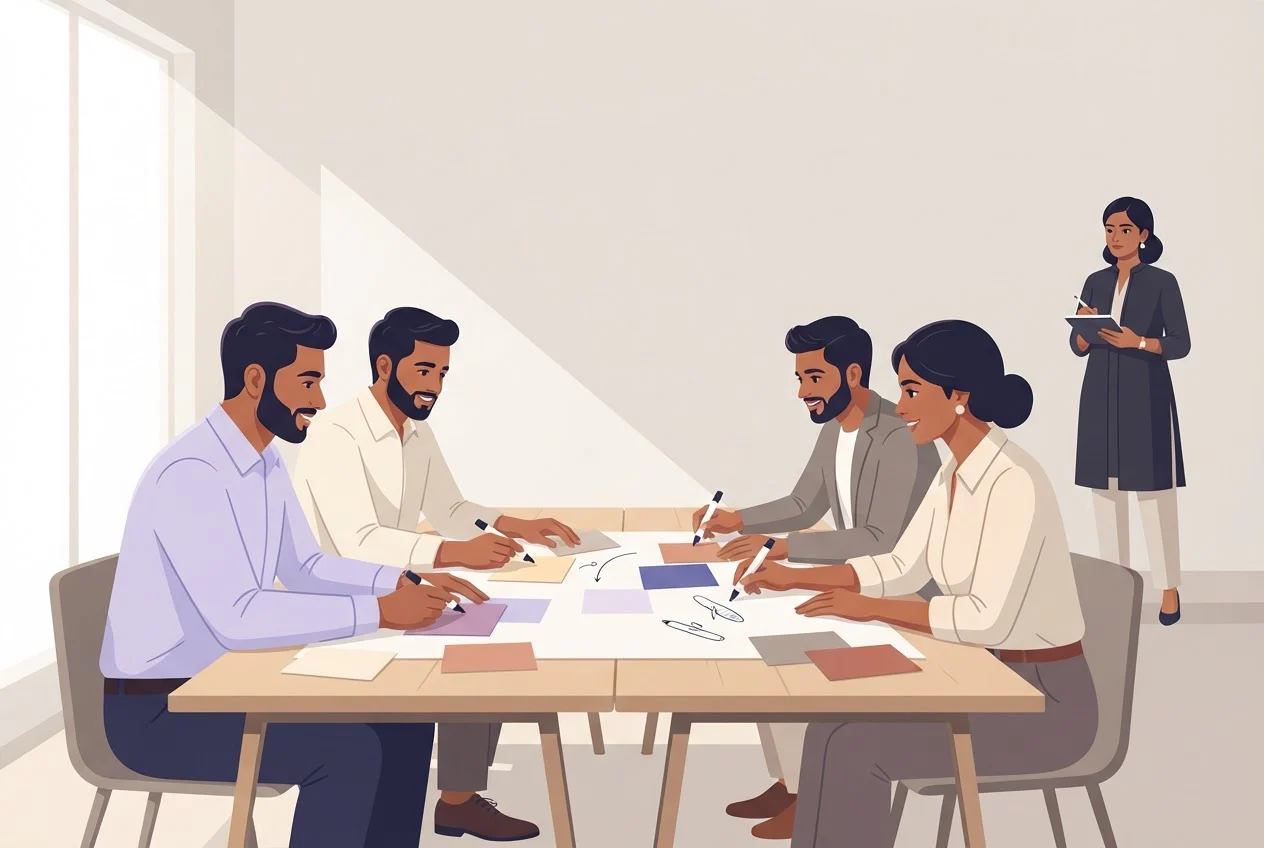
Our recommendation is that the presenter holds the floor for a third of the time or less: in the five agendas we tallied, presenter time was 22 to 33% in four and 67% in one, and a large meta-analysis of university STEM classes favours participants doing the work.
We tallied input minutes in five published agendas: three from Cochrane's trainer guide and two from Berkun's guide. The Cochrane 2-hour example excludes the recorded webinar participants watch before the session. Input is the minutes of presentation, summary or talk. Each figure is input minutes divided by session length.
| Agenda | Input minutes | Session length | Input share |
|---|---|---|---|
| Cochrane, 1-hour session | 15 | 60 | 25% |
| Cochrane, 2-hour session | 30 | 120 | 25% |
| Cochrane, 1.5-hour session | 60 | 90 | 67% |
| Berkun, 45 minutes as 15/15/15 | 15 | 45 | 33% |
| Berkun, 45 minutes as 10/20/15 | 10 | 45 | 22% |
The median is 25%. Presenter time was 22 to 33% in four agendas and 67% in one. The 67% session is a theory block inside a ten-day course, followed by an exercise and feedback, so a first-time facilitator should not copy it. Five agendas is a small sample. We use it to set a working rule, not to prove one.
Does the evidence back doing over listening? A meta-analysis (a study that pools many studies) of 225 undergraduate science, technology, engineering and mathematics (STEM) courses found exam performance up by 0.47 standard deviations under active learning (roughly a 6% rise in average exam scores). The odds of failing were 1.95 times higher under lecturing, and the effect was greatest in classes of 50 or fewer (Freeman et al., Proceedings of the National Academy of Sciences (PNAS) 2014). Those were university classes. That adult professionals follow the same pattern is our inference.
Should you switch activity every ten minutes? No. The belief that attention collapses after 10 to 15 minutes is not supported by the primary data, and the largest variation in attention comes from differences between teachers (Bradbury, Advances in Physiology Education, 2016). Move to an exercise when the next outcome needs participants to do something, not when a stopwatch says so.
How many people should be in a workshop?
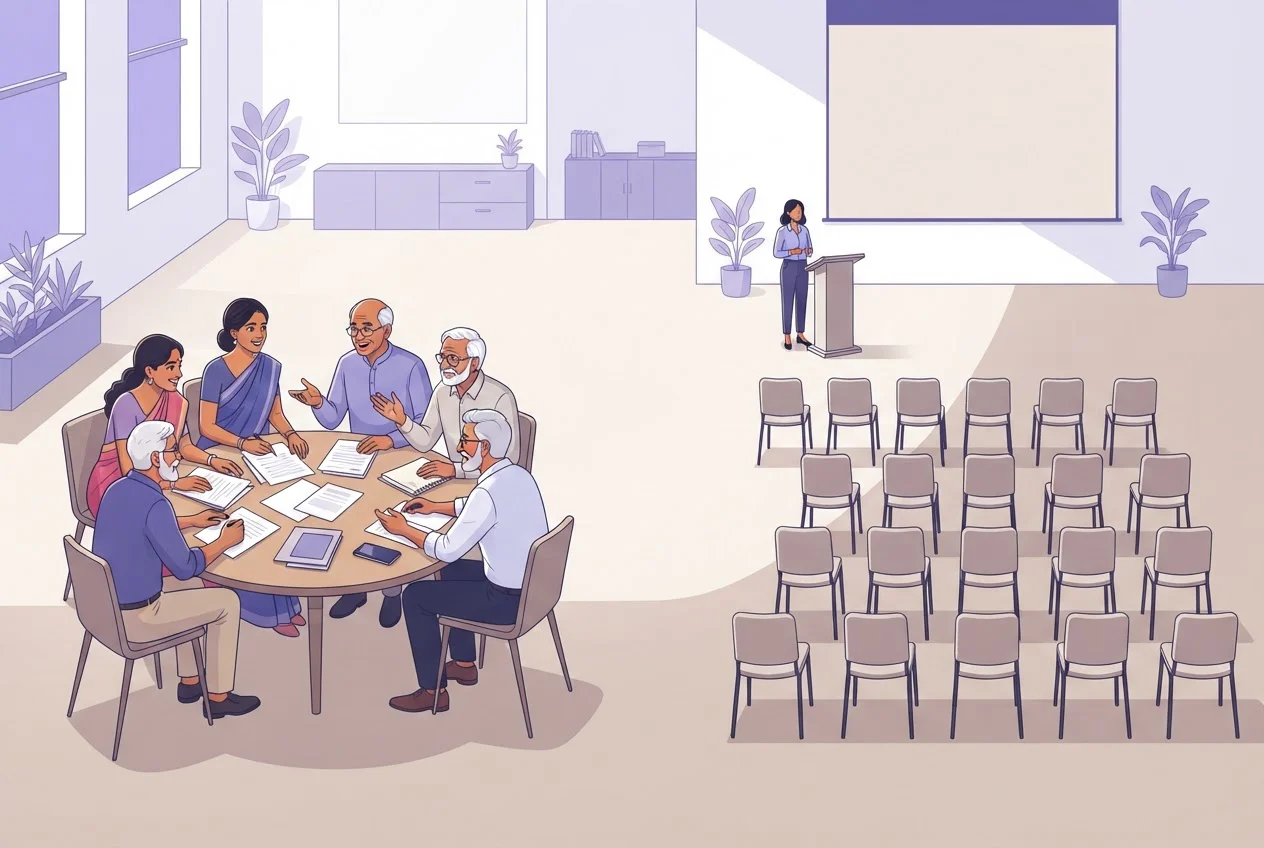
Group size follows purpose: up to seven when the group must decide something, eight to twelve when people are learning a skill, and up to 20 to 25 when one facilitator is teaching a room.
| Purpose | Group size | Why |
|---|---|---|
| Reach a decision | Up to 7 (our recommendation) | Everyone can speak, and disagreement surfaces quickly |
| Learn a skill | 8 to 12 | Small enough for everyone to get their questions answered (Community Tool Box, University of Kansas) |
| Teach a room | Up to 20 to 25 | Beyond this a single instructor is spread thin (Berkun) |
Past those numbers, split the room. Cochrane's example divides 20 clinicians into five groups of four, which works because each group has its own task. An introductory session is typically 45 to 90 minutes, and a session of moderate depth 90 minutes to three hours (Community Tool Box, above).
What should you check before the day of a workshop?
Run these eight tests in the week before. Each has a pass and a fail, and a fail means you change the plan, not the plan's confidence.
- Outcome test. Pass: the blank in "By the end, each person will have ___" is something you can see. Fail: it says "understand".
- Tally test. Pass: input is a third of the total minutes or less.
- Stopwatch test. Our recommendation, based on one published first-workshop account (Hamburger, 2024) where a 45-minute plan needed 90: time each exercise yourself with a timer, then add 50 to 100% for a first run. Pass: your timed exercises plus the planned buffer fit the slot.
- Tool test. Join your own session as a participant on a second device. Pass: you can see the shared screen, mute and unmute, and recording works if you promised it. The same first-workshop account missed a recording setting.
- Slide test. Pass: each slide carries one instruction you can say in a sentence. Fail: a definition, its uses and its steps share one screen.
- Silence test. After a question, count to ten before you speak. Pass: someone answers. Fail: you answered it yourself.
- Dry-run test. Run the first half with three to five people like your attendees. Pass: they finish the first exercise unaided in the time you gave. Berkun calls this beta-testing your exercises.
- Next-step test. Pass: every participant writes one action with a date before they leave.
Nerves before the first run are normal. Our guide to overcoming the fear of public speaking gives a ladder for them.
What does it cost to run a paid workshop in India?
Razorpay, an Indian online payment gateway, charges 2% per successful domestic transaction plus 18% Goods and Services Tax (GST) on that fee, with no setup fee (Razorpay pricing page, checked 1 November 2026). Venue, software and your time come on top.
Our model, for a 100-seat workshop at ₹199:
- Gross: 100 × ₹199 = ₹19,900.
- Fee: 2% × ₹19,900 = ₹398.
- GST on the fee: 18% × ₹398 = ₹71.64.
- Total payment cost: ₹469.64, about 2.4% of gross.
- Left: ₹19,900 − ₹469.64 = ₹19,430.36, before venue, software and your time.
This is a worked example with an assumed price and seat count. It is not an official figure.
Is free the norm? As of 1 November 2026, insiderOne's India workshop listing, an aggregator of organisers' own listings, shows 74 of 106 open workshops as free to register for, and the other 32 list a registration fee. With most listings free, a paid session needs a clear outcome in its description. Our guide to what a masterclass is explains one common paid format.
Where do we fit when you want to sell your own workshop?
We teach the business around the room. This page covers running the session. Our 3-day XSAM (Xtraordinary Speakers Academy Masterclass) workshop, run live online, is for aspiring coaches, experienced professionals, entrepreneurs and teachers who want to turn their knowledge into a coaching business.
- Day 1 covers launching a coaching business and finding your niche.
- Day 2 covers using AI for content creation, marketing and customer support.
- Day 3 covers automating and scaling.
As of 1 November 2026, the next live online XSAM batch runs 13 to 15 November 2026 at ₹199, with 100 slots. You can register on the XSAM registration page.
Our workshops and seminars also help coaches, speakers, leaders and entrepreneurs find their niche and strengths, sharpen communication and leadership skills, and turn their experience into programmes. You can also ask us which fits through our contact form.
Turn your expertise into a coaching business
Frequently asked questions
Sources
- 1.Good practice guide for trainers, Cochrane, © 2026
- 2.How to Run a Good Workshop, Berkun, S., 2013
- 3.Conducting a Workshop, Community Tool Box, University of Kansas
- 4.Active learning increases student performance in science, engineering, and mathematics, Freeman S. et al., PNAS, 2014
- 5.Attention span during lectures: 8 seconds, 10 minutes, or more?, Bradbury N., Advances in Physiology Education, December 2016
- 6.Cohort Confession: My First Workshop was a Flop!, Hamburger L., 13 February 2024
- 7.Pricing, Razorpay, checked 1 November 2026
- 8.Workshops in India, insiderOne, 1 November 2026