How to Write a Speaker Bio: Four Sentences, Three Lengths
To write a speaker bio, state who you help, add one fact a stranger can check, link it to the talk, and add one human line, in third person.
By Rohini Mundra, Founder · Updated 14 Oct 2026
Key takeaways
- A working speaker bio is four sentences in the third person: who you help, one fact a stranger can check, why you suit this session, and one human detail.
- Keep three lengths of the same bio, about 30, 60 and 120 words. Of nine call-for-speakers pages we opened in October 2026, only two printed a word limit (100 and 200 words). Where the limit is 100 words or less, send the 60-word cut.
- Time each length aloud. At 130 words a minute, our working pace, 60 words take about 28 seconds and 200 words take about 92.
- Shorten from the bottom: human detail first, then the session sentence, and keep sentences one and two. Delete any adjective with no fact beside it.
In this article
- 1How to write a speaker bio that an organiser can use as it is
- 2How long should a short professional bio be when the form gives no limit?
- 3Why do most speaker bios fall apart when a host reads them aloud?
- 4How can you test a speaker bio before you send it?
- 5Should a speaker bio be in the first or third person?
- 6How do we help new speakers and coaches build a name beyond the bio?
- 7Frequently asked questions
A speaker bio is written once and then used three ways: pasted into an application form, printed in a programme and read aloud by a host who has never met you. In our view, a bio written for a form often fails when read aloud.
The limits are not consistent. The call for speakers for the Institute of Electrical and Electronics Engineers (IEEE) Cloud Summit 2026 asks for bios of at most 200 words, while several Indian events do not state a bio length at all, so the length is left to you.
Without a number to aim for, it is easy to list every designation and add words such as "passionate" and "renowned". In our experience, that leaves a paragraph a host cannot read aloud in the time they have.
Below is a four-sentence structure that can be shortened to any length, the reading time of each length, and a five-check test that removes every claim a stranger cannot verify.
How to write a speaker bio that an organiser can use as it is
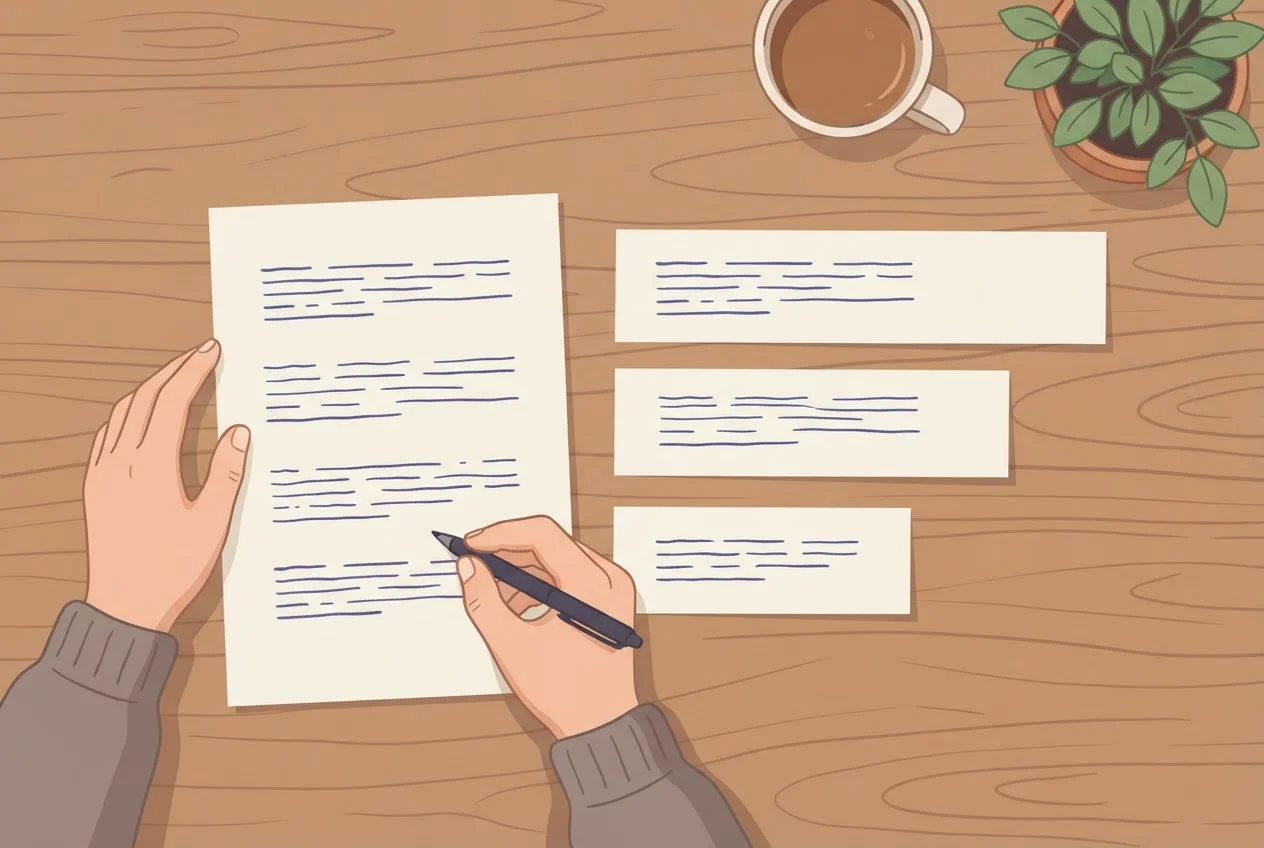
Write four sentences in the third person, in this order: who you help and the result you help them reach, one fact a stranger can check, why you suit this session, and one human detail. A speaker bio is a short written biography used in forms, programmes and host introductions.
A "cut" is the same bio shortened to a fixed length. Write the full text once, then make the cuts from the bottom.
- Who and for whom.
"[Name] helps [a specific audience] [reach a specific result]." Name the audience and the result, not your job title.
- Proof.One fact someone can look up: a named public stage, a published piece, a role with dates, or a number from work you can show. Name a client only with their permission.
- This session.
"In this session [name] [does one specific thing for the audience]." Rewrite this sentence for every event.
- Human detail.One line about you outside the topic. It must be removable without leaving a gap.
For the 120-word cut, add a second proof point after sentence two.
Worked example. The trainer below is fictional and invented for this page.
Before: "Priya Nair is a passionate, results-driven learning professional with over a decade of experience, an MBA and several certifications. A renowned trainer, she loves people."
Programme cut (62 words, about 29 seconds aloud): "Priya Nair helps new managers hold hard conversations without losing their team. She has run a two-day feedback workshop for 14 batches at one Pune firm since 2019. In this session she walks through a three-step script for the first feedback conversation with a new direct report, with a worked example from the workshop. Outside work she coaches an under-14 cricket team."
Introduction cut (sentences one and two, 28 words, about 13 seconds): "Priya Nair helps new managers hold hard conversations without losing their team. She has run a two-day feedback workshop for 14 batches at one Pune firm since 2019."
The "before" version has four descriptions of Priya and no fact a stranger could check. The "after" version has one audience, one result and one number someone could confirm with her employer.
How long should a short professional bio be when the form gives no limit?
Keep three lengths ready: about 30 words for the host's introduction, about 60 for a programme page and about 120 for forms that allow 150 to 200 words. If the limit is 100 words or less, send the 60-word cut. If a form gives no number, send the 60-word cut and offer the 120-word cut by email. A longer text risks being cut mid-sentence.
Only two of the nine pages we opened print a limit:
| Call for speakers (as of October 2026) | Bio limit on the page |
|---|---|
| "max 200 words each" | |
| "Short Bio (100 word max)" |
The other seven print no length: BSides Kolkata ("short bio"), Future Ready AI Summit in Bengaluru ("Speaker Biography"), UXINDIA 2026, DevFest Pune 2026, PyCon India 2025, Convergence India and the Women in Publishing Summit.
This is a convenience sample of nine call-for-speakers pages, opened in October 2026, covering events from 2025 to 2027, several already closed. We recorded what each public page says about the bio. A form behind the page may still set a limit. PyCon India tells applicants to "read the help text for each field", so read it before you submit.
Reading time. This is our model, not an official figure. Seconds = words ÷ 130 × 60, rounded to the nearest second. The 130 words a minute is our assumption for an unhurried delivery, so time yourself.
| Length | Words | Seconds aloud |
|---|---|---|
| Introduction cut | 30 | 14 |
| Programme cut | 60 | 28 |
| Full cut | 120 | 55 |
| ACSA limit | 100 | 46 |
| IEEE limit | 200 | 92 |
A host reading the IEEE maximum would need a minute and a half before you say a word.
Cut order. Remove the human detail first, then the session sentence, and keep sentences one and two. If you added a second proof point, remove that before the human detail.
Why do most speaker bios fall apart when a host reads them aloud?
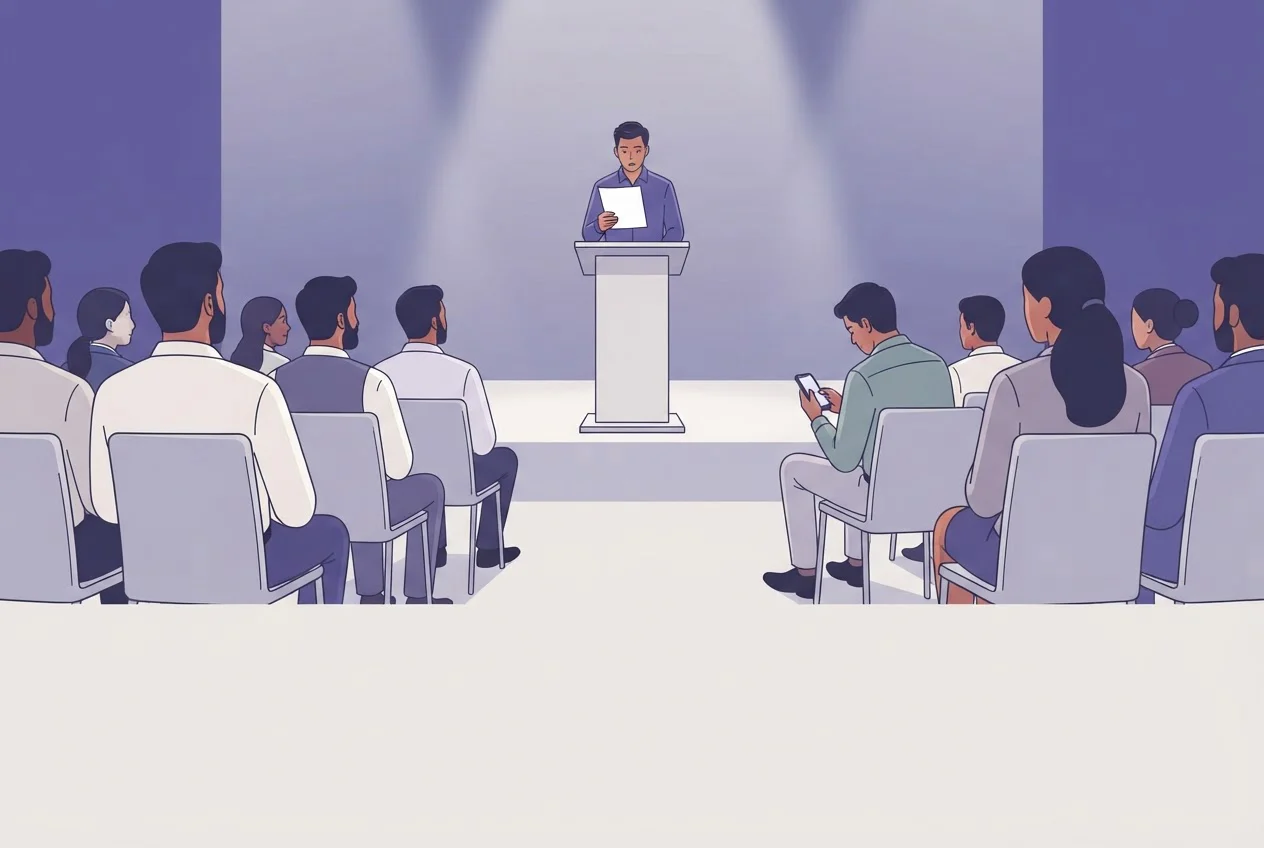
In our experience, many bios are built for the eye: a stack of designations, years of experience and adjectives. A listener cannot skim, so a host reading that stack aloud loses the audience early. A bio that works for the ear names one audience, one proof and one reason to listen.
Your bio will also travel without you. The Women in Publishing Summit tells applicants: "Assume that any information and headshots you share will eventually wind up in our marketing materials if you are chosen as a speaker." Readers will meet the text with no context, so it must say who you are and what you do for whom.
One reader's reaction to a long, third-person bio, in a Hacker News thread, was "Third person, extremely long, lots of pictures with CEOs and smelling of LLM writing". LLM stands for large language model, the technology behind AI writing tools. That is a single comment, not a rule, but it shows how a bio can read to someone who does not know the speaker. In our view, adjectives with no fact beside them add length and tell the host nothing, so cut them.
Do not write so narrowly that the bio becomes your permanent label. A bio aimed at one audience "may end up as a top result for your name in a web crawl, making it hard to change your professional narrative", as one LinkedIn contributor puts it. A web crawl is the automated collection of web pages by search engines. Keep sentence one about the people you serve and let sentence three carry the event-specific angle.
How can you test a speaker bio before you send it?
Run five checks. Every claim must be verifiable by a stranger in two minutes. No adjective may stand without a fact. Each cut must read aloud within its time. A cold reader must not stumble. Sentence three must change with the session. Each check has a clear pass and fail.
- Stranger check.
Try to confirm each claim using only public pages. Pass: every claim has a page, recording or document you could link. Fail: any claim you cannot link. Replace it or delete it. Words such as "top", "leading" or "first" pass only if a published list or record names you.
- Adjective check.
Underline every word that describes you rather than what you did, such as "passionate", "dynamic" or "renowned". Pass: none left, or each sits beside a fact in the same sentence. Fail: any left standing alone.
- Stopwatch check.
Read aloud at an unhurried pace and time it. Pass: 30 words in 15 seconds or less, 60 words in 30 seconds or less, 120 words in 60 seconds or less. These ceilings are the modelled times (14, 28 and 55 seconds) rounded up to 15, 30 and 60 seconds. Fail: anything longer.
- Cold-read check.
Ask someone who does not know you to read it aloud once, with no practice. Pass: no pause or mispronunciation on a name, acronym or term. Fail: any stumble. Rewrite that word or spell out the acronym.
- Session check.
Swap in a different event. Pass: only sentence three needs to change. Fail: sentence three would work unchanged for any event, or sentences one and two had to change.
Should a speaker bio be in the first or third person?
Use third person for forms, programmes and anything a host may read aloud. Use first person for your own website, LinkedIn and email signature. Third person is the standard convention for speaker bios, and it gets easier once you treat the text as a script for someone else to say.
Write the third-person version first, because the host's version is the hardest to get right. Then swap your name for "I" for your own pages. If praising yourself feels awkward, ask a colleague to draft sentence one from what they have watched you do, then check every claim yourself. The one-line version of sentence one is covered in our personal brand statement guide, and the spoken version in how to introduce yourself professionally.
How do we help new speakers and coaches build a name beyond the bio?
We help new speakers, trainers and coaches build the name behind the bio. Brand New Brand You is our 40-day programme for people who want their own speaking, training or coaching business without a long client history. It breaks the work into simple, exact steps, from establishing your name to finding first clients and building trust.
It costs ₹1,50,000 as of October 2026. The same idea drives the stranger check in this guide: when your experience is limited, trust comes from claims others can verify.
Our founder, Rohini Mundra, spoke at TEDxDSCE, a TEDx event at Dayananda Sagar College of Engineering in Bengaluru, and our speaker page shows that work. Because each TEDx event is independently organised, check that event's own form. If you are preparing a TEDx application, our TEDx speaker coaching costs page explains what a fee can and cannot guarantee.
Build the name behind your speaker bio
Frequently asked questions
Use the same four sentences, with your institution, research area and one publication or project as the checkable proof. Check the call's limit first: the ACSA 2026 call caps the short bio at 100 words, so send the 60-word cut.
Sources
- 1.IEEE Cloud Summit 2026: Call for Speakers
- 2.ACSA 2026 Intersections Research Conference: Call for Speakers
- 3.BSides Kolkata: Call for Speakers
- 4.Future Ready AI Summit 2026: Call for Speakers
- 5.UXINDIA 2026: Call for Speakers
- 6.DevFest Pune 2026: Call for Speakers
- 7.PyCon India 2025: Call for Proposals
- 8.Convergence India: Speaker Registration
- 9.Women in Publishing Summit: Call for Speakers 2026
- 10.Hacker News discussion of a long third-person bio
- 11.LinkedIn Advice: common mistakes when writing a speaker bio
- 12.TEDxDSCE event page on ted.com
- 13.Brand New Brand You programme page