How Can a ₹50 Lakh Business Scale Lean? Lean Business Coaching for Indian Coaches and Consultants


TL;DR
We show Indian coaches and consultants how a ₹50 lakh service business can scale lean: improve offer economics, standardize delivery, automate stable work, and add flexible capacity before fixed payroll. The article includes a capacity model, leverage comparisons, workflow decisions, hiring triggers, and a 90-day implementation path we use to turn founder dependency into controlled growth.
India’s MSME dashboard recorded 3.53 crore service registrations as of August 2026, yet a growing service business can still be constrained by one person’s calendar. At ₹50 lakh annual revenue, the question is usually not whether demand exists, but whether delivery can grow without eroding margin or quality.
A ₹50 lakh service business can scale without a large team by increasing leverage before adding payroll. We simplify the offer, raise revenue per delivery unit, standardize recurring work, automate stable processes, and use bounded specialist support. We hire permanently only when recurring workload, process maturity, quality control, and contribution margin justify fixed capacity.
This guide explains how we approach lean business coaching for Indian coaches and consultants through capacity maths, operating systems, flexible support, and a focused 90-day implementation plan.
What Does Lean Scaling Mean for a ₹50 Lakh Business?
Lean scaling means increasing revenue or delivery capacity without letting fixed payroll, founder hours, and operational complexity rise faster than the business can support. It is not an instruction to remain a solo operator forever. It is a way to make the next capacity decision from evidence rather than exhaustion.
At this stage, startup advice is often too early. You do not need another exercise to prove that someone will buy. You need to know whether your real constraint is qualified demand, offer economics, delivery time, client experience, or inconsistent operations. Our revenue plateau diagnostic helps make that distinction before a founder commits to a tool, contractor, or hire.
A business is ready for scale-up work when demand repeats, the offer has a recognisable delivery path, and you can review recent revenue, delivery, and margin data. If every project is entirely bespoke, or if client results depend on improvised founder effort, simplify and document before trying to increase volume.
How Do We Measure Delivery Capacity and Economic Headroom?
A full calendar does not automatically prove that you need an employee. It may show that a proposal process is slow, that clients receive too much live support, or that an offer produces too little contribution margin to fund additional capacity. We start with records, not assumptions.
Calculate the Numbers from Business Records
Use the last 12 months of collected revenue, completed client engagements or cohort seats, direct delivery costs, fixed operating costs, and a realistic founder time log. Divide collected revenue by completed delivery units to find revenue per unit. Divide available delivery hours by founder hours per unit to estimate sustainable delivery capacity.
For contribution margin, subtract direct variable cost from the price of each delivery unit. The break-even formula then connects fixed costs to the contribution each sale makes toward covering them.
Identify the Constraint Before Solving It
If revenue per unit is low and you still have unused capacity, improve positioning, packaging, price, or conversion. If demand is healthy but founder delivery hours are high, standardize the delivery path before adding people. If margin is thin, a hire can make a busy business less viable.
Our solo consultancy ceiling is useful when the founder’s calendar is the obvious bottleneck but the financial case for a team remains unclear.
Run a Weekly Owner Dashboard
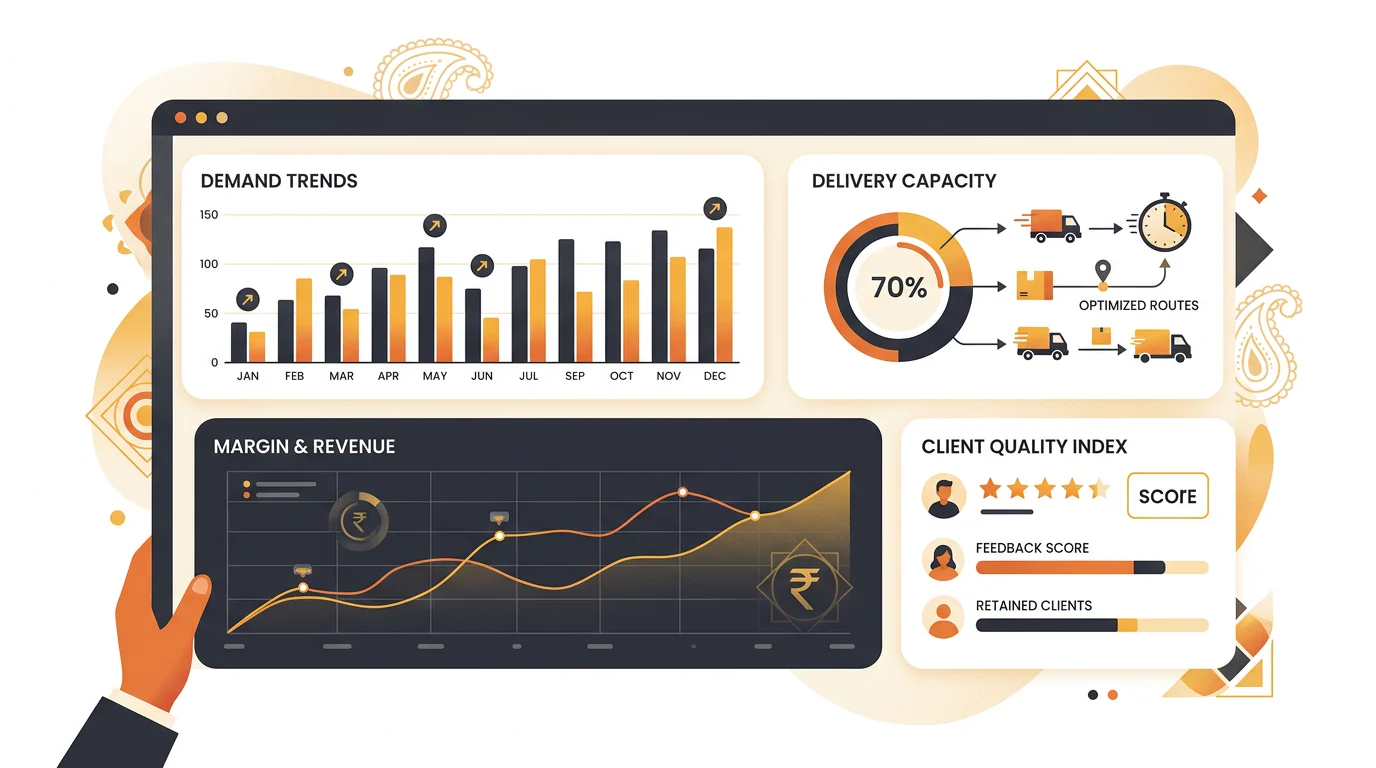
Track qualified leads, sales conversion, delivery units sold, founder delivery hours, direct delivery cost, client quality signals, and the next four weeks of available capacity. Add one question to the review: “What is the single constraint limiting healthy growth this week?” That stops the dashboard becoming another administrative ritual.
Which Leverage Options Increase Output Before Payroll?
The first scaling move should reduce the amount of founder time required for each unit of value, or improve the value captured for time already spent. It should not create a lower-quality experience that damages referrals and renewals.
| Lever | Best When | Capacity Effect | Main Risk | Metric To Watch |
|---|---|---|---|---|
| Repricing | Outcomes and demand are clear | Raises revenue per unit | Promise and value no longer match | Close rate and contribution margin |
| Productized Service | Work repeats materially | Reduces custom design time | Oversimplifying a complex problem | Delivery hours per unit |
| Group Delivery | Clients share a common problem | Creates one to many delivery | Poor fit for individual needs | Completion and outcomes |
| Licensing | Proven intellectual property can be used independently | Separates some revenue from founder time | Quality and usage control | Renewal or usage rate |
| Asynchronous Support | Questions repeat between live sessions | Lowers live-call load | Slow or unclear responses | Response time and client progress |
| Recurring Intellectual Property | Frameworks and tools repeat across clients | Creates reusable assets | Building before validation | Usage and conversion |
We use these options as design choices, not automatic upgrades. A group format can work beautifully when members need the same transformation. It is a poor substitute when the work depends on confidential, highly individual decisions. Founders comparing private, group, and event support can also review support format options.
The goal is to make each delivery unit more valuable, more repeatable, or less founder-dependent. That is how lean business coaching for Indian coaches and consultants turns growth from a calendar problem into an operating-model decision.
What Should We Build, Automate, Outsource, or Hire?
A useful rule is simple: automate stable steps, outsource bounded specialist work, retain strategic judgement, and hire only for predictable workload. India’s flexible talent market is expanding, with a NITI Aayog forecast projecting 2.35 crore gig workers by 2029-30, but availability does not remove the need for clear quality standards.
Map the Six Recurring Workflows
| Core Process | Standardize First | Suitable Automation | Suitable External Support | Keep Founder-Owned When |
|---|---|---|---|---|
| Lead Qualification | Fit criteria and routing rules | Forms, CRM scoring, reminders | Admin support | Fit requires nuanced judgement |
| Proposals | Scope, exclusions, pricing bands | Templates and follow-ups | Proposal administration | Risk or scope is unusual |
| Onboarding | Kickoff checklist and intake | Scheduling and reminders | Client-success coordination | Relationship reset is needed |
| Content | Editorial themes and approval flow | Drafting support and scheduling | Editor or designer | Claims and point of view need review |
| Client Communication | Service levels and escalation rules | Status prompts and knowledge base | Coordinator or community manager | A sensitive decision is involved |
| Reporting | Definitions and source data | Dashboard refreshes and reports | Analyst or bookkeeper | Interpretation changes a client decision |
Use Five Decision Criteria
Score each process on frequency, stability, strategic importance, risk, and judgement required. High-frequency, stable, low-risk work is a strong automation candidate. Bounded work requiring specialist skill but clear acceptance criteria can be outsourced. High-risk or strategically central work belongs inside a documented internal system.
If a senior capability is needed periodically, a fractional specialist often fits better than a full-time role. If work is predictable for two consecutive quarters, the process is documented, quality can be managed, and contribution margin remains healthy after payroll, then a permanent hire becomes reasonable. Our lean-team coaching guide can help you assess that transition.
Set Hiring Triggers Before You Recruit
Do not make revenue alone the trigger. Set conditions in advance: recurring workload, a documented role, stable quality standards, viable contribution margin, and a named person who can manage the role. Without those conditions, hiring often transfers the founder’s uncertainty to someone else.
Which Systems and 90-Day Plan Support Lean Growth?
Demand amplifies whatever sits behind it. If onboarding is unclear, more sales create more client confusion. If delivery quality is not measured, more clients hide the problem until retention or referrals decline. The automation survey in the World Economic Forum’s 2025 report found that 73% of surveyed employers expected to accelerate process and task automation, reinforcing why process clarity must come before tool selection.
Days 1 to 30: Diagnose the Primary Constraint
Audit offer-level revenue, direct costs, founder hours, recurring tasks, client outcomes, and current demand. Choose one constraint to address, then establish a weekly dashboard and a definition of healthy capacity. Founders who suspect they have outgrown their hours can begin with our capacity bottleneck assessment.
Days 31 to 60: Document and Test
Document the delivery path, quality checks, handoffs, and exceptions. Test one leverage move, such as a tighter offer, asynchronous support, a group element, an automated workflow, or a specialist contractor. Define a stop rule before the test begins, especially if client quality or margin deteriorates.
Days 61 to 90: Implement and Decide
Run the new workflow with real client work, then review capacity, contribution margin, quality, and founder hours each week. Keep what improves the operating model. Redesign what creates friction. Only then decide whether further automation, flexible capacity, or a permanent role is the next step.
Structured coaching should provide diagnosis, implementation review, and accountability. Motivation may help a founder act, but it does not replace a capacity model, workflow map, or decision rule. Our coaching revenue diagnosis is designed for founders who need the underlying constraint clarified before they build more demand.
How Rohini Mundra Helps You Scale Lean
At Rohini Mundra, we work with established coaches and consultants who have proven demand but have become the operating bottleneck. Our lean business coaching for Indian coaches and consultants begins with a diagnosis of offer economics, founder time, delivery quality, and the recurring work that can safely move off the founder’s calendar. Together, we choose one constraint, build the required operating system, and review implementation against a weekly scorecard. That gives you a practical alternative to chasing new tools or adding payroll because the business feels busy. You leave with clearer capacity thresholds, a decision rule for flexible support, and evidence for or against a permanent hire. If your calendar is full, margins feel vague, or client delivery depends too heavily on you, we can immediately help you turn that pressure into a focused 90-day operating plan. Talk with Rohini
FAQs on Lean Business Coaching for Indian Coaches and Consultants
Can a ₹50 Lakh Coaching or Consulting Business Scale Without Full-Time Staff?
Yes. Measure delivery capacity, contribution margin, and recurring workload first. Standardize stable work, use flexible specialist support, then hire only after demand and quality thresholds persist.
What Should I Systemize Before Growing a Service Business?
Systemize offer qualification, proposals, onboarding, delivery milestones, client communication, reporting, and escalation rules. Each process needs a clear owner, standard, tool, review point, and exception path.
Should I Automate, Outsource, or Hire First?
Automate stable, frequent, low-risk tasks first. Outsource bounded specialist work with acceptance criteria. Hire permanently only when workload, process maturity, management capacity, and margin support fixed capacity.
When Is a Permanent Hire Justified in a Lean Service Business?
A permanent hire is justified when the role’s workload repeats for two quarters, quality standards are documented, flexible support is insufficient, and post-hire contribution margin remains healthy.
What Does Structured Business Coaching Actually Help Me Do?
Structured coaching helps you diagnose one constraint, choose a measurable experiment, review implementation, and make staffing decisions from verified business data rather than momentum, fear, or generic motivation.