Can Your Business Scale Past Your Hours? A Founder Capacity Bottleneck Diagnostic
Find the founder capacity bottleneck holding your service business back, then choose the right pricing, delivery, or delegation move.

By Rohini Mundra, Founder · Updated 11 Oct 2026

In brief
At Rohini Mundra, we help coaches, consultants, and boutique agency owners identify the founder capacity bottleneck behind a revenue plateau. This guide separates capacity from demand, conversion, and delivery problems, then gives you a practical audit, model maths, redesign choices, a transfer plan, and weekly measures for reducing dependence on your hours.
In this article
- 1Is the Plateau Really a Capacity Problem, or a Founder Capacity Bottleneck?
- 2Where Does the Business Depend on You?
- 3Run a Weekly Time Audit
- 4Map the Founder Dependency
- 5Use a Controlled Absence Test
- 6What Does Your Current Model Allow?
- 7Establish Your Available Delivery Capacity
- 8Calculate Your Revenue and Contribution Ceiling
- 9Read the Result Correctly
- 10Which Structural Change Fits the Constraint?
- 11What Should You Transfer First?
- 12Start with Repeatable Work
- 13Transfer Decisions, Not Just Tasks
- 14Protect the Client Experience
- 15How Will You Know the Ceiling Is Moving?
- 16Build Past Your Hours with Rohini Mundra
- 17FAQs on Founder Capacity Bottleneck
For coaches, consultants, and boutique agency owners, personal expertise often starts the business and later becomes its limit. In India, other services represented 41.48% of unincorporated non-agricultural establishments in the latest ASUSE survey, so this is a common structural question for service founders.
A business cannot scale past the founder’s hours when selling, delivery, approvals, and client communication still rely on the founder. A founder capacity bottleneck does not disappear with longer weeks. It moves only when you identify the dependent workflow, redesign delivery, transfer repeatable work, and measure whether revenue is less tied to personal time.
We built this diagnostic to help you tell capacity problems apart from weak demand, poor conversion, and inefficient delivery before choosing your next move.
Is the Plateau Really a Capacity Problem, or a Founder Capacity Bottleneck?
A revenue plateau is a signal, not a diagnosis. If your calendar has room and qualified conversations are scarce, you may have a demand problem. If prospects are interested but do not buy, conversion may be the issue. Capacity becomes the leading constraint when good opportunities create more delivery pressure, longer client waits, or more founder hours.
Look for the pattern across the business, not in one disappointing month. A founder dependency issue is likely when client work slows during your absence, every proposal needs your approval, or your strongest clients only trust contact with you. For a wider view of flat revenue, use our plateau diagnosis alongside this narrower test.
| Constraint | Symptoms | Evidence To Inspect | False Fix | Appropriate Intervention |
|---|---|---|---|---|
| Demand | Too few qualified conversations or an empty calendar | Lead sources, enquiry quality, booked calls | Hiring before demand exists | Improve positioning, referrals, outreach, or channel fit |
| Conversion | Calls happen, but few become clients | Qualified-call conversion and lost-deal reasons | Generating more leads | Improve qualification, offer clarity, proof, and sales process |
| Delivery Capacity | New work creates backlog, rework, or late delivery | Delivery hours, client wait time, margin, backlog | Selling more before changing fulfilment | Standardise, price, group, automate, or add delivery support |
| Owner Dependency | Work, decisions, or client communication stop without you | Approval queue, founder-only tasks, client-contact map | Working longer or hiring without authority | Transfer repeatable work and bounded decisions |
The distinction matters because the wrong remedy deepens the problem. More marketing can create a larger backlog. A new hire can create more questions for you. Higher prices can fail when the offer is unclear. We start by locating the constraint that is actually limiting progress, then we choose the smallest structural change that relieves it.
Where Does the Business Depend on You?
Owner dependency is often hidden because founders are used to being helpful. We see it in the quick approval, the client reply sent late at night, the proposal rewritten before it goes out, and the delivery step no one else can complete. Our hands-on coaching approach begins by making those dependencies visible rather than treating them as personality traits.
Research on firm growth recognises the underlying issue: founders have limited managerial time, and difficulty transferring decisions can restrict the size a business reaches. The delegation research used evidence from India and the United States to examine precisely that friction.
Run a Weekly Time Audit
Track one normal week, including the work you do between meetings. Do not label an activity “strategic” because it feels important. Ask what outcome it advances and whether another person could eventually own the execution.
| Work Category | Hours Last Week | Outcome Supported | Must Remain Founder-Led? | First Transfer Candidate |
|---|---|---|---|---|
| Lead Generation | ||||
| Sales | ||||
| Client Delivery | ||||
| Administration | ||||
| Strategic Work |
The audit makes a crucial distinction: founder-owned work is not always founder-performed work. You may need to own positioning or a complex client diagnosis while someone else gathers information, prepares materials, manages follow-up, or coordinates delivery.
Map the Founder Dependency
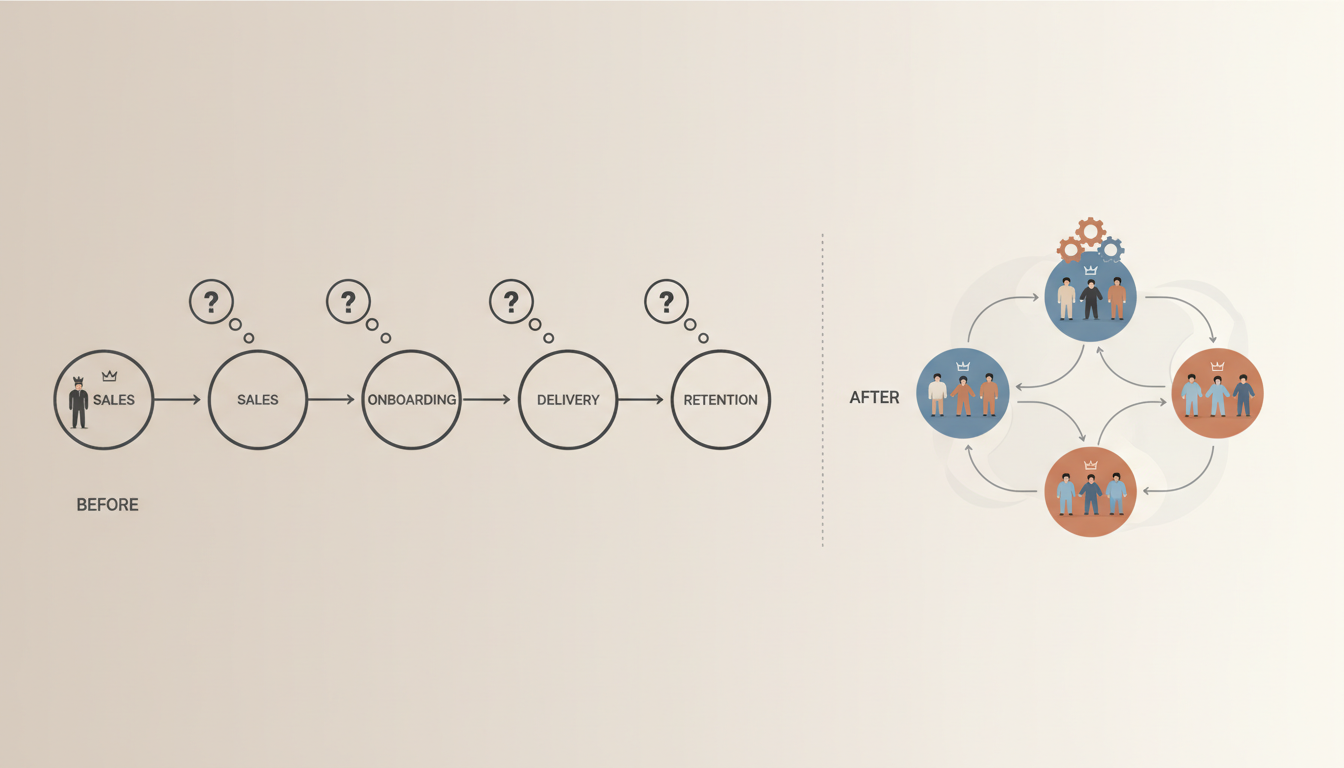
Next, review the client journey from sale through retention. Rate each workflow honestly. A business is dependent on you when the team can perform a task but cannot finish it, decide it, or communicate it without your intervention.
| Workflow | Founder Performs It | Founder Approves It | Team Can Complete It | Client Expects Founder | Risk If Founder Is Unavailable |
|---|---|---|---|---|---|
| Sales | |||||
| Onboarding | |||||
| Fulfilment | |||||
| Decisions | |||||
| Client Retention |
Use a Controlled Absence Test
Choose two ordinary working days when you are not the default answer. Beforehand, tell the team where to find process guidance and which issues truly need escalation. Afterwards, record what stalled, what was resolved, and what clients experienced.
This test is not about disappearing to prove a point. It gives us evidence about the process, the decision boundaries, and the standards that have not yet been made explicit.
What Does Your Current Model Allow?
A founder’s ceiling is not a motivational problem. It is a mathematical relationship between available delivery time, realised revenue per delivery hour, and the margin left after direct delivery costs. The official productivity definition similarly treats output in relation to hours, which is why we measure revenue and contribution against actual founder capacity.
Use records, not list prices or rough memory. Pull booked founder-delivery hours from your calendar, realised revenue from paid invoices, and direct delivery costs from your accounts. If your pricing includes access, preparation, revisions, and support, those hours belong in the calculation too.
Establish Your Available Delivery Capacity
Start with the time you can sustainably devote to delivery, after allowing for lead generation, sales, administration, and strategic work. Multiply founder delivery hours per week by the paid delivery weeks you can genuinely maintain each year.
This number is your available founder-delivery capacity. If the business needs every one of those hours to retain current clients, there is no capacity left for growth, regardless of how many leads arrive.
Calculate Your Revenue and Contribution Ceiling
Use these equations with your verified inputs:
- Annual founder-delivery capacity: Founder delivery hours per week × paid delivery weeks per year
- Annual revenue ceiling: Annual founder-delivery capacity × realised revenue per founder-delivery hour
- Delivery margin: (Revenue minus direct delivery costs) ÷ revenue
- Delivery contribution ceiling: Annual revenue ceiling × delivery margin
We recommend calculating this for each offer, not only for the business as a whole. One offer may consume founder time and compress margin while another creates space for growth. Our business growth guide can help you turn those findings into a focused operating plan.
Read the Result Correctly
If your calculated ceiling is already above your target, capacity is not yet the central problem. Check demand, conversion, pricing, or retention. If the ceiling sits below the target and requires more personal hours for every new client, the model needs redesign.
Revenue can rise while the business becomes less healthy. If delivery margin falls, client waits increase, or founder hours keep climbing, you are growing workload rather than building scale.
Which Structural Change Fits the Constraint?
The right intervention depends on what the evidence says. We do not advise every founder to raise prices, create a group programme, or delegate delivery. Each option solves a different version of the problem, and choosing too early can weaken service quality or cash flow.
| Option | Choose It When | Evidence Required | Avoid It When | First Test |
|---|---|---|---|---|
| Raise Prices | Demand is healthy, capacity is constrained, and outcomes support greater value | Win rate, client outcomes, utilisation, delivery margin | Conversion is weak or offer value is unclear | Apply a revised price to new clients with the same scope |
| Productise Delivery | Much of the work follows repeatable stages | Workflow map, rework points, repeatable deliverables | Every engagement has genuinely unique requirements | Standardise one phase or client segment |
| Add A Group Offer | Clients share a problem, journey, and suitable learning environment | Common needs, curriculum, cohort demand, confidentiality review | Clients need entirely private or highly bespoke work | Run a small pilot while retaining premium private support |
| Delegate | Standards, training, economics, and escalation boundaries are clear | Quality checklist, decision map, direct-cost review | The founder has not defined what good looks like | Transfer one repeatable workflow with quality review |
Raise prices when demand is strong and your current capacity is fully used. Productise when repeatable delivery is buried inside bespoke work. Add a group offer when clients benefit from shared learning, not simply because you want more leverage. Delegate when you can define the result, teach the method, and let someone make bounded decisions.
These choices can work together, but sequence matters. Use our readiness guide if you need to decide whether the immediate job is clarifying your direction or redesigning how the business operates. Digital systems can support the change, but they cannot replace an unclear workflow.
What Should You Transfer First?
The first handoff should not be the work that makes clients choose you. Start with repetitive, observable work where quality can be checked and exceptions can be defined. This creates capacity without asking clients to absorb an abrupt change in experience.
Start with Repeatable Work
Prioritise work that recurs, has clear inputs, and creates a visible output. Scheduling, reminders, invoicing, information gathering, routine updates, and standard follow-up are often better first transfers than sensitive diagnosis or complex client strategy.
- Choose one workflow: Pick a recurring activity that consumes time and has a visible definition of done.
- Document the standard: Record inputs, sequence, examples, exceptions, and the client-facing quality standard.
- Demonstrate the work: Let the new owner observe the workflow before asking them to perform it.
- Reverse-shadow delivery: Watch the first attempts, then correct the process rather than silently taking the work back.
- Set escalation boundaries: Define the specific situations that require founder judgment.
Transfer Decisions, Not Just Tasks
A task handed off without authority becomes a new approval queue. For each workflow, define what the new owner can decide, what information they need, and the exact conditions that justify escalation. We use founder accountability groups to help founders keep these commitments visible while new habits are forming.
A recent field study of 186 entrepreneurs and 47 matched co-founders found that founders were more likely to delegate to people they perceived as capable and trustworthy. Capability grows when expectations, examples, and feedback are concrete.
Protect the Client Experience
Keep the founder visible in the moments where trust and insight matter most, then introduce clients to the person who owns operational communication. Review samples, retention, and feedback while responsibility expands. If quality drops, improve the standard or training before reclaiming the work.
The transition from technician to operator is gradual. It succeeds when the team can deliver a defined result, clients know who to contact, and the founder has room to improve the model rather than rescue every exception.

How Will You Know the Ceiling Is Moving?
Revenue is a lagging indicator. We track the signals that show the business is becoming less dependent on the founder before waiting for a quarterly number to confirm it. A useful scorecard is short enough to review every week and specific enough to trigger action.
- Founder Delivery Hours: Track time spent directly delivering client work. Sustainable progress means these hours fall or stay level while output improves.
- Qualified Conversations: Count conversations that meet your defined fit criteria. This keeps a capacity project from ignoring demand.
- Conversion Rate: Divide won clients by qualified conversations. A lower rate may point to positioning, qualification, or sales issues.
- Delivery Margin: Calculate revenue minus direct delivery costs, divided by revenue. Watch whether new capacity is profitable capacity.
- Delegated Decisions: Track decisions completed within assigned authority, then review the decisions that still return to you.
Add two practical checks: revenue per founder-delivery hour and the percentage of clients with a non-founder operational contact. We also recommend repeating the controlled absence test monthly, then using a trusted entrepreneur peer group to challenge the assumptions that keep work flowing back to you.
The ceiling is moving when the business can create more valuable output without a matching increase in your delivery hours, approval load, or client dependency. That is the evidence of scale we want to see.
Build Past Your Hours with Rohini Mundra
At Rohini Mundra, we help service founders turn a crowded calendar into a clearer operating model. Our private coaching starts with the numbers and workflows already inside your business: where demand is real, where conversion leaks, where delivery consumes founder time, and where routine decisions keep returning to you. Together, we choose one constraint to address first, set a practical transfer plan, and review the indicators that show whether capacity is genuinely improving. This is not a promise to remove you from the client experience overnight. It is a structured way to protect quality while your role moves from doing every task to designing the conditions in which good work happens consistently. If your coaching practice, consulting firm, or boutique agency has reached the point where more revenue appears to require more personal hours, we can help you test the next right move with discipline. Start with Rohini Mundra
FAQs on Founder Capacity Bottleneck
Can My Business Scale Beyond My Own Hours Without Hiring Immediately?
Yes, when capacity, pricing, offer design, or administration is limiting growth. Hire when verified delivery demand exceeds the capacity of founder led client fulfilment work.
How Do I Know Whether Demand or Capacity Is the Problem?
Review qualified conversations, conversion, booked delivery hours, backlog, and client wait time together. Demand is weak when conversations are scarce; capacity is constrained when fulfilment delays grow despite healthy demand.
Should I Raise Prices Before Creating a Group Offer?
Raise prices when demand is healthy, your calendar is constrained, and outcomes support the change. Create a group offer only when clients share a suitable journey.
What Should a Consultant Delegate First?
Start with scheduling, invoicing, reminders, data collection, and repeatable follow-up. Transfer delivery steps only after documenting standards, reviewing samples, and defining the specific situations that require escalation.
How Will I Know the Ceiling Is Moving?
Review founder delivery hours, qualified conversations, conversion rate, delivery margin, and delegated decisions weekly. The ceiling is moving when output improves without a matching increase in founder dependence.