Overcome Fear of Public Speaking: A Ladder and Script
To overcome fear of public speaking, climb a ladder of small speaking tasks, rate your fear from 0 to 100 at each step, and repeat each step until the rating roughly halves.
By Rohini Mundra, Founder · Updated 4 Oct 2026
Key takeaways
- Fear of public speaking falls when you speak repeatedly in graded steps, starting with tasks you can finish. Confidence follows the speaking; it does not come first.
- Memorise only two opening lines, two closing lines and three one-word cues, and keep a rescue line ready for a blank.
- As of 4 October 2026, a self-paced online certificate lists at ₹6,500 (a ₹3,250 offer ended on 3 October 2026), live one-to-one classes start at ₹3,499, and a new member in Toastmasters District 224 pays about ₹17,343 (indicative; confirm with the club treasurer). Speaking aloud in every session matters more than the price.
- See a doctor or clinical psychologist if fear makes you skip classes, interviews or meetings, or does not ease after four weeks of the ladder.
In this article
- 1How do you overcome fear of public speaking if you feel nervous every time?
- 2How do you build a fear ladder for public speaking?
- 3What should you memorise so your mind does not go blank on stage?
- 4Which help is worth paying for in India: a course, classes or a club?
- 5When does fear of public speaking need a clinician rather than a coach?
- 6What does private coaching with us involve for speakers?
- 7Frequently asked questions
Many speakers find the first thirty seconds hardest. The mind goes blank, the voice shakes, the hands will not settle, and the sentences you prepared seem to vanish. In a classroom, an office or a family function, the pattern is the same. That moment, more than the whole talk, is what to prepare for.
You are not unusual. In a 2025 survey of 1,130 Sudanese medical students, 45% reported moderate public speaking anxiety, according to BMC Psychology, so the fear is common among students who are expected to present.
Two habits keep it alive. Avoiding every chance to speak lets the fear grow, and in our view, memorising a whole speech word for word leaves you stuck when one line disappears. Both are fixable with practice.
Below you get a step-by-step ladder, an opening and closing script, what courses, classes and clubs cost in India as of October 2026, and the signs that call for a clinician.
How do you overcome fear of public speaking if you feel nervous every time?
You overcome fear of public speaking by speaking, in steps that start below the level that frightens you, and repeating each step until the fear drops. Avoiding speaking feels safer but makes fears grow, and gradual exposure to the feared situation is the recommended way out (NHS Every Mind Matters).
The racing heart and shaking voice are the body's fight-or-flight response, its automatic alarm for danger, firing in a situation that is not dangerous. The alarm can be over-sensitive, and it quietens when you stay in the situation long enough to learn that nothing bad happens.
The evidence that training works is strong. A 2019 meta-analysis (a study that pools many trials) covered 30 randomised controlled trials, meaning experiments where people are assigned by chance to a treatment or a comparison, with 1,355 participants. Straight after treatment, psychological treatments reduced fear of public speaking with an effect size of 0.74 (Ebrahimi et al., Frontiers in Psychology). That figure is Hedges' g, a measure of how far treated groups moved beyond comparison groups; values near 0.8 are conventionally called large. The gains held at follow-up (g = 1.11 across the 11 studies that reported it, measured against the start of treatment, with a mean follow-up of 4.46 months), and treatments delivered through technology worked as well as face-to-face ones.
Those trials tested structured psychological programmes, so they do not guarantee the same result for a ladder you run alone. Our recommendation is to use the ladder first and add guided help if it stalls.
How do you build a fear ladder for public speaking?
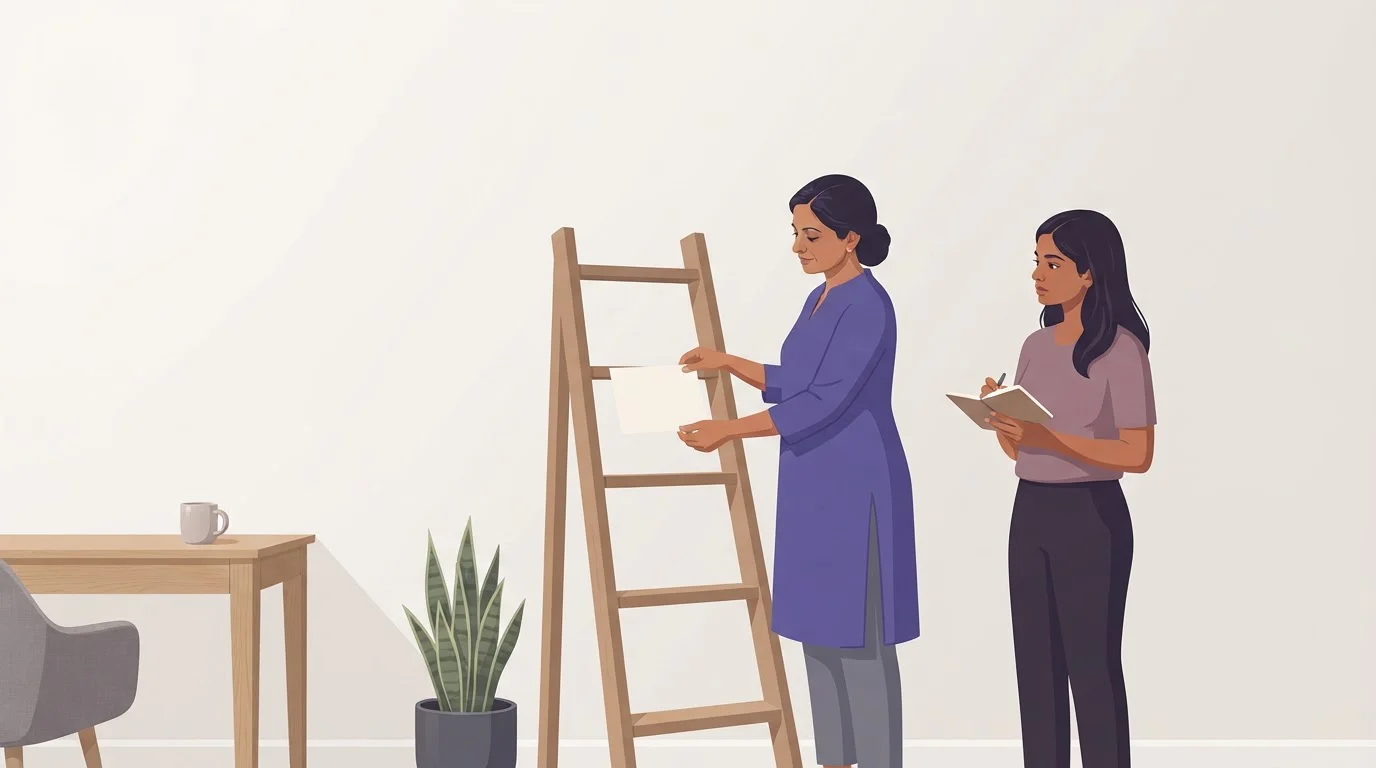
A fear ladder is a list of speaking situations rated from 0 (no fear) to 100 (the most fear you can imagine), ordered from easiest to hardest. You start at the bottom and stay on each step until your rating falls by about half (NHS Every Mind Matters).

Write your rating before and after every attempt. Do not check your phone or ask a friend "was that okay?" during a step, because distraction and reassurance-seeking stop the learning. Record yourself and watch it later.
Here is a ladder for Indian classrooms, offices and colleges. Rewrite the steps to match your own life.
| Step | Task | Pass test |
|---|---|---|
| 1 | Record a 60-second voice note introducing yourself and play it back once | You finished without restarting |
| 2 | Say two sentences in a group voice call | You spoke without waiting to be asked |
| 3 | Answer one question aloud in class or a meeting | You answered in your own words |
| 4 | Give a two-minute update to two or three people you know | You reached your last sentence |
| 5 | Ask a question in a larger session, giving your name | You asked it out loud |
| 6 | Present for three minutes to your team or class | You used your opening and closing script (next section) |
| 7 | Present for ten minutes and take questions | You answered at least one question |
| 8 | Speak to people you do not know, at a meetup, college event or club meeting | You stayed to the end |
A step is passed only when you meet its test and your rating is half your first rating or lower. If not, repeat the step; do not skip up the ladder.
Our suggested calendar is two steps a week: steps 1 and 2 in week 1, steps 3 and 4 in week 2, steps 5 and 6 in week 3, and steps 7 and 8 in week 4. If you have not passed a step by the end of its week, repeat it and push every later step back a week. Plan on about four weeks, and allow up to eight if steps need repeating.
What should you memorise so your mind does not go blank on stage?
Memorise two opening lines, two closing lines and three one-word cues for the middle, and nothing else. Practise aloud and record yourself, because rehearsing in your head does not test your voice (Toastmasters International).
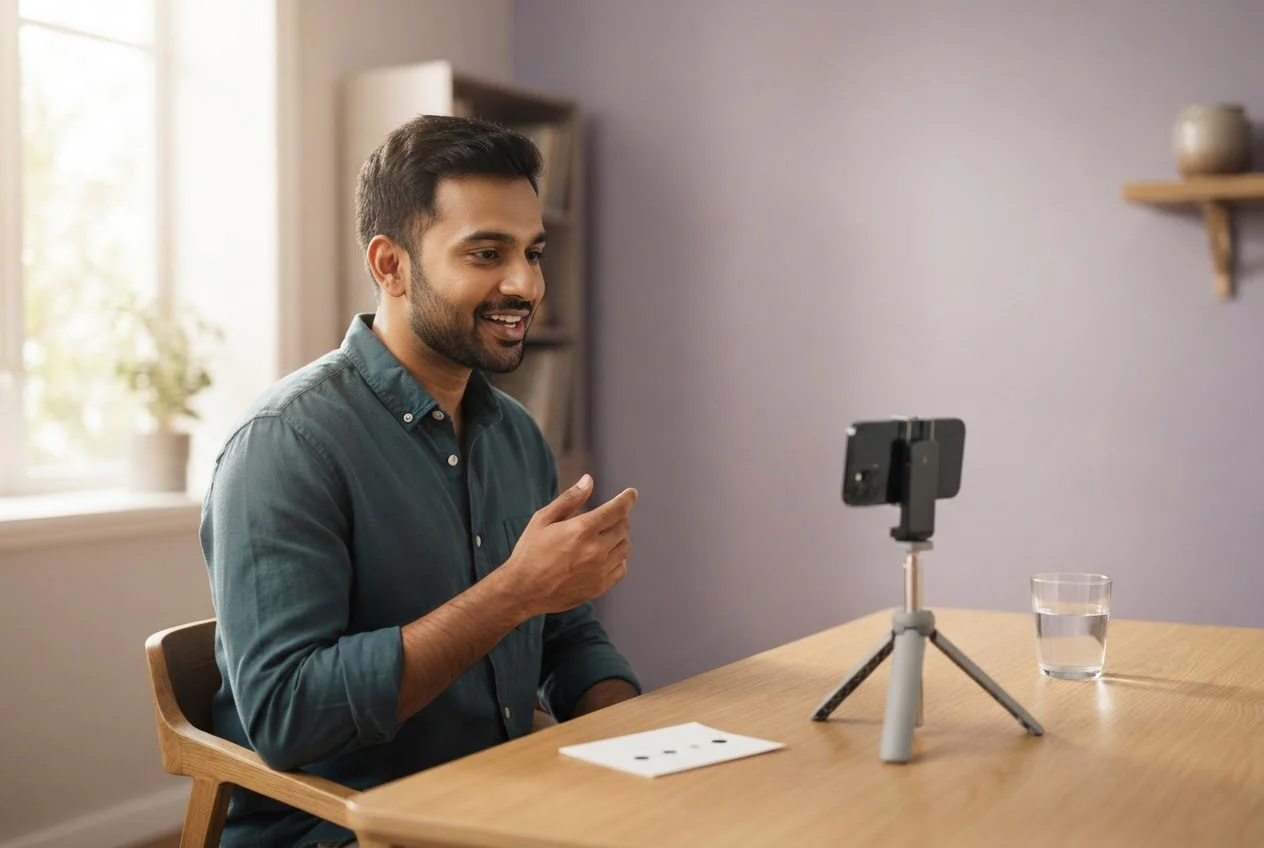
A fully memorised speech fails the moment one sentence disappears, and you have nowhere to restart. A speech built on cues can restart from any cue. For a three-minute talk, use this:
- Opening line 1: "Good morning. I am [name], and for the next [three] minutes I will talk about [topic]."
- Opening line 2: "If you remember one thing, make it this: [your main point]."
- Cues: three single words on a card, one for each point in the middle.
- Closing line 1: "To sum up: [your main point]."
- Closing line 2: "Thank you. I am happy to take questions."
If your mind blanks, pause, look at your notes and say: "Let me come back to that. The point that matters is [main point]." Pausing and restarting with a transition phrase such as "as I was saying" is a recovery tactic (Toastmasters International).
Before you start, breathe in for four counts, hold for four, and breathe out for six to eight (Toastmasters International). Our guide to starting a speech gives more opening lines for school, college and work.
Which help is worth paying for in India: a course, classes or a club?
Pay for the option in which you speak aloud in every session, because fear drops through practice, not through information. As of 4 October 2026, listings from three kinds of provider show these prices:
| Type of help | Listed price | What it gives | Source line |
|---|---|---|---|
| Self-paced online certificate | ₹6,500 (a 50% offer of ₹3,250 ran to 3 October 2026) | Two months suggested, fully online; study materials and a 60-minute online exam of 30 multiple-choice questions | |
| Live one-to-one online classes | ₹3,499 for one month, ₹7,499 for two, ₹9,999 for three | 35-minute one-to-one classes; a trial session is available | |
| Toastmasters club | About ₹17,343 for a new member in District 224, a regional group of Toastmasters clubs | ₹14,443 international dues including 18% GST (goods and services tax), ₹1,700 new member fee, ₹1,200 club fee; the club fee varies |
The club total adds up: 14,443 + 1,700 + 1,200 = 17,343. District 224 calls these indicative figures and asks you to confirm with the club treasurer. Toastmasters International charges dues for each six-month period, so ask the treasurer how many periods the ₹14,443 covers, and treat ₹17,343 as a joining total, not a monthly fee.
Our working on one-to-one classes, which is our calculation and not an official figure: the three-month plan is ₹9,999 ÷ 3 = ₹3,333 a month, about 5% below the one-month rate of ₹3,499 (166 ÷ 3,499 = 4.7%).
A certificate with a multiple-choice exam tests what you know about speaking, not whether you can do it. That is our inference from the exam format, so pair it with real speaking practice. Whoever you pay, run three tests:
- Do I speak aloud in every session? Pass: yes. Fail: it is a lecture or a video.
- Does someone give me feedback on a recording or a live attempt? Pass: yes, within the same week. Fail: no feedback.
- Can I try one session first? Pass: a trial or a refundable first month. Fail: full payment upfront.
Our guide to choosing public speaking coaches covers private coaching in more depth. We publish this page and we offer coaching of our own, which is not among the options above.
When does fear of public speaking need a clinician rather than a coach?
Fear of public speaking needs a clinician when it has a big impact on your life. Those are the words the NHS uses for when to see a doctor about social anxiety, a lasting fear of social situations (NHS social anxiety). In India, start with a psychiatrist or a clinical psychologist, or call Tele-MANAS, the government's 24×7 toll-free mental health helpline, on 14416 (Ministry of Health and Family Welfare).
Run these three tests:
- Avoidance test: In the last three months, have you skipped a class, interview, meeting or event because you would have had to speak? Pass: no. Fail: more than once.
- Spread test: Does the same fear appear in ordinary conversation, such as phoning someone or ordering food? Pass: no. Fail: yes.
- Ladder test: After four weeks, have your ratings on steps 1 and 2 fallen to half or lower? Pass: yes. Fail: no.
The pass-fail lines are our recommendation, not a diagnostic rule.
The NHS describes cognitive behavioural therapy (CBT), a therapy that helps you identify negative thought patterns and behaviours and change them, as generally the best treatment. It also lists guided self-help, a CBT-based workbook or online course with regular support from a therapist (NHS social anxiety). A coach does not replace this. Our comparison of a life coach, therapist and mentor explains where each one stops and lists India helplines.
What does private coaching with us involve for speakers?
Our private coaching is a three-month programme for you and your business, and if you tell us your speaking goal, we will say whether it fits. The three months are:
- Month 1, Inner Awareness: understand your nature and quiet overthinking.
- Month 2, Soul and Karma: explore deeper patterns and find connection.
- Month 3, Living the Wisdom: apply peace in real life, under real pressure.
We also run group coaching workshops and seminars for coaches, speakers, leaders, entrepreneurs and professionals, covering communication and leadership among other themes; see our projects. Ask us for current details and fees, and tell us your speaking goal here.
Tell us your speaking goal
Frequently asked questions
Freezing is the body's fight-or-flight response, which can fire without conscious fear. That is our summary of how the NHS describes the response. Use the breathing steps above, then say your first rehearsed line.
Not exactly. Fear of public speaking is fear of one situation, while social anxiety is a wider, lasting fear of social situations. They overlap: treatments for public speaking fear also eased general social anxiety (g = 0.35 straight after treatment, 0.70 at follow-up) (Ebrahimi et al.).
A doctor can prescribe medicine for social anxiety, and the NHS lists antidepressants such as escitalopram or sertraline (NHS social anxiety). Those names are examples from UK guidance, and the treatment is for anxiety affecting daily life, not one presentation. Ask a psychiatrist and do not self-medicate.
Shaking hands are one of the body's fight-or-flight reactions, and fear responses ease with repeated exposure (NHS Every Mind Matters). Until they do, our advice is to rest your hands on a lectern or hold one card, rather than hide them.
Sources
- 1.NHS Every Mind Matters: Facing your fears
- 2.NHS: Social anxiety
- 3.Ebrahimi et al. (2019), Psychological Interventions for the Fear of Public Speaking: A Meta-Analysis, Frontiers in Psychology
- 4.Ahmed et al. (2025), Public speaking anxiety and self-efficacy among Sudanese medical students, BMC Psychology
- 5.Toastmasters International: How to Overcome Your Fear of Public Speaking
- 6.Toastmasters International: Membership dues and payments
- 7.Toastmasters District 224: Fee calculator
- 8.Speaking Fever: Online public speaking course plans
- 9.Indian Institute of Skill Development Training (IISDT): Certificate in Public Speaking
- 10.Ministry of Health and Family Welfare: Tele-MANAS helpline 14416