Before Testimonials, Build a Coach’s Personal Brand in 40 Days
A documented point of view, an accurate LinkedIn profile, three teaching artefacts and a transparent proof inventory.
- Time
- 40 days
- Difficulty
- Moderate
- Cost
- No required spend
- Steps
- 4
Before you start, have
- A LinkedIn profile
- A document or notes app
- A way to publish short teaching material
- A list of your relevant experience, qualifications and work examples
Heads up: Avoid keyword stuffing or inflating experience, education or qualifications.
Heads up: Do not present prior employment, teaching content or early feedback as client outcomes.
Heads up: Keep support for factual claims and obtain permission before naming people, firms or institutions.

By Rohini Mundra, Founder · Updated 16 Sept 2026
In brief
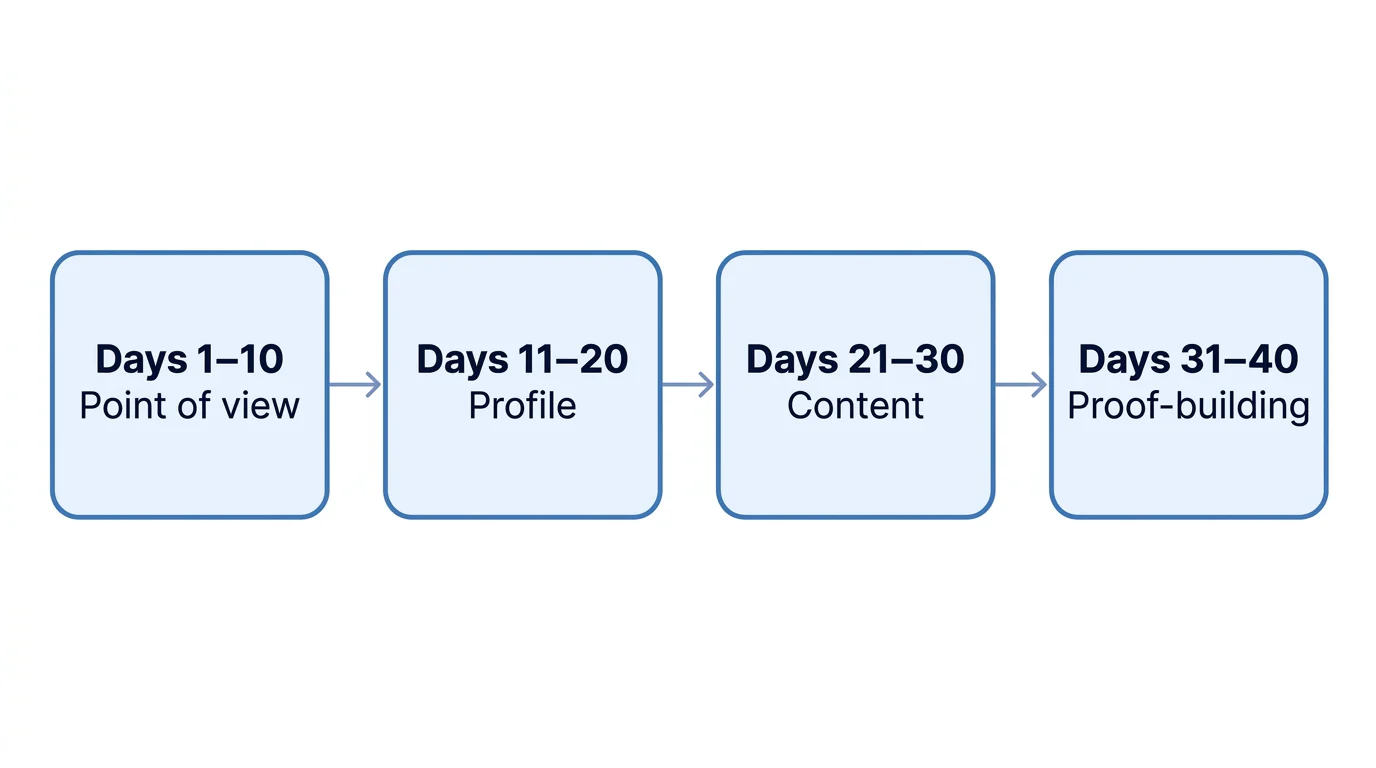
Personal branding for coaches can begin before client testimonials. Use four 10-day stages to define a point of view, make your profile accurate, publish teaching artefacts and assemble transparent evidence without presenting it as client results.
Write your point of view
Use Days 1–10 to write a short statement covering who you help, the problem you focus on and the change you want to help them work towards. Then add the beliefs that shape your approach, including what you would do differently from generic advice.
Keep the language specific enough that a reader can recognise whether it is for them. If the audience is still broad, use this guide to narrow your coaching niche before moving on.
When this works, you can describe your focus without relying on a title, logo or claim of results.
Rebuild your profile around accurate evidence
Use Days 11–20 to update your headline, About section and experience details with the statement you wrote. Include relevant work, qualifications and skills, but separate previous professional experience from coaching outcomes.
LinkedIn’s 2024 profile guidance says the About section allows up to 2,600 characters. Write for clarity rather than length. LinkedIn also advises against keyword stuffing and artificially inflating experience or education in its profile search guidance.
The profile is ready when a visitor can see who you help, what you focus on and one clear way to contact or follow you.
Publish teaching artefacts
Use Days 21–30 to create three short pieces that demonstrate your thinking. Teach one useful distinction, answer one recurring question or show how you would approach a common problem. Keep examples general unless you have permission to identify a person or organisation.
Do not convert an opinion into an outcome claim. A teaching artefact can show your method and judgement without saying that it has changed a client’s results. Use coaching business ideas that need proof before a promise to test whether the content matches an offer you can support.
This stage is complete when the three pieces are published or ready to publish and each reflects the same point of view as your profile.
Assemble a transparent proof inventory
Use Days 31–40 to list every statement you may use as evidence: relevant experience, qualifications, public speaking, facilitation, work samples and feedback. Mark each item by what it actually demonstrates. Do not relabel career experience as a coaching testimonial.
For statements about objectively ascertainable facts, retain the material that supports them. ASCI’s advertising code says such advertising claims should be capable of substantiation and addresses permission for references to people, firms and institutions.
Finish by choosing the evidence you can use now and the evidence you will need to earn through future coaching work. For a next-step outreach plan, see getting first coaching clients without becoming an influencer.
You'll know it worked when
Your public presence includes one positioning statement, a complete accurate LinkedIn profile, three teaching artefacts and a proof inventory that distinguishes existing evidence from client testimonials.
Keep the work in order
Each stage produces material for the next one, so avoid starting with posts or a logo. The sequence ends with observable assets, not a promise of bookings or income.
Your first 40 days