
Thirty Days to Get Coaching Clients Without Becoming an Influencer
A documented 30-day client-acquisition cycle with clear outreach, live conversation routes and recorded next steps.
- Time
- 30 days
- Difficulty
- Moderate
- Cost
- Variable
- Steps
- 8
Before you start, have
- A one-sentence description of who you help and the problem you address
- A list of warm contacts and relevant groups or communities
- A way to offer and hold a coaching conversation
- A shared tracker for outreach and follow-up
- A written coaching agreement if you begin a paid engagement
Heads up: Do not promise clients, income or outcomes that you cannot substantiate.
Heads up: Do not use a referral introduction as permission to pressure someone into coaching.
Heads up: If you represent yourself as an ICF professional, follow the ICF requirements that apply to your agreement, confidentiality and referral disclosures.

By Rohini Mundra, Founder · Updated 14 Sept 2026
In brief
You can pursue first coaching clients without building an influencer audience by running a 30-day cycle of warm outreach, talks, partnerships, referrals and follow-up. Use one clear offer, send specific invitations, and measure conversations and next steps rather than followers.
Write a repeatable first-offer sentence
Complete this sentence: “I help [specific people] who are dealing with [specific problem].” Keep the first version narrow enough that a contact can recognise the person you mean without asking for a long explanation. Use five evidence checks for a coaching niche if you need to test the scope.
You have finished this step when you can say what you do in two sentences and another person can repeat who the offer is for.
List warm contacts and make a specific announcement
Write down former colleagues, classmates, clients from earlier work, community contacts and people who have seen your relevant experience. Send an individual note rather than a broadcast: “I am opening a coaching offer for [specific people] dealing with [specific problem]. If someone comes to mind, would you be open to an introduction?”
Record the contact, date, reply and agreed next step in your tracker. A warm contact is not an obligation to buy. It is a person who can understand or introduce the work accurately.
Pitch one useful talk to a group that already gathers
Choose a community, professional group or audience that includes the people in your offer. Propose a practical session on the problem they already discuss. Use this message: “I work with [specific people] on [specific problem]. I could run a short practical session for your group on [useful topic], followed by questions. Would that be useful for your members?”
A good talk request produces a clear yes, no or follow-up question from a host. It does not require you to build an audience before you speak.
Invite complementary partners to exchange introductions
Identify people whose work reaches the same audience but solves a different part of the problem. Ask for a short conversation about fit, not a referral promise: “Our work may serve some of the same people in different ways. Would you be open to comparing the situations we each handle and deciding whether introductions would ever be useful?”
Write down the partner’s audience, boundaries and any next action. If a referral arrangement includes compensation or benefits, an ICF professional must disclose that information to clients.
Ask for referrals after you have created value
When someone has experienced your relevant work, ask for an introduction with enough detail to make the request easy to pass on: “I am working with [specific people] who are dealing with [specific problem]. If anyone in your network fits that, would you be comfortable introducing us?”
Accept a no without pressure. The result you are looking for is a clear introduction or a clear boundary, not a vague promise.
Follow up from the tracker
Review every open conversation and send a concise follow-up that refers to the previous exchange: “I wanted to check whether this is still relevant. If it is not, no problem. If it is, I can suggest a next step.” Set the next action and date in the tracker immediately after each message or call.
This step is working when no interested person relies on your memory or an unsearched inbox to receive a response.
Hold a fit conversation and document the next decision
Ask where the person is now, what they want to change, what is getting in the way and whether coaching is the appropriate form of support. If there is a fit, explain the scope and agree the next action. If there is not, say so plainly.
Before coaching begins, use an agreement that states roles, responsibilities, confidentiality and financial arrangements. For a fuller first-offer foundation, read Build a Coaching Business in India From a Clear First Offer.
Review the four routes and repeat the clearest one
At the end of the 30 days, review the tracker by route: warm network, talks, partnerships and referrals. Compare the six recorded measures, then repeat the route that produced the clearest relevant conversations and next steps. Keep the other routes available rather than assuming one channel must carry the whole practice.
The result is a repeatable acquisition cycle, not an income guarantee.
You'll know it worked when
Your tracker contains entries from the four routes, each open conversation has a recorded next step, and any coaching engagement has a documented scope and agreement.
Measure direct conversations, not visibility
Keep the four routes active in parallel and record every open thread in one place. This guide’s 30-day operating plan tracks six measures: outreach sent, replies, conversations, calls booked, calls held and agreed next steps.
Four routes, one follow-up record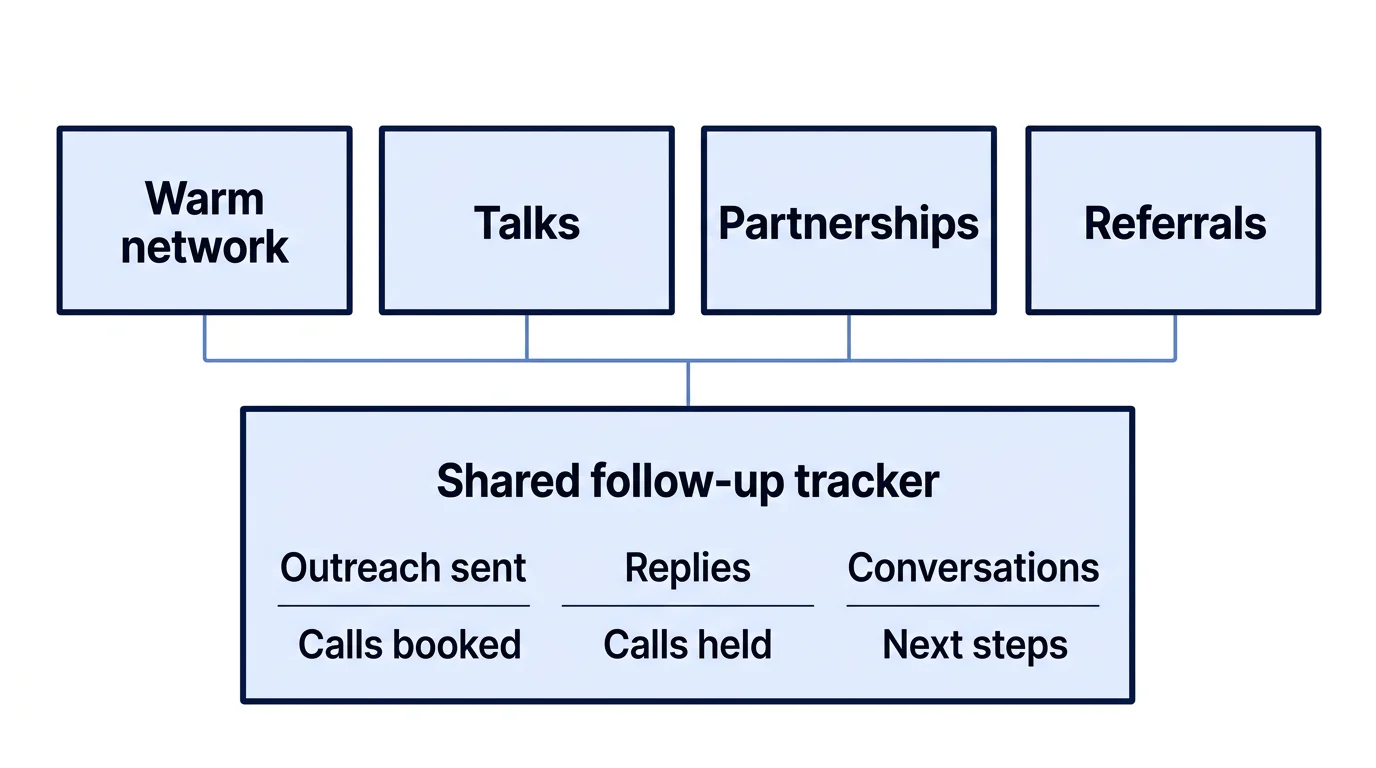
Keep your marketing and onboarding accurate
India’s Guidelines for Prevention of Misleading Advertisement in Coaching Sector, 2024 apply to advertisements by people engaged in the coaching sector. Do not promise clients, income or outcomes that you cannot substantiate. If you are an ICF professional, the ICF Code of Ethics calls for an agreement before coaching begins that covers roles, responsibilities, confidentiality and financial arrangements.
Keep reading



Frequently asked
State who you help, the problem you work on and the introduction you are seeking. For example: “I am working with [specific people] who are dealing with [specific problem]. If someone in your network fits that, would you be open to introducing us?” If you are an ICF professional and a referral involves compensation or benefits, disclose that to the client.