

TL;DR
We help stuck founders choose a mastermind when peer challenge and recurring accountability are the constraint, and private coaching when a sensitive or business-specific decision needs tailored support. This guide defines both formats, shows how to vet them, explains accountable delivery, and calculates the value a better decision must create.
A founder doing ₹8 lakh a month is running about ₹96 lakh in annual revenue, while ₹50 lakh annually is about ₹4.17 lakh monthly. A 2023 meta-analysis pooled 39 randomized coaching samples involving 2,528 participants, but it does not prove that any coaching format will produce a business result.
Choose a mastermind or private coaching by locating the constraint first. Pick a screened peer room for isolation, honest challenge, and weak follow-through. Pick confidential one-to-one support for sensitive, business-specific decisions needing tailored diagnosis. Neither works without implementation, clear terms, and a way to value better decisions.
We will define the formats, match them to common founder bottlenecks, show what credible accountability looks like, and give you a practical test before you commit.
What Are You Actually Buying: Mastermind or Private Coaching?
The labels are often used loosely, which is why founders can pay for community when they needed diagnosis, or buy private access when recurring peer challenge would have been more useful. We separate formats by the operating job they perform, not by their marketing language.
| Format | What You Are Buying | Primary Input | Best Use |
|---|---|---|---|
| Mastermind | Peer challenge and recurring commitments | Stage-matched peers | Isolation, blind spots, execution drift |
| Group Coaching | Guided learning and shared application | Coach plus peers | A common, teachable constraint |
| Private Coaching | Confidential tailored support | Coach and founder | Sensitive or highly specific decisions |
| Networking Community | Introductions and broad relationships | Wider membership | Opportunity discovery and connection |
| Course | A repeatable curriculum | Instruction and tools | A defined knowledge or skill gap |
A mastermind should create a small enough setting for candour, useful disagreement, and visible commitments. Group coaching can include peers, but the facilitator owns the learning agenda. A networking community may be valuable, but relationships alone do not create operating accountability. For a wider distinction among support formats, see our format comparison.
| Criterion | Mastermind | Private Coaching |
|---|---|---|
| Source Of Advice | Peers with relevant lived experience | Coach-led diagnosis and questioning |
| Confidentiality | Shared among members, so rules matter | One-to-one, with written terms |
| Personalization | Limited by group time and relevance | Built around one founder’s context |
| Peer Value | Central benefit | Usually absent |
| Accountability | Witnessed commitments and peer follow-up | Direct review with the coach |
| Access | Scheduled group touchpoints | Defined one-to-one access |
| Cadence | Recurring meetings | Agreed sessions and support |
| Cost | Varies with room, access, and travel | Varies with scope and access |
Which Format Fits Your Bottleneck?
A plateau is not one problem. We first ask whether the founder lacks perspective, clarity, implementation discipline, capacity, or a safe place to discuss a hard issue. Our revenue bottleneck diagnostic is the useful starting point when the answer is not yet clear.
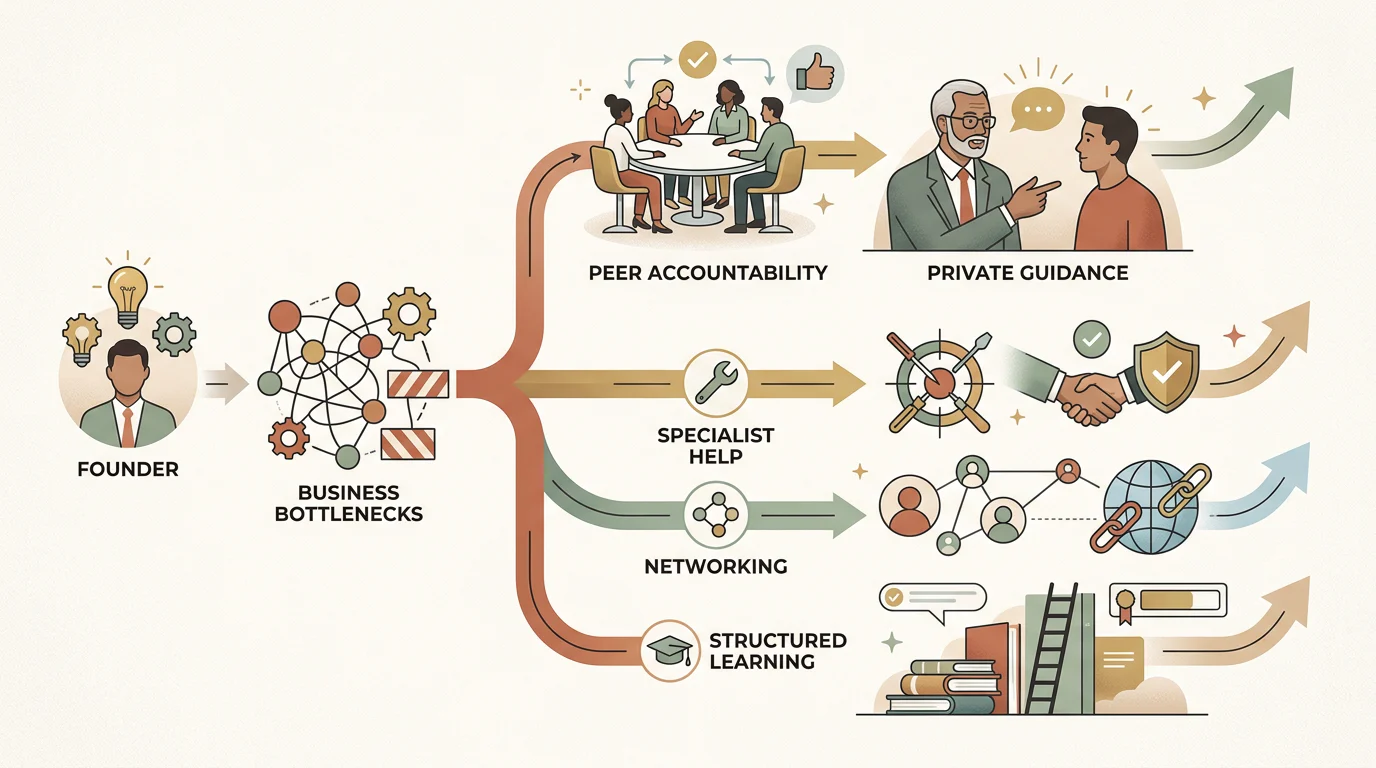
Isolation and Execution Drift
Choose a mastermind when you know broadly what to do but keep delaying the decision, avoiding a difficult conversation, or working alone without credible challenge. The value is not agreement. It is having peers who notice when your stated priority and your calendar no longer match.
Strategic Blind Spots
A screened peer room can help when founders at comparable complexity have already navigated similar trade-offs. It is less useful when the room is too mixed, too polite, or dominated by people selling methods rather than sharing experience.
Positioning Uncertainty
Choose private support when the question is specific to your offer, customer evidence, sales process, or delivery model. A founder reaching a solo-founder ceiling may need a tailored diagnosis before they need more peer exposure.
Sensitive Operational Problems
Do not use a peer room as the first place to resolve legal exposure, cash distress, partner conflict, personnel issues, or a matter requiring regulated expertise. Confidential coaching may help you think through the decision, while a qualified specialist handles the technical risk.
How Should Accountability Work?
Good accountability is designed, not announced. A founder should leave each interaction with one decision, a named action, an owner, a due date, and a future point where someone will ask what happened.
The evidence for coaching is strongest around individual behavioural outcomes, not automatic revenue gains. A research review found an overall positive coaching effect and stronger results for behavioural outcomes, which is why we would measure actions completed rather than rely on motivational language.
Matched Cohorts and Useful Hot Seats
A credible mastermind screens for operating stage, decision authority, and conflicts between members. Hot seats should be prepared in advance, focused on one consequential decision, and structured so every member has a fair chance to be challenged.
Witnessed Commitments and Facilitator Intervention
A commitment is useful only when it is recorded and revisited. The facilitator should protect confidentiality, stop pitching, draw out quiet members, and intervene when advice becomes generic or the founder evades the actual issue.
Diagnosis and Private Follow-Through
Private coaching should begin with a clear problem definition and end each session with tailored next steps. Between-session support only matters if its boundaries, response expectations, and purpose are stated before the engagement begins.
If a plateau is really a time and delegation issue, begin with our capacity diagnostic rather than assuming a new room will solve it.
How Do You Vet the Room or Coach?
Treat the decision like vendor diligence. The room may influence pricing, hiring, workload, and high-stakes choices, so a polished sales call is not enough. Ask direct questions, score the answers, and request written terms before paying.
Score each answer from zero to two. A zero means vague or unavailable, one means partly evidenced, and two means clear and documented. A score of 16 or above warrants further diligence, while a low score is a signal to walk away.
- Is the member stage aligned by revenue, complexity, and decision authority?
- Can the organiser describe selection standards without exposing member confidentiality?
- What is the current group size and typical attendance?
- What happens after repeated absences or missed commitments?
- How often does each member receive a meaningful hot seat?
- What relevant facilitation and business-diagnosis experience does the leader bring?
- Are confidentiality and conflicts covered in writing?
- Are commitments recorded and reviewed?
- Can you attend a trial session or speak with a suitable member?
- Are fees, refunds, renewals, cancellations, and upsells clearly explained?
Professional coaching ethics call for clarity about roles, confidentiality, financial arrangements, and engagement terms. We would treat vague member criteria, status-heavy marketing, forced upsells, absent accountability records, and unverifiable outcomes as red flags.
A good room should also fit the work you actually need to do. Use our constraint map to separate a support problem from a business-model problem.
What Would Make the Investment Worthwhile?
The right question is not whether a room feels elite. It is whether one improved decision, avoided error, or completed priority can plausibly justify the total cost of participating.
Calculate total investment as the stated fee, travel and incidental costs, plus founder hours multiplied by a realistic hourly contribution value. Then calculate required incremental contribution as total investment minus documented avoided loss. If you need revenue rather than contribution, divide the remaining amount by your gross contribution margin.
| Scenario | Count Only | Time Horizon | Decision Standard |
|---|---|---|---|
| Conservative | One high-confidence implemented decision | Three months | Exclude speculative referrals and future possibilities |
| Base | Documented decision value and avoided error | Six months | Include only actions actually implemented |
| Upside | Additional attributable gains | Twelve months | Treat this as optional, never as the buying case |
For an in-person room, add travel time and recovery time to the calculation. For an online room, test whether the founder will still show up prepared. Geography matters less than candid participation, but it is still part of the economic choice when travel steals attention from delivery or sales.
A peer room cannot replace capacity. If the business cannot scale without more founder hours, our founder capacity guide can help identify the operating constraint before you spend on support.
Which Rohini Mundra Option Fits?
At Rohini Mundra, we help established founders decide whether a peer room, a structured program, private coaching, or no new commitment is the honest next move. We start with the business constraint, not the prestige of a room. If a revenue plateau is really about capacity, offer clarity, positioning, delivery, or follow-through, we will name that before recommending support. We will also confirm scope, cadence, access, cost, and terms before we suggest a route. That prevents a founder from buying networking when they need confidential diagnosis, or buying coaching when a peer commitment loop is the missing discipline. Bring us the decision you keep delaying, the numbers you can safely share, and the change that would make the investment worthwhile. We will help you choose a defensible next step for your business and your calendar with calm, practical judgment. Start with Contact Us.
FAQs on Mastermind or Private Coaching
Are Entrepreneur Masterminds Worth It?
We consider a mastermind worthwhile when peers match your stage, confidentiality is real, commitments are reviewed, and one improved decision can plausibly exceed the total participation cost.
Should I Choose a Peer Mastermind or Private Business Coach?
We choose a mastermind for recurring peer challenge and execution drift. We choose private coaching for confidential, tailored diagnosis when a specific business decision needs focused support.
How Do High-Level Entrepreneur Communities Actually Work?
Strong communities combine screened members, recurring meetings, prepared discussions, confidentiality, and follow-up. Without those mechanics, they resemble networking more than disciplined, accountable peer support for founders.
Is a Mastermind Right for a Founder Stuck in Operations?
A mastermind can help when challenge and follow-through are missing. When systems, delegation, cash, or personnel risk is central, private guidance or specialist support may fit better.
How Do I Vet an Entrepreneur Mastermind Group Before Paying?
Ask about member fit, attendance, confidentiality, hot-seat frequency, facilitator experience, commitment tracking, trial access, fees, refunds, renewals, and upsells. Request each answer clearly in writing.
What Should I Calculate Before Joining a Mastermind or Hiring a Private Coach?
Calculate the full cash and time cost, then identify the incremental contribution, avoided error, or recovered capacity required before the investment can make financial sense.