
Beyond Subject Expertise, Become a Corporate Trainer in India
A route-selection guide for Indian subject-matter experts, with trainer capability guidance as of September 2026.
5 chapters · Updated Sep 30, 2026 · By Rohini Mundra
In brief
Independent corporate training starts with a credible subject, but subject expertise alone is not enough. Build adult-learning design, facilitated practice, an evidence-backed proof asset and a narrowly scoped first engagement. NCVET guidance is useful for trainer capability in vocational education and skilling, while internal L&D employment and independent training are different routes.
Choose the route before you choose a course
A corporate trainer can be an employee responsible for a single organisation’s learning, or an independent professional who designs and delivers for clients. Those routes overlap in facilitation skill, but they do not ask for the same portfolio, hiring evidence or commercial readiness. Decide which route you want before investing in a credential or describing yourself to buyers.
NCVET’s trainer guidance is valuable capability context, but it applies to the vocational education and skilling ecosystem. It separates domain skills from platform skills and expects trainers to understand learner needs, deliver suitable content, use assessment and assess impact. NCVET’s trainer guidance should therefore inform your craft, not become a blanket claim that you are approved for every corporate assignment.
Independent and VET trainer routes serve different jobs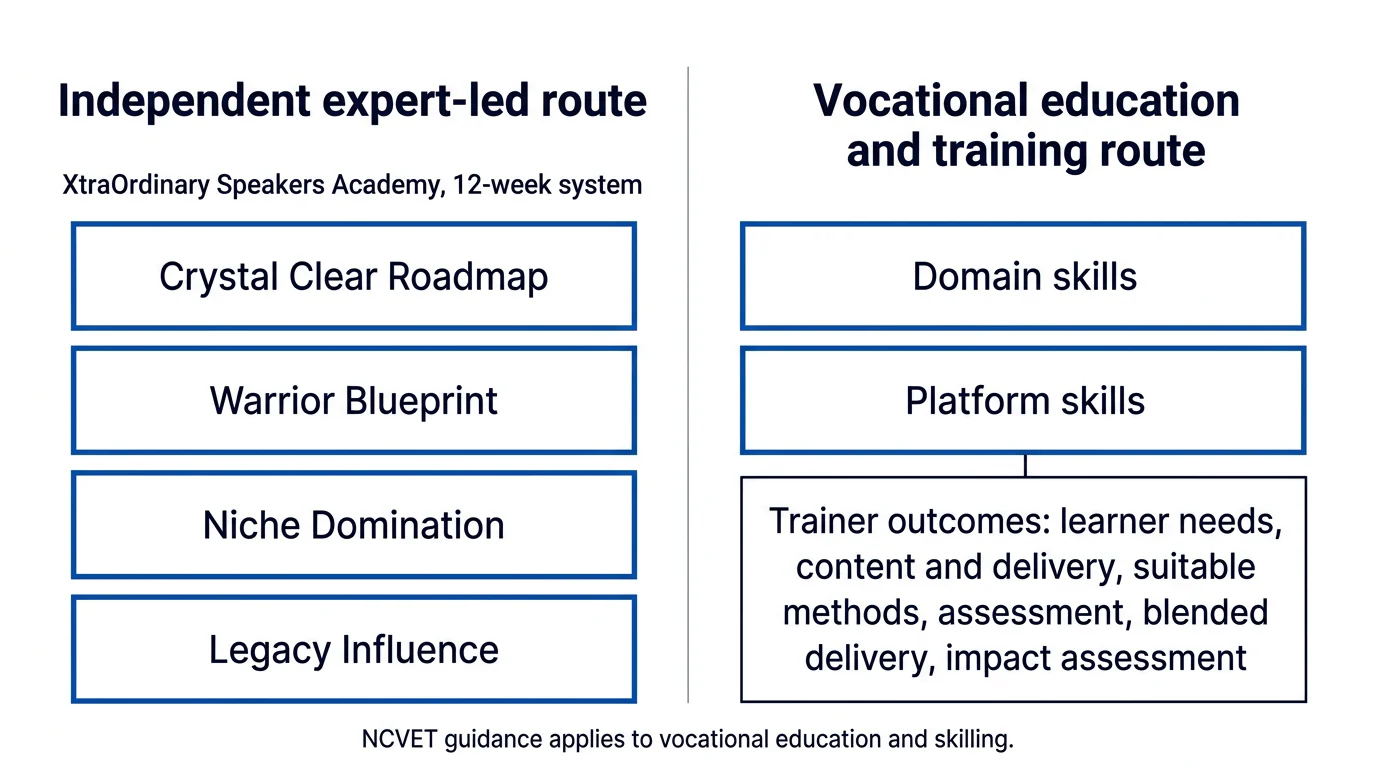
For an independent expert-led route, our XtraOrdinary Speakers Academy is a 12-week system for speakers, trainers and coaches. It costs ₹1,80,000 for the catalogue version and ₹4,00,000 for the legacy membership version. The programme moves through Crystal Clear Roadmap, Warrior Blueprint, Niche Domination and Legacy Influence, with goals, mindset, niche and public-speaking focus. It is built for an independent expert-led offer, rather than an internal-L&D employment credential.
Takeaway: Name the route you are building before you spend on a programme or make a capability claim.
Turn a subject into an adult-learning experience
Start with a subject you can support through real work, not merely enthusiasm. Define the workplace situation in which the learner should use the capability. Then state what a participant should be able to do, say, decide or produce after the session. That statement is more useful than a broad promise such as confidence, leadership or communication.
Build the session backwards from that observable practice. Select a realistic scenario, make space for learners to attempt the task, facilitate reflection and use a check that shows what has changed in their understanding or performance. This converts a presentation into a learning design. NCVET similarly frames trainer capability around learner needs, content development and delivery, suitable methodology, assessment and impact, rather than content coverage alone.
Narrowness is an advantage at this stage. A trainer with a clear workplace problem can prepare relevant examples, activities and checks. Use the evidence questions in this niche assessment to separate lived expertise from an attractive but unsupported topic.
Takeaway: Design around an observable learner capability, not around the slides you want to present.
Build proof that matches the claim
Before seeking larger assignments, assemble a proof asset from work you can stand behind. It can include the learner group, the problem addressed, the session objective, a short outline, a sample activity, the assessment approach and approved participant or client feedback. Ask permission before using names, logos, photographs, recordings or testimonials.
Keep the claim smaller than the evidence when necessary. A pilot can support the statement that you designed and facilitated a session for a defined audience. It does not automatically support a promise of productivity, revenue, retention or transformation. The Department of Consumer Affairs published the Guidelines for Prevention of Misleading Advertisements and Endorsements for Misleading Advertisements in 2022, which is a practical reason to describe capability and outcomes with care.
A good proof asset is not a trophy page. It is a decision aid for a prospective client, showing what you can deliver, how you will check learning and what evidence exists so far.
Takeaway: Make only the capability claim your available evidence can support.
Make the first engagement easy to evaluate
A first engagement should be specific enough for a client to understand the risk and for you to prepare well. Name the learner group, the workplace problem, the expected capability, the practical activity, the learning check and the follow-up evidence you will request. This gives the buyer something more concrete than an offer to deliver a motivational session.
Keep the engagement within your proven subject area. If you have experience in sales onboarding, for example, do not lead with a broad claim to transform leadership culture. A focused offer gives you better material to facilitate, makes participant practice more relevant and creates a clearer record for your portfolio.
Independent training is not the best route for someone who needs the predictability of an employee salary or wants an organisation to supply the learning brief, internal data and delivery infrastructure. Internal L&D employment may be the better route for that reader. If your work is closer to inspiration than skill practice, compare corporate training and motivational speaking before you pitch the session.
Takeaway: Offer a bounded engagement with a defined learner capability and an agreed learning check.
Measure capability, then run the work professionally
Agree what evidence is appropriate before delivery. A knowledge check may suit a process explanation, while a role play, observed task or manager follow-up may suit a behavioural skill. Record what was measured, when it was measured and what the result can and cannot show. This is how a new trainer avoids confusing participation with workplace change.
Professional readiness also includes commercial basics. Confirm scope, learner numbers, schedule, payment terms, cancellation terms, permission to use proof and the client’s expectations for follow-up. Where you make taxable supplies, the Central Goods and Services Tax Act states that GST registration generally applies when aggregate financial-year turnover exceeds ₹20 lakh, or ₹10 lakh in special-category states, with exceptions that can apply. The CGST Act also requires registered suppliers of taxable services to issue tax invoices within the prescribed period.
As your evidence strengthens, package the work around the business problem and delivery scope rather than a vague personal brand. A high-ticket service begins with clear scope and credible proof, not a large promise.
Takeaway: Measure the capability you set out to build, and document the commercial terms before delivery.