Scope Sets the Fee for Corporate Training in India
Use these dated public prices as scoped reference points, not as a market average.
Five-day open-enrolment Training of Trainers course, before GST
₹25,000
Multi-city enterprise AI programme for 500 to 2,000 people, before GST and travel
₹12,00,000+
Dated public reference points, not market averages. As of September 2026, tax and travel treatment differ between examples.

By Rohini Mundra, Founder · Updated 19 Sept 2026
In brief
Corporate training in India has no defensible single market rate because public fees package different audiences, durations and delivery. Compare the three dated reference points below only after checking GST, participant caps, materials, travel and venue obligations.
What’s in the price
| Item | Cost | Notes |
|---|---|---|
| Five-day Training of Trainers course | ₹25,000 + 18% GST | ni-msme, July 2025. Includes training, reading material, boarding, lodging and exposure visits. Candidate travel is excluded. |
| One-day team intensive, up to 25 people | ₹1,25,000 | Hypermind Lab, 2026. Published starting fee for its own sales intensive. GST is excluded. |
| Multi-city enterprise AI programme, 500 to 2,000 people | ₹12,00,000+ | Nirmal Rabari, 11 July 2026. Published starting figure for its own enterprise-wide programme. GST and travel are excluded. |
What moves the price
Participant cap
20 included, then pro rata to 25BIS publishes this headcount rule for its off-campus training. Put the cap and the cost of additional participants in the proposal.
GST treatment
+18%BIS stated that GST was extra at 18% on its published training fees when its page was updated in November 2025. Confirm the tax treatment for the actual supplier and buyer.
Location
−10% in BIS Category II locationsBIS publishes Category II locations at 10% below its normal charge. A supplier may use a different model, so ask whether city and travel change the total.
Legitimate ways to pay less
- 1.Keep confirmed attendance within the stated participant cap before accepting the proposal.
- 2.Request a location-specific quote and ask whether the provider uses a lower charge outside its highest-cost city group.
- 3.List buyer-provided venue, AV, refreshments and local transport separately so they are not mistaken for included supplier costs.
- 4.Use an open-enrolment option only when individual seats meet the learning need and the excluded travel cost is acceptable.
The published spread is a scope comparison, not an average
The three examples below are deliberately unlike-for-like. The ni-msme programme is an open-enrolment Training of Trainers course with reading material, boarding, lodging and exposure visits included, while travel is excluded, as its July 2025 programme entry states. Hypermind Lab's one-day sales intensive and Nirmal Rabari's multi-city AI enterprise programme are provider-specific offers, so neither figure can stand in for a general Indian corporate-training rate.
A lower open-enrolment fee is not a substitute for a bespoke team intervention when the buyer needs company-specific content, an onsite format or a large rollout. A larger enterprise figure is not a useful comparison when the requirement is a short, focused workshop.
Do not compare before you separate the components
BIS states that its off-campus training fee covers 20 or fewer people, rises pro rata up to 25 people, leaves faculty travel and stay to the client, and treats course material as an actual cost. Its fee page, updated in November 2025, also states GST was 18%; the BIS fee guidance is a useful checklist, not a universal supplier rule. IAHE similarly says an outside-campus sponsor may need to arrange venue, AV equipment, refreshments, accommodation and local transport, with the fee set case by case by participant count, course structure and location.
What belongs in the total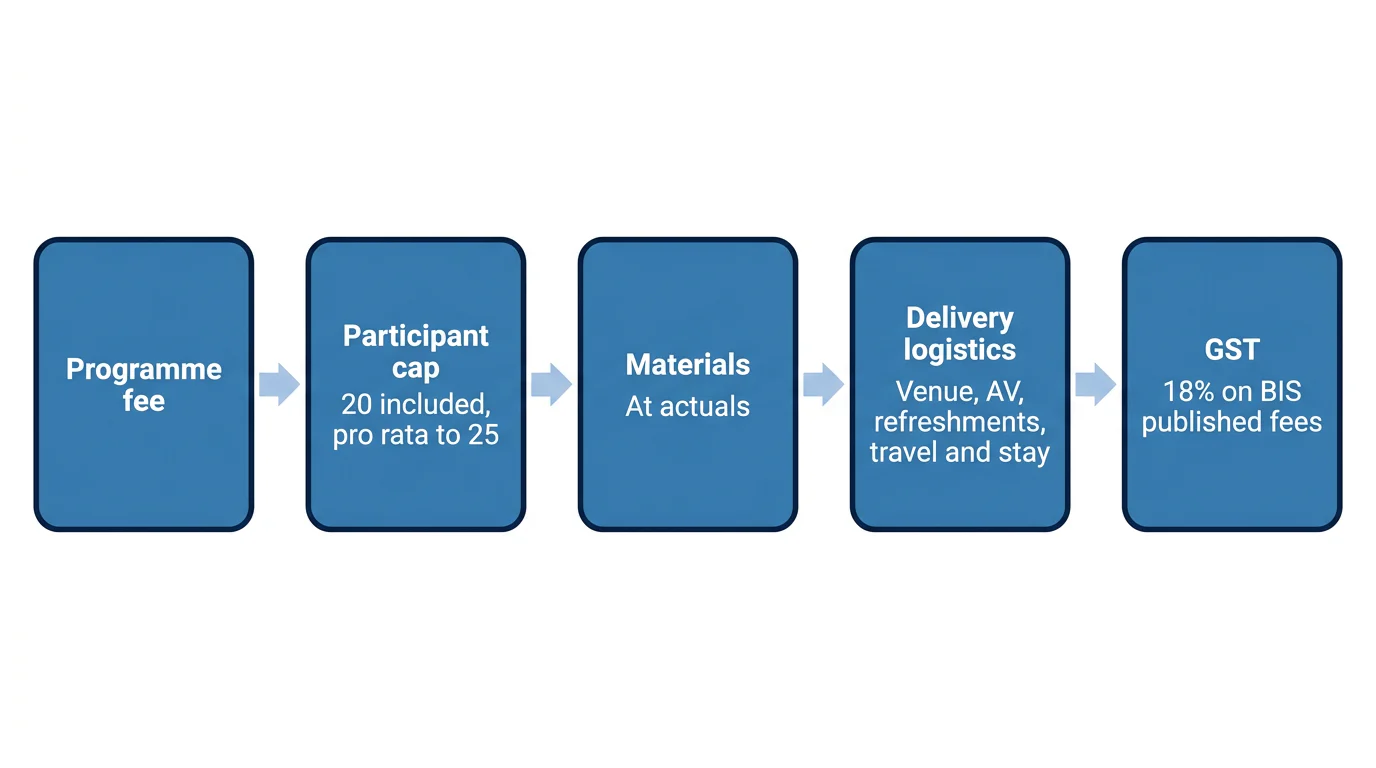
Questions to put into every proposal
Ask the provider to name the participant cap, delivery format, duration, materials, travel and stay treatment, venue and AV responsibilities, GST treatment, and any post-session support. A proposal is easier to compare when each line says whether it is included, charged separately or supplied by the buyer.
For a team planning a training offer rather than buying one, use this buyer-ready playbook. If the underlying need is digital capability for a smaller business, this digital transformation guide is a relevant next read.
Four ways to reduce avoidable spend
- Confirm attendance before accepting a fee with a participant cap. BIS publishes a base allowance for 20 people and a pro-rata increase through 25, which shows why late headcount changes need a written rule.
- Ask whether the quoted location changes the fee. BIS publishes Category II location charges at 10% below its normal charge, so location should be visible in a proposal rather than buried in an all-in total.
- Separate host-provided logistics from supplier-provided logistics. If the buyer provides venue, AV, refreshments or local transport, record those obligations and their internal cost before calling the supplier quote cheaper.
- Choose an open-enrolment programme only when an individual-seat format fits the learning need. The ni-msme example includes several residential items but excludes travel, which is a different purchase from a company-specific workshop.