
Comparison
Practice Changes Corporate Training vs Motivational Speaking
Motivational speaking fits an event that needs attention and shared energy, while corporate training fits a defined skill that participants must practise, measure and carry back into work.

By Rohini Mundra, Founder · Updated 24 Sept 2026
Rohini Mundra Workshops-Seminars
Communication, leadership and confidence themes for coaches, speakers, leaders, entrepreneurs and professionals.
Best for: A defined capability brief that needs participant practice, evidence of learning and workplace follow-through.
Motivational speaking
An event format for attention, energy and a shared perspective.
Best for: A corporate event that needs a focused, time-bounded speaking session.
The short answer
Choose motivational speaking when your immediate job is attention, energy or a shared perspective at an event. Choose a corporate training workshop when people must practise a defined behaviour, show what they learned and receive follow-through. Neither format replaces the management support and operating changes needed for on-the-job transfer.
Which should you choose?
Choose Rohini Mundra Workshops-Seminars if
- You want a workshop brief around communication, leadership or confidence, with a defined behaviour to practise.
- You can agree a baseline, a post-session skill check and a delayed follow-up with participants or managers.
- You can give participants opportunities and support to apply the skill after the session.
Choose Motivational speaking if
- Your immediate need is attention, energy or a shared perspective for a corporate event.
- You need a time-bounded speaking engagement rather than a practice-led learning design. Puja Puneet, for example, publicly offers motivational-speaking bookings of 2 hours, 4 hours or a full day.
Rohini Mundra Workshops-Seminars vs Motivational speaking, point by point
A check marks the stronger side on that point. Points without a check are even, or depend on what you need.
| What matters | Rohini Mundra Workshops-Seminars | Motivational speaking |
|---|---|---|
| Immediate job | Develop a defined communication, leadership or confidence capability. | Stronger hereFocus attention, energy and a shared perspective at an event. |
| Participant activity | Stronger hereUse a workshop brief that specifies activities, practice and feedback for the target behaviour. | Use a talk when the event does not require a practice design. |
| Evidence after delivery | Stronger hereUse a baseline, a post-session skill check and delayed follow-up to assess transfer. | Event satisfaction can be useful feedback, but it does not establish skill transfer. |
| What must happen at work | Manager support and opportunities to apply the skill still matter after the workshop. | Manager support and opportunities to apply any intended behaviour still matter after the talk. |
Immediate job
- Rohini Mundra Workshops-Seminars
- Develop a defined communication, leadership or confidence capability.
- Motivational speakingStronger here
- Focus attention, energy and a shared perspective at an event.
Participant activity
- Rohini Mundra Workshops-SeminarsStronger here
- Use a workshop brief that specifies activities, practice and feedback for the target behaviour.
- Motivational speaking
- Use a talk when the event does not require a practice design.
Evidence after delivery
- Rohini Mundra Workshops-SeminarsStronger here
- Use a baseline, a post-session skill check and delayed follow-up to assess transfer.
- Motivational speaking
- Event satisfaction can be useful feedback, but it does not establish skill transfer.
What must happen at work
- Rohini Mundra Workshops-Seminars
- Manager support and opportunities to apply the skill still matter after the workshop.
- Motivational speaking
- Manager support and opportunities to apply any intended behaviour still matter after the talk.
Where each is stronger
When the speaker wins
Choose motivational speaking when the main success condition is a focused event experience, not observed skill practice after the room clears.
When neither format wins
Address blocked processes, incentives or missing manager support before expecting either format to change day-to-day work.
Choose for the work after the room
A strong event response is not the same as evidence that people can apply a skill at work. CDC's 2024 guidance on measuring training effectiveness recommends assessing both learning and workplace transfer, with delayed follow-up as the best way to assess whether transfer occurred.
Put four questions before the booking
Start with the outcome, then decide whether participants need practice, how learning will be measured and who will reinforce application after the session. A workshop only earns its place when the sponsor can support that full chain.
Four questions before you choose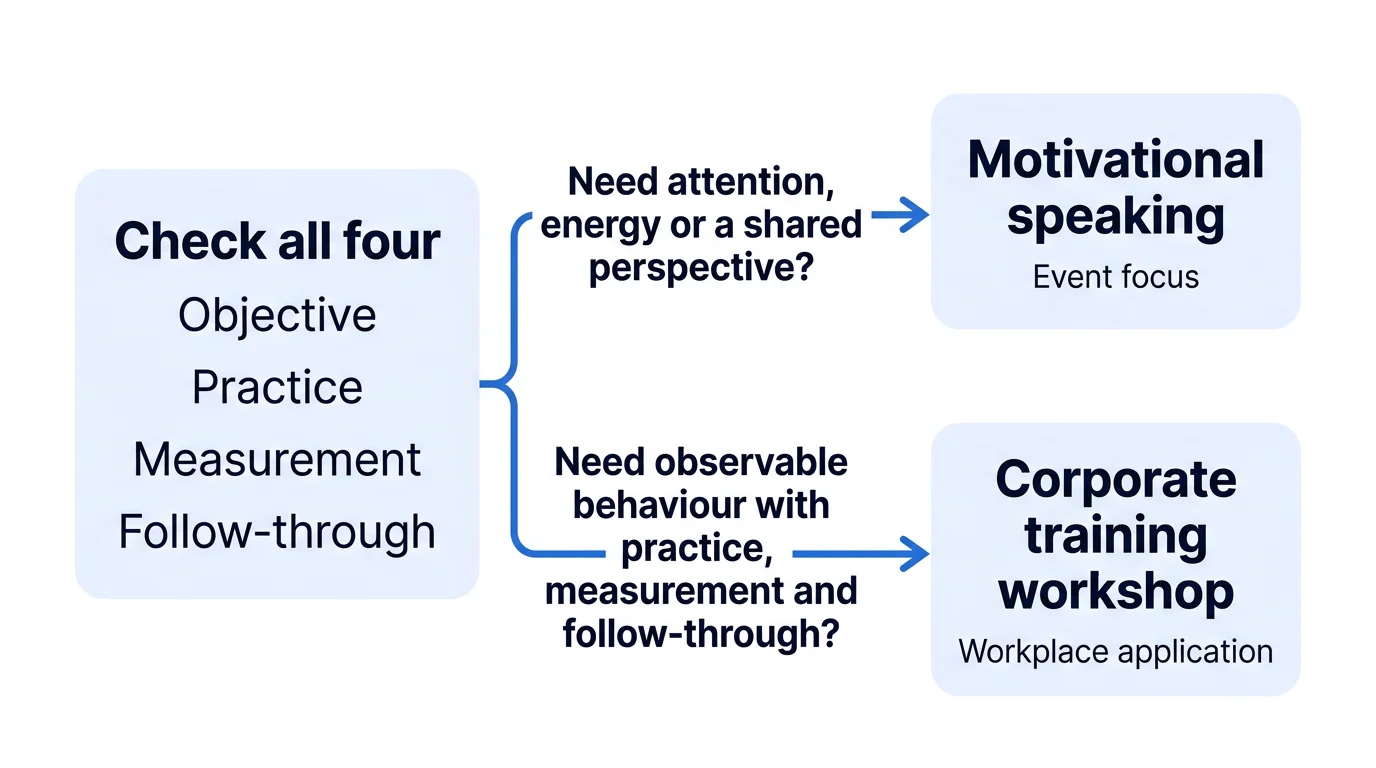
A workshop is not an organisational-change substitute
A 2024 systematic review covering 91 papers found that feedback or debrief, simulation or practice, and management support were among the most frequently examined factors in soft-skills transfer. The review, Making soft skills ‘stick’, supports a practical boundary: select a format for its immediate job, then address the conditions that allow people to use it at work.
For Rohini Mundra's documented communication, leadership and confidence themes, see Corporate Communication and Leadership Workshops for Indian Teams. Before requesting proposals, use the scope checklist in Corporate Training Cost in India to separate delivery, participant, logistics and follow-through decisions.
Our verdict
Choose motivational speaking for an event moment. Choose a corporate training workshop when the organisation can define a behaviour, build practice into the session and check whether that behaviour transfers into work.