
Glossary
Value Ladder
A value ladder is a sequence of offers rising in price and depth, from free to premium, so a buyer earns trust before a large purchase. Check each price step in rupees.

By Rohini Mundra, Founder · Updated 24 Oct 2026
On this page
- 01Definition
- 02Quick facts
- 03Introduction
- 04What is a value ladder, and what is it often confused with?
- 05What does a value ladder look like in rupees?
- 06Why does the first step of a value ladder cause most of the trouble?
- 07How do you check your own value ladder?
- 08How Rohini Mundra handles it
- 09Example
- 10Related terms
- 11Frequently asked
What is a value ladder?
A value ladder is the ordered set of offers a business sells, arranged by rising price and depth, so each rung is a sensible next step from the one below. It maps what you sell. It does not promise that buyers climb all of it.
Key takeaways
- The gap between rungs matters more than the number of rungs. A jump of hundreds of times from a promotional ₹99 workshop to a ₹21,999 programme leaves buyers no sensible next step.
- A ladder is a path, not a toll gate. A ready buyer can start at the top.
- Test your own ladder by dividing each price by the one below it, then running the five other checks below.
Quick facts
- Typical rungs
- Free content, a low-priced workshop, a core programme and a premium engagement
- Suggested step between rungs
- 2× to 10× (a rule of thumb, not an official standard)
- Often confused with
- Sales funnel, customer-value ladder and laddering in market research
- What the entry rung should do
- Solve one named problem in one sitting
Introduction
The gap between rungs is the part of a value ladder that is easiest to get wrong. Pair a ₹99 workshop with a ₹21,999 programme and the step is more than two hundred times, which leaves a buyer nothing sensible to say yes to in between.
Coaches, consultants and speakers in India usually add offers one at a time as ideas arrive: a workshop here, a mentoring package there, a retreat later. Months on, there are plenty of offers and no order, and a stranger cannot tell which one is meant for them.
That is why so many sellers ask whether a ladder is needed at all, or whether to sell the high-ticket (premium-priced) offer directly.
This entry defines the term, separates it from look-alike ideas, gives rupee prices and an illustrative ladder, and ends with a six-test check you can run on your own prices today.
What is a value ladder, and what is it often confused with?
A value ladder is the ordered set of offers a business sells, arranged by rising price and depth, so each rung is a sensible next step from the one below. Typical rungs are free content, a low-priced workshop, a core programme and a premium engagement. It maps what you sell. It does not promise that buyers climb all of it.
Three other ideas share the name or the shape:
- A sales funnel describes how strangers become buyers, from first contact to purchase. The ladder lists what they can buy.
- A customer-value ladder ranks what customers expect, would like and would love.
- Laddering, in market research, links product features to consequences and personal values.
This page covers the first meaning only.
What does a value ladder look like in rupees?
A value ladder in rupees runs from a free item to a paid workshop, then a group programme, then private coaching, each step priced 2× to 10× above the last. The table below is an illustrative ladder, not market data and not anyone's real prices. Its free first rung is often a lead magnet.
A value ladder with 2× to 10× steps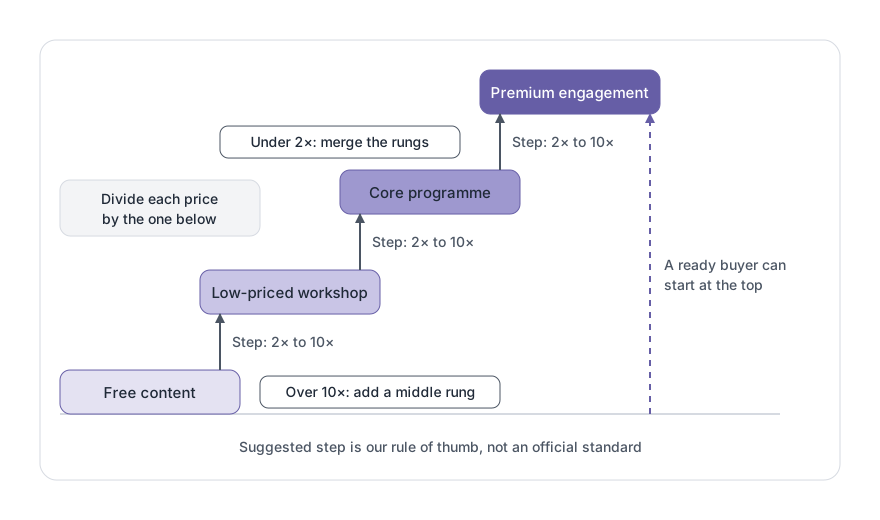
Some Indian coaches run ₹99 trial workshops as limited-time promotions. These are event promotions, not standing prices.
- Rung
- 1
- Offer
- Free checklist (a lead magnet, a free item offered in exchange for contact details)
- Price
- ₹0
- Step up
- Rung
- 2
- Offer
- Two-hour workshop
- Price
- ₹499
- Step up
- Rung
- 3
- Offer
- Group programme
- Price
- ₹2,999
- Step up
- about 6×
- Rung
- 4
- Offer
- Private coaching
- Price
- ₹24,999
- Step up
- about 8×
Why does the first step of a value ladder cause most of the trouble?
The jump from a token-price entry offer to the first real programme can be the widest on the whole ladder, and the buyer has nothing to say yes to in between. As an illustration, pair a ₹99 workshop with a three-day programme at ₹21,999 including Goods and Services Tax (GST). ₹21,999 divided by ₹99 is 222.2, so the step would be about 222 times.
The first step is where a ladder most often needs work. That view rests on this illustration and on the gap test below, not on a survey. A ₹99 buyer has shown interest, not readiness for ₹21,999. A middle rung of a few thousand rupees gives them something to say yes to.
Two habits make this worse:
- A cheap rung that repackages your whole system. The buyer has no reason to climb. The entry offer should solve one named problem.
- A cheap rung used mainly as a pitch. Buyers feel the low price was bait.
How do you check your own value ladder?
Run six tests. Each has a pass and a fail, and the bands in test 2 are a rule of thumb, not an official standard.
- List the rungs. Write every offer with its rupee price and the hours of your own time it takes. Pass: every offer is on the list. Fail: some offers are sold only by word of mouth.
- Divide each price by the one below. Pass: every step is 2× to 10×. Fail: under 2× (merge the rungs) or over 10× (add a middle rung).
- Skip test. Could a stranger buy your top offer without buying the bottom one? Pass: yes, and your page says who it is for. Fail: the top offer can only be reached through the cheaper ones.
- One-problem test. Does your entry rung solve one named problem in one sitting? Pass: yes. Fail: it is your whole system sold cheaply.
- Next-step test. Does each rung's delivery page or final message name the next rung and its price? Pass: yes, both. Fail: it names neither, or only one.
- Time test. Is your cheapest rung delivered to a group or recorded? Pass: yes. Fail: it takes one-to-one time at the lowest price.
Once the gaps are right, work on brand positioning, the choice of which buyer and problem you serve, so each rung names a different problem. For the top rung, see how to package, price and sell a high-ticket (premium-priced) service.
How Rohini Mundra handles it
Our offers run from group coaching workshops and seminars for coaches, speakers, leaders and entrepreneurs, to The Heart of Business group programme, to three-month private coaching. The Heart of Business is an interactive group program with personalised sessions. We also run a yearly 1:1 coaching mega event and the Brand New Brand You masterclass on building a memorable brand identity.
Current prices are on our programme prices page, and our business programmes page covers the business side. To talk through how your own offers fit together, use our contact form, email rohinimundra@rohinimundra.com or call +91 7760095707.
Example
Take the illustrative ladder above. Dividing ₹2,999 by ₹499 gives about 6×, and dividing ₹24,999 by ₹2,999 gives about 8.3×. Both steps sit inside the 2× to 10× band, so a buyer at each rung has a sensible next step.