
Glossary
Lead Magnet
A lead magnet is a free resource given in exchange for contact details, such as an email address. It only works when it matches one problem your paid offer solves.

By Rohini Mundra, Founder · Updated 23 Oct 2026
Also called freebie
On this page
- 01Definition
- 02Quick facts
- 03Introduction
- 04What is a lead magnet, and how is it different from free content?
- 05How to check a lead magnet idea before you build it
- 06What Indian data law requires when a lead magnet collects an email address
- 07A consent line you can adapt
- 08Where a lead magnet sits next to a landing page, a funnel and your website
- 09How Rohini Mundra handles it
- 10Example
- 11Related terms
- 12Frequently asked
What is a lead magnet?
A lead magnet is a free resource, such as a checklist or template, that a visitor receives only after giving contact details. The form is what separates it from free content.
Key takeaways
- Without the contact-details exchange, a free resource is just free content.
- Build one only if the idea solves one narrow problem and leads to one paid offer; a small list of the right people beats a large list of the wrong ones.
- Put the data you collect and why in the notice beside the form; the DPDP Rules, 2025 notice rule applies from 13 May 2027 and is not yet in force as of October 2026.
- Judge it by calls booked per 100 sign-ups. A booked call is a person who schedules a conversation with you.
Quick facts
- Also known as
- Freebie
- Common formats
- Checklist, template, quiz, short email course, recorded class
- Who it suits
- Coaches and consultants with a paid offer
- Key measure
- Calls booked per 100 sign-ups
- Indian notice rule applies from
- 13 May 2027 (DPDP Rules, 2025, Rule 3)
Introduction
Gating the guide behind a form is what turns a visitor into a lead, a person you can contact again by email or phone.
Coaches and consultants go wrong in two ways. The first is the offer. A free guide on a topic loosely related to what you sell fills a list with people who will never book a call. The second is the form. In India, a sign-up form collects personal data, and the Digital Personal Data Protection Rules, 2025 set out what the notice beside it must say.
This page gives a five-test check to run before you build anything, and a consent line you can adapt for your own form.
What is a lead magnet, and how is it different from free content?
A lead magnet can be a checklist, template, quiz, short email course or recorded class. If the same resource sits openly on your site with no form, it is free content: useful, but not a lead magnet.
Free content versus a lead magnet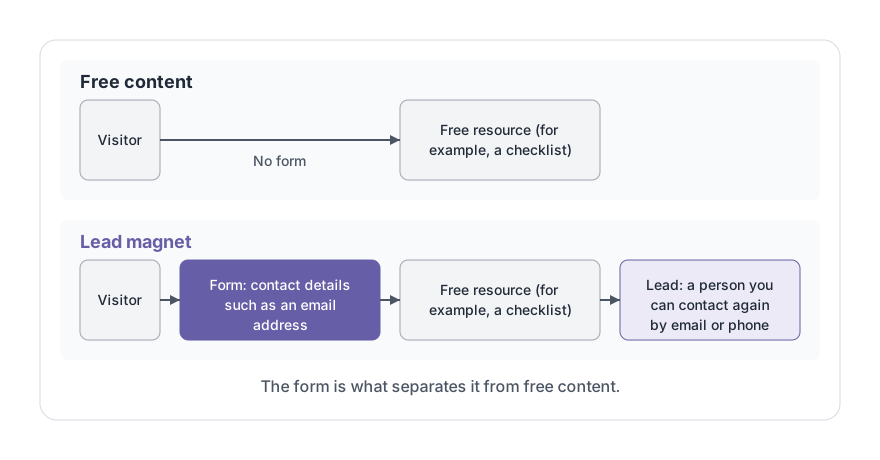
Some neighbouring terms are easy to mix up:
- Freebie: the everyday word for the same thing. On the form itself, name the resource for what it is ("a one-page checklist"), not "a freebie".
- Opt-in: the act of signing up, or the form that does it.
- Content upgrade: a lead magnet tied to one article, offering a deeper version of that article's topic.
- Sales funnel: the steps from first contact to purchase. A lead magnet is usually the first step.
How to check a lead magnet idea before you build it
Run five tests, each of which you can pass or fail in a few minutes. Build only an idea that passes all five.
Test 4 matters most. A topic that is merely popular fills the list with readers who do not need your service.
Then measure the result. Here is a worked example, an illustration with assumed numbers. Say 500 visitors see your form and 20% sign up, which is 100 sign-ups. If 5% of those book a call, that is 5 booked calls, or 5 calls booked per 100 sign-ups. If the list doubles to 200 sign-ups and still produces 5 booked calls, the rate falls to 2.5 per 100. The list is larger and worse. Track that rate, not the sign-up count.
- Test
- 1. Gate
- Pass
- A form stands in front of the resource.
- Fail
- It sits on a public page.
- Test
- 2. One problem
- Pass
- You can state the problem in one sentence with no "and".
- Fail
- You need two problems to describe it.
- Test
- 3. One sitting
- Pass
- Finished and used in about ten minutes, and delivered on the thank-you page or by email within five minutes.
- Fail
- Anything longer, or delivery after more than five minutes.
- Test
- 4. Offer match
- Pass
- You can complete this line truthfully: "Someone who downloads this has problem ___, and my paid offer ___ is the next step."
- Fail
- The blanks describe different problems, or you need the word "eventually".
- Test
- 5. Minimum data
- Pass
- Every field on the form is used in your first follow-up email.
- Fail
- A field has no use yet.
What Indian data law requires when a lead magnet collects an email address
From 13 May 2027, the DPDP Rules, 2025 require the notice you show before collecting data to be understandable on its own, to list the personal data you collect, to state the purpose, and to explain how to withdraw consent. This applies to a lead magnet form like any other.
The Rules were published in the Gazette on 13 November 2025, and Rule 1(4) brings Rule 3, the notice rule, into force eighteen months later, on 13 May 2027. In January 2026 the Ministry of Electronics and Information Technology (MeitY) floated cutting this to 12 months; as of 23 October 2026 no amending notification has been published, and the published timeline still shows May 2027.
Rule 3 asks for "an itemised description of such personal data" and "the specified purpose or purposes". It also asks for a way to withdraw consent "with the ease of doing so being comparable to that with which such consent was given". The Act itself requires consent to be "free, specific, informed, unconditional and unambiguous with a clear affirmative action". Any business that decides why and how personal data is used is a Data Fiduciary, the Act's term for the party responsible. The government's summary says the top penalty is up to ₹250 crore for failing to keep reasonable security safeguards; any other violation of the Act or Rules, which would include a defective notice, can attract up to ₹50 crore.
A consent line you can adapt
Here is a consent line built from those elements, to adapt. It is a drafting aid, not legal advice, so have a lawyer check your final wording.
[Business name] will use your name and email address only to send you the checklist and one email a week about [topic]. You can withdraw consent at any time by clicking "unsubscribe" in any email or writing to [your email]. ☐ Yes, send me the checklist and the weekly emails.
Leave the box unticked, so the sign-up is a clear affirmative action. Show the text beside the button, not buried in a policy page. Build it in now, so your form needs no rework when the rule starts.
Where a lead magnet sits next to a landing page, a funnel and your website
A lead magnet sits on a landing page, a single page built to get one action, here the form sign-up. That page belongs to a wider site; see website for coaches in India. After sign-up come the follow-up emails, which are covered in marketing automation: what to fix before you buy. If your paid offer is an expensive one, read how to package and sell a high-ticket service first, because the lead magnet should point at it.
A lead magnet succeeds or fails at two places: the offer behind it and the page that carries it.
How Rohini Mundra handles it
For the page and the emails around a lead magnet, Rohini Mundra offers Online Marketing, which means content-driven and targeted strategies to grow your business online, and Web Development, which means personalised, customer-centric website creation.
Example
A leadership coach sells a three-month programme to first-time managers. She offers a one-page agenda for your first one-to-one with a new team member, ready to use that day. It solves one problem and takes ten minutes to use. Her three-month programme covers the same problem in depth, so the next step is obvious.
Frequently asked
Sources
- 1.Digital Personal Data Protection Rules, 2025: Rules 1(3), 1(4) and 3 (Gazette text)
- 2.Press Information Bureau, Government of India: "DPDP Rules, 2025 Notified", 17 November 2025, Press Information Bureau, 2025-11-17
- 3.Digital Personal Data Protection Act, 2023: Section 6
- 4.MirvoLegal: DPDP Rules, 2025 compliance timeline, MirvoLegal, 2026-09
- 5.DPDP timeline, 2026-10-23