
Glossary
Unique Value Proposition (UVP)
A unique value proposition is a statement of the specific value you give a named customer that competitors do not, and why that difference is worth choosing you for.

By Rohini Mundra, Founder · Updated 24 Oct 2026
Also called UVP
On this page
- 01Definition
- 02Quick facts
- 03What does unique value proposition mean in practice?
- 04UVP vs USP, tagline and high-concept pitch
- 05What do Indian business-coaching websites lead with instead?
- 06How to test a unique value proposition before publishing it
- 07How Rohini Mundra handles it
- 08Example
- 09Related terms
- 10Frequently asked
What is a unique value proposition?
A unique value proposition (UVP) is a statement of the specific value a business creates for a named customer that competitors do not, and why that difference is worth choosing it for.
Key takeaways
- Settle the customer, the need and the relative price before you write the sentence.
- Do not lead with a rank, a size or a rating: a competitor could paste it onto their own site.
- Put the outcome in the buyer's words, ideally with a number.
- Run the five checks before the line goes on a homepage.
Quick facts
- Also known as
- UVP
- Rests on
- Which customers you serve, which of their needs you meet, and what relative price gives them acceptable value and you acceptable profit
- Often confused with
- Unique selling proposition (USP), tagline, high-concept pitch
- Suggested headline length
- About 120 characters (Ash Maurya, Lean Canvas)
- Where it goes
- The headline of a homepage or landing page, with one supporting sentence beneath
A buyer reading a coaching homepage wants to know what they get here that they cannot get elsewhere, and whether it is worth the price. A unique value proposition, usually shortened to UVP, is the written answer to that question.
The term causes trouble because it covers three things: a strategy decision, a line of marketing copy, and, loosely, a synonym for the unique selling proposition (USP). Founders searching for it are often stuck on the same points. They are too close to their own offer to see what makes it different, or they list features where the buyer wants a result.
This entry gives the meaning, separates the look-alike terms, shows what a sample of Indian service websites lead with instead, and hands you a five-part test you can run on your own line today.
What does unique value proposition mean in practice?
A unique value proposition (UVP) names the specific value you create for a specific customer and shows why a competitor does not create the same thing. A value proposition is the kind of value a company will create for its customers. It rests on three decisions: which customers you serve, which of their needs you meet, and what relative price gives them acceptable value and you acceptable profit (Harvard Business School, Institute for Strategy and Competitiveness).
"Unique" means your answers to those decisions differ from your competitors' answers. If they do not, you are competing on operational excellence (HBS ISC), which means executing the same offer better than rivals. The written version is the line a buyer reads: why your offer is different and worth paying attention to, built on the customer's main problem and the outcome they want (Ash Maurya, Lean Canvas).
UVP vs USP, tagline and high-concept pitch
A UVP gives the whole reason a customer should choose you. A USP is the single claim your competitors do not make. A tagline is a memorable phrase. A high-concept pitch is a comparison such as "Flickr for video".
The USP comes from advertising. Rosser Reeves formulated it in the early 1940s as a specific benefit that competitors cannot or do not offer and that is strong enough to move buyers (Wikipedia: Unique selling proposition). The Lean Canvas treats the high-concept pitch as a separate exercise that does not belong on a landing page (Ash Maurya, Lean Canvas). Some templates, including the business model canvas, use UVP and USP as one term (Wikipedia: Unique selling proposition), so check which one a template means before you copy it.
Positioning is the wider choice of where you sit in your market: see Brand Positioning. The one-line statement of who you are is covered in Personal Brand Statement.
- Term
- Unique value proposition
- What it is
- The whole reason a customer should choose you
- Term
- Unique selling proposition
- What it is
- The single claim your competitors do not make
- Term
- Tagline
- What it is
- A memorable phrase
- Term
- High-concept pitch
- What it is
- A comparison such as "Flickr for video"
What do Indian business-coaching websites lead with instead?
A reading of seven Indian business-coaching and corporate-training homepages in October 2026 found that five led with a rank, scale or rating rather than a customer result.
The homepages came from two searches: "business coach India for founders and service businesses homepage" and "corporate trainer India leadership training company official website". Seven homepages were read on 24 October 2026: the headline, subheadline, page title and meta description (the search-result summary). The coding rules were:
- "Names the customer" means the headline or opening lines name a customer group.
- "Number on the result" means a figure tied to the customer's outcome.
- "Rank, scale or rating" means a claim of position, size or score.
By those rules, four of the seven name a customer group, none puts a figure on the customer's result, and five lead with a rank, scale or rating.
This is a small sample from two searches, covering only the part of each page visible without scrolling, plus its title and description. It shows what these sites lead with, not how well they sell.
Three mistakes are common when founders write the line. A feature sits where a benefit belongs. The difference is one buyers do not pay for, so price decides. The founder describes the work instead of the buyer's result. A rank or size claim also fails because a competitor could say it too.
- Site
- JPCL Business Coaching (ActionCOACH, Delhi National Capital Region, NCR)
- Headline quoted
- "Build a Profitable, System-Driven, Scalable Business"
- Rank, scale or rating claim
- "#1 ActionCOACH Business Coaching Firm in Delhi NCR"
- Site
- Rahul Malodia
- Headline quoted
- "VYAPARI TO CEO"
- Rank, scale or rating claim
- "Best Business Coach in India" (page title)
- Site
- Mentora India
- Headline quoted
- "Soft Skills Corporate Training Companies & Leadership Training Companies in India."
- Rank, scale or rating claim
- "India's Leading Corporate Soft Skills Training Company"
How to test a unique value proposition before publishing it
To test a unique value proposition, write one line in the format below, then check that a stranger can name the buyer and need, the outcome is in the buyer's words, no competitor could paste it, buyers pay for the difference, and the price makes sense against the alternative.
The five-part UVP line and its five checks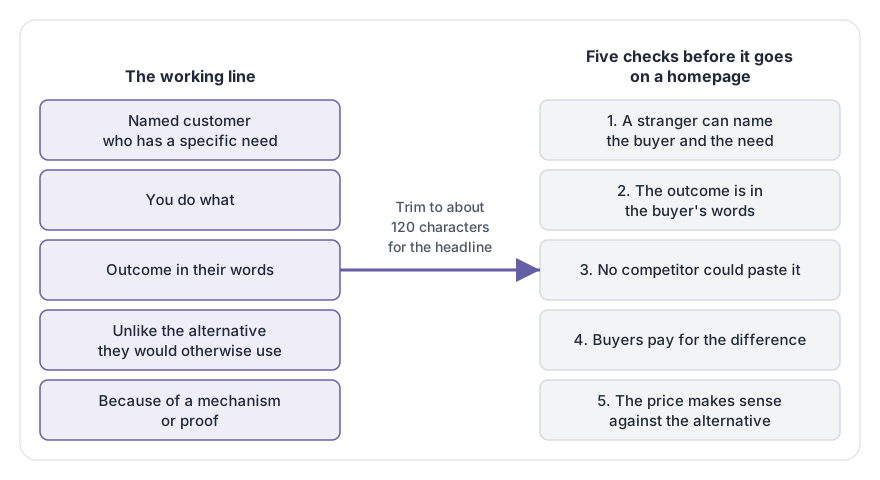
For [named customer] who [specific need], [you] [do what] so they get [outcome in their words], unlike [the alternative they would otherwise use], because [mechanism or proof].
This five-part line is a working draft. Trim it to a headline of about 120 characters (Ash Maurya, Lean Canvas).
Can a stranger name the buyer and the need?
Pass: at least four of five strangers in your target market, each reading the line once, name the customer and the need correctly. Fail: two or more say "everyone" or guess wrong. This threshold is a recommendation, not a measured standard.
Is the outcome in the buyer's words?
Pass: the result is something a buyer would say aloud, ideally with a number. Fail: it is a feature, a method name or an adjective such as "best".
Could a competitor paste it onto their site?
Pass: no, because it names a customer, an alternative or a mechanism only you have. Fail: yes. Rank, size, years in business and ratings all fail.
Do buyers pay for the difference?
Pass: you can name a recent buyer who chose you over an alternative because of it. If you have no buyers yet, pass only if three prospects say the difference would change their choice. Fail: the difference matters to you and buyers ignore it.
Does the price make sense against the alternative?
Pass: you can say where your price sits against what the buyer would otherwise use, and why. Fail: you cannot.
How Rohini Mundra handles it
Every check above depends on knowing your niche, your strengths and where you sit in the market. That is the ground we cover with coaches, speakers, trainers and business owners.
Our group coaching workshops help participants discover their niche, identify their strengths and turn their knowledge and experience into programmes and businesses. Our Meditation Brand New Brand You programme is a masterclass to build a unique, authentic and memorable brand identity, covering personal branding and positioning. See our programmes, then ask about current fees and fit at rohinimundra@rohinimundra.com or +91 7760095707, or use our contact form. Once your line is ready, How to Write an About Me Page shows where it belongs.
Example
This example is invented for illustration and is not a client result. Before: "Business coach for entrepreneurs in India." After: "For owners of small architecture studios in Pune who discount to win projects, [Name] runs a three-session quote review so they hold their price, unlike general business coaching, because every session works from the studio's own last five quotes." It names the buyer, the need, the outcome, the alternative and the mechanism. Add a real number once you have one.
Frequently asked
Sources
- 1.Unique Value Proposition, Harvard Business School Institute for Strategy and Competitiveness, Harvard Business School
- 2.What is Lean Canvas?, Ash Maurya, 22 February 2024
- 3.Unique selling proposition, Wikipedia
- 4.JPCL Business Coaching, 24 October 2026
- 5.Rahul Malodia, 24 October 2026
- 6.Mentora India, 24 October 2026
- 7.Indus Management Consultants, 24 October 2026