
Glossary
Landing Page
A landing page is a standalone web page where a visitor arrives after clicking an ad, email or link, built around one action such as registering for a workshop.

By Rohini Mundra, Founder · Updated 23 Oct 2026
On this page
- 01Definition
- 02Quick facts
- 03Introduction
- 04How a landing page differs from a homepage
- 05Terms that get mixed up with a landing page
- 06What a landing page for a workshop or programme needs
- 07How to test whether your page works as a landing page
- 08Do you need a landing page, a website or both?
- 09How Rohini Mundra handles it
- 10Example
- 11Related terms
- 12Frequently asked
What is a landing page?
A landing page is a standalone web page where a visitor arrives after clicking an ad, email or link, built to get one action such as registering for a workshop.
Key takeaways
- A homepage welcomes everyone and offers many routes. A landing page offers one.
- A workshop page needs eleven things, each with a pass or fail test, from the headline to the thank-you page.
- Three checks on a phone show whether your current page works as a landing page: link count, a five-second test and ad match.
Quick facts
- Page types
- Reference pages present information; transactional pages collect a sign-up, usually an email address
- Workshop page type
- Transactional
- Defined by
- Google: "the webpage where people end up after they click your ad"
- Links on the page
- As few as possible; zero site-menu links
Introduction
A workshop advert that lands on a homepage makes the visitor hunt for the workshop through a menu, a blog and a list of services. Each extra link is another chance to leave without registering.
The fix is smaller than a new website. It is one page with one job, written to match the message that brought the visitor there. A dedicated page shows the workshop headline, the date and time, and a form, with little else to click. A coach can run a whole launch on it.
Below you will find the plain definition, how a landing page differs from a homepage and a website, an eleven-point brief for a workshop or programme page, a test you can run on your current page in five minutes, and the prices providers in India list.
The word "coach" is used throughout, but the same page works for a trainer, consultant or speaker who is selling a seat or a call.
How a landing page differs from a homepage
A landing page is the page a visitor reaches after clicking an ad, email or link, and it is built to get one action. Google defines it as "the webpage where people end up after they click your ad". A homepage is the front door for everyone.
Homepage offers many routes; landing page offers one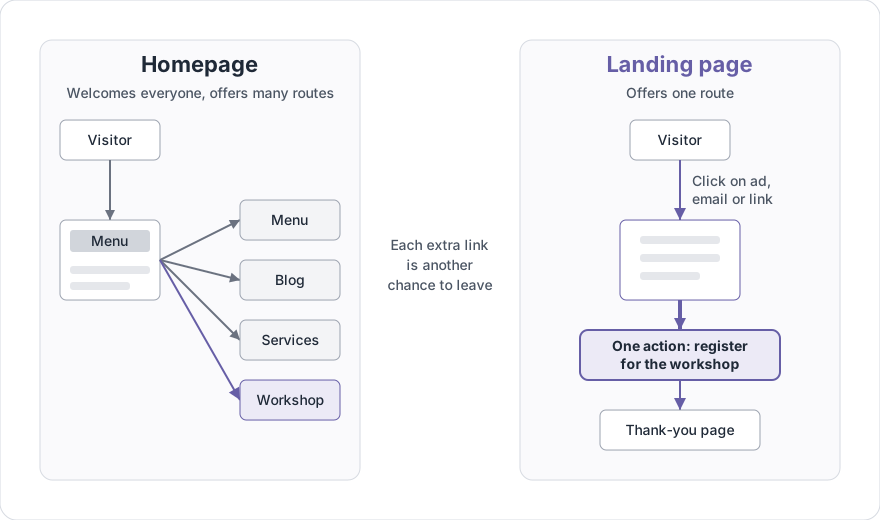
Landing pages come in two kinds. Reference pages present information. Transactional pages collect a sign-up, usually an email address. A workshop page is transactional.
- Aspect
- Who arrives
- Homepage
- Anyone
- Landing page
- Someone who clicked one ad, email or link
- Aspect
- Job
- Homepage
- Introduce the whole business
- Landing page
- Get one action
- Aspect
- Links
- Homepage
- Many
- Landing page
- As few as possible
Terms that get mixed up with a landing page
A landing page is one page, not a website or a domain, and a sales page is a landing page whose action is payment. A website is the whole set of pages. A domain is the web address you register. A lead magnet is a free resource offered in exchange for contact details. A call to action (CTA) is the button or line that asks for the action. A thank-you page is what the visitor sees after acting.
What a landing page for a workshop or programme needs
It needs eleven things, each with a test you can pass or fail.
Does your headline repeat the ad?
Pass: the ad's key phrase appears in the first line.
Does a stranger know who it is for?
Pass: one line says who the workshop is for, and a stranger can say "yes, me" or "no".
Are the date, time and format on the page?
Pass: date, time, length, online or city, and language are all shown, so nobody has to email to ask.
Do three outcomes say what attendees leave with?
Pass: each outcome can be checked afterwards.
Does the page prove who you are?
Pass: it names a result or credential you can show. A guide to writing an About Me page covers this block.
Is the price in rupees on the page?
Pass: the price is shown in rupees, stating whether GST (goods and services tax) is included, or the page says "free". Nobody has to ask the cost.
Is there one action?
Pass: one action (register, pay or book a call), one button, worded the same each time.
Is the form short?
Pass: name, phone and email, and you use every field you ask for. A WhatsApp or call option is another way to submit the same action, not a second one.
Are the likely questions answered?
Pass: two or three answers on refunds, recordings and missing the date, each in two sentences.
Is the site menu gone?
Pass: zero navigation links.
Does a thank-you page show the next step?
Pass: after submitting, the visitor sees what happens next.
For a high-ticket programme the action is often a conversation, not a payment. See how a high-ticket coach acquisition system works.
How to test whether your page works as a landing page
Run three checks on your current page, on a phone. Google Ads judges landing page experience on usefulness, ease of navigation, number of links and match to the ad (Google Ads Help). This test is built on those factors.
- Link count. Count every tappable link. Pass: two or fewer links (the action and a privacy link). Fail: three or more, or any site menu. This threshold is a recommendation; Google names link count as a factor but gives no number.
- Five-second test. Show the page to someone who does not know you for five seconds, then hide it. Pass: they can say the offer and the action.
- Ad match. Put the ad beside the page. Pass: the headline, price and date match. Fail: any mismatch.
Do you need a landing page, a website or both?
Start with a landing page if your visitors come from your own ads, WhatsApp, LinkedIn or email. Add a website when people begin searching for you by name and want to look around. That is a recommendation, and Website for Coaches in India covers the full build and cost.
When you compare providers' prices in India, compare what each includes, such as copywriting and tracking.
How Rohini Mundra handles it
Rohini Mundra works on the two things a landing page depends on: the website and the marketing that sends people to it. The Web Development service is website creation built around your customer and aimed at business results, run in 45 to 60-minute virtual sessions. The Online Marketing service is content-driven, targeted strategy to grow your business online.
Rohini Mundra also runs Group Coaching Workshops and Seminars for coaches, speakers, leaders and entrepreneurs. Questions about the website and marketing around your workshop, and about prices, can go through Contact Us, or to rohinimundra@rohinimundra.com and +91 7760095707.
Example
A coach runs an advert for a free 90-minute workshop on pricing a programme. The click lands on a page with that sentence as the headline, three outcomes, the date and time, and a three-field form. The same click on a homepage would leave the visitor to find the workshop themselves.
Frequently asked
Sources
- 1.Google Ads Help: Landing page definition, Google
- 2.Wikipedia: Landing page, Wikipedia