
Glossary
Keynote Speech
A keynote speech is the main talk at an event, setting its central theme for the whole audience, often in an opening or closing slot. Fame and slides do not define it.

By Rohini Mundra, Founder · Updated 23 Oct 2026
Also called Keynote address, Opening keynote or Closing keynote
On this page
- 01Definition
- 02Quick facts
- 03Introduction
- 04What makes a keynote different from any other talk?
- 05Keynote vs chief guest, guest speaker and TEDx talk
- 06Which five tests show that an invitation is really a keynote?
- 07What do new speakers charge for a paid talk in India?
- 08How Rohini Mundra handles it
- 09Example
- 10Related terms
- 11Frequently asked
What is a keynote speech?
A keynote speech, also called a keynote address, is a talk that establishes the main underlying theme of an event for everyone attending.
Key takeaways
- A keynote speech frames the whole event for the whole audience. It does not teach one topic in depth.
- It is a role in the programme, so read the programme before assuming a chief guest or guest speaker is giving the keynote.
- Ask the organiser for the slot in minutes, in writing, and whether Q&A and travel are covered.
- Run the five-test check on any invitation before you agree a fee.
Quick facts
- Also known as
- Keynote address; plenary session or invited talk at some conferences
- Typical length
- 30 to 60 minutes
- Usual slot
- Opening or closing, though large conferences add more keynotes in between
- Audience
- Every delegate, not one track
- Early paid talk in India
- ₹50,000 to ₹2,00,000 before travel and stay (October 2026, booking-site guides)
Introduction
Most people call any big talk by a well-known guest a keynote. Organisers use the word more narrowly. A keynote is the talk that tells everyone in the room why the event exists and how the other sessions fit together.
In India the confusion has an extra layer. A college seminar or conference inauguration can have a chief guest, a guest of honour and a keynote. Speakers get caught too, because a keynote invitation can mean very different things for preparation and fee.
A keynote frames the whole event, while the talks inside the sessions go deeper, and that difference decides how you prepare. If you want a way to open such a talk, see how to start a speech.
What makes a keynote different from any other talk?
Five points separate a keynote from other talks:
- It frames more than it teaches. Keynotes at an inaugural work at a high, broad level, while keynotes inside the sessions work closer to the ground.
- It speaks to the full room. A breakout session serves one track. A keynote serves every delegate.
- It is usually an opening or closing slot, though large conferences add more keynotes in between. Opening keynotes, closing keynotes and others can sit in the same programme.
- It runs about 30 to 60 minutes. That is the typical range for a keynote speech.
- It does not need a giant screen, slides or a celebrity. It needs a speaker willing to define the whole topic, not only their own corner of it.
Keynote vs chief guest, guest speaker and TEDx talk
A keynote is a speaking role with a job: set the theme. The look-alike roles have different jobs. One person can hold two roles, for example chief guest and keynote speaker, but only when the programme lists both. Read the programme before you assume.
- Term
- Keynote speech or address
- What it means
- Sets the main theme for the whole event
- Term
- Chief guest
- What it means
- The most important guest at a function (Gurushala)
- Term
- Guest of honour
- What it means
- The person in whose honour the ceremony or festivity is held (Gurushala)
- Term
- Guest speaker
- What it means
- A person invited to cover one topic in depth, usually inside a session
- Term
- Plenary session, invited talk
- What it means
- Conferences increasingly use these interchangeably with "keynote" (Wikipedia), so one can be a keynote under another name
- Term
- TEDx talk
- What it means
- One idea, typically 12 to 18 minutes (TEDxOmaha); that organiser aims for 8 to 10
Which five tests show that an invitation is really a keynote?
Run five yes-or-no tests on the invitation: four or five yeses mean a keynote. This check is built from the definition above.
Five yes-or-no tests for a keynote invitation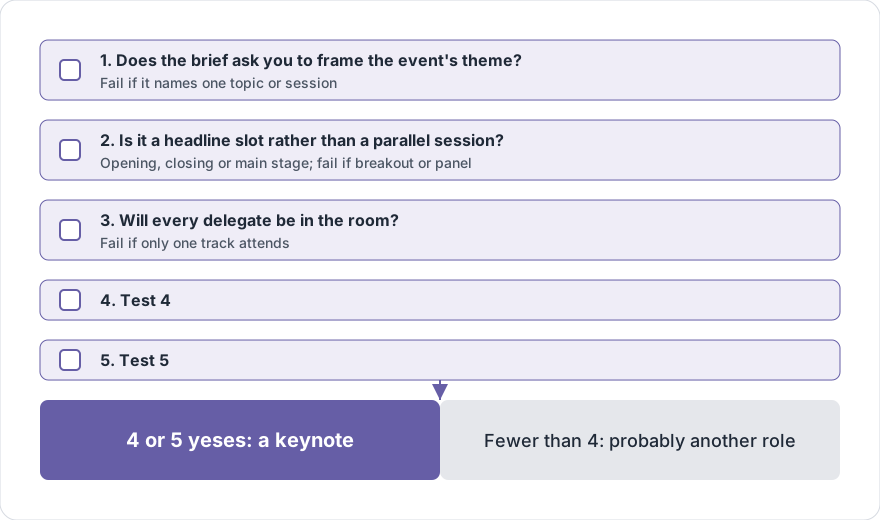
Does the brief ask you to frame the event's theme?
- Pass: the brief asks you to frame the event's whole theme.
- Fail: the brief names one topic or session.
Is it a headline slot rather than a parallel session?
- Pass: a headline slot on the main stage, before or after the other sessions, or an opening or closing slot.
- Fail: a parallel breakout or panel.
Will every delegate be in the room?
- Pass: every delegate is in the room.
- Fail: one track or one group.
Is the slot 30 to 60 minutes, in writing?
- Pass: a written slot of 30 to 60 minutes.
- Fail: shorter, longer or unstated.
Will the organiser build the other sessions around your theme?
- Pass: the brief says the organiser will build the other sessions around your theme.
- Fail: the brief names a topic only.
Score your yeses:
- 4 or 5 yeses: a keynote. Prepare a theme talk and price it as one.
- 2 or 3 yeses: a featured talk. Confirm the brief before you agree a fee.
- 0 or 1 yes: a guest session. Prepare for depth on one topic.
Before you say yes, also ask whether Q&A is inside the slot and who pays for travel and stay.
What do new speakers charge for a paid talk in India?
As of October 2026, an early paid talk in India is typically quoted at ₹50,000 to ₹2,00,000 before travel and stay. Three booking sites' guides support this. Each prices motivational speakers in general, not keynotes specifically. These are asking bands published by booking agencies, not invoices paid, so treat them as a guide. All three guides treat travel and stay as extra, so settle who pays before you accept.
- Fee guide
- StarClinch (24 January 2026)
- Entry tier
- Emerging / niche: ₹50,000 to ₹2,00,000
- Fee guide
- KeynoteSpeakerIndia (undated)
- Entry tier
- Motivational trainers and upcoming speakers: ₹50,000 to ₹1,00,000
How Rohini Mundra handles it
Rohini Mundra's Group Coaching Workshops-Seminars are interactive workshops and seminars designed to help coaches, speakers, leaders, entrepreneurs and professionals unlock their true potential. As of October 2026, the XtraOrdinary Speaker's Academy Masterclass is listed at ₹1,50,000 on its registration page; check the page for GST (goods and services tax) and current terms. Read more about the XtraOrdinary Speakers Academy, or compare public speaking coaches.
Rohini Mundra's TEDxDSCE talk, "Power of Rituals", is a TEDx talk, not a keynote.
Before you pitch for a keynote, get your speaker bio and your story structure in order. To talk through your situation, contact us.
Example
Take a two-day conference for small-business owners on growing online. The opening keynote does three things in about 30 minutes. It says why growth now depends on being found online. It names what the three tracks will cover. It leaves delegates with two questions to carry into every session. It does not walk through how to set up a profile or run an advert; a breakout does that. Delegates should leave knowing why they are there and what to listen for.
Frequently asked
Sources
- 1.Keynote, Wikipedia
- 2.TED Talk vs. Keynote Speech, TEDxOmaha
- 3.What is the difference between chief guest and guest of Honour?, Gurushala
- 4.Keynote addresses, Prasad Modak's blog, 15 March 2025
- 5.Motivational Speaker Fees in India: 2026 Budgeting Roadmap, Engage4more, 25 June 2026
- 6.Motivational Speaker Fee Brackets in India, StarClinch, 24 January 2026
- 7.Keynote Speaker Fees in India, KeynoteSpeakerIndia
- 8.Rohini Mundra projects
- 9.XtraOrdinary Speaker's Academy Masterclass registration page
- 10.TEDxDSCE talk "Power of Rituals"