
Glossary
Brand Audit
A brand audit is a structured review of what your brand says and what buyers actually see, used to find gaps in positioning, identity and visibility before you change anything.

By Rohini Mundra, Founder · Updated 24 Oct 2026
On this page
- 01Definition
- 02Quick facts
- 03What is a brand audit, and what are its two halves?
- 04Why most brand audit guides do not fit a solo expert
- 05How to run a brand audit on yourself
- 06What your brand audit score tells you to do next
- 07Brand audit vs related terms
- 08How Rohini Mundra handles it
- 09Example
- 10Related terms
- 11Frequently asked
What is a brand audit?
A brand audit is a review of how a brand is set up and how buyers see it, so gaps can be found before anything is changed. For a solo expert it ends in a short list of fixes.
Key takeaways
- The method has two halves: an inventory of what exists, and research into what buyers think. Both fit an individual.
- Checks 1 and 5 need client replies, so send those messages first and allow a few days.
- Your number of fails decides the next step: fix it yourself, rewrite the positioning sentence and then every profile, or rebuild positioning and identity.
- Each fail points to one fix: rewrite the positioning sentence, align the profiles, correct what search shows, or add checkable proof.
Quick facts
- Two halves
- A brand inventory (what exists) and a brand exploratory (what buyers think and feel)
- Format for one person
- Five checks, each ending in a pass or a fail
- Output
- A count of fails and a short list of fixes, not a report
- Not the same as
- A rebrand, a marketing audit or a website audit
- How often
- Once a year, and whenever your offer, role or audience changes
A brand audit built for a company needs employees, surveys and several departments. A solo coach, consultant or speaker has none of them, only a LinkedIn profile, a website, a bio and a handful of clients.
The method still works at that size. A brand audit has two halves: a list of what your brand is on paper, and a test of how buyers see it. For one person, both halves are small, and the output is a short list of fixes, not a report.
Of the five checks below, checks 2, 3 and 4 take about 45 minutes (an estimate). Checks 1 and 5 need replies from clients, so send those messages first and allow a few days. Client replies are the most reliable evidence a solo expert has, because they come from buyers who know your work. Each check ends in a pass or a fail, so you finish with a count rather than an opinion.
What is a brand audit, and what are its two halves?
A brand audit is "a systematic assessment of your brand as it exists now, to determine how well or poorly your current brand supports your vision and sense of self", in the words of Harvard Business School Online. In this guide, a brand audit has two halves: a brand inventory, which lists what exists, and a brand exploratory, which tests what buyers think and feel.
The two halves of a brand audit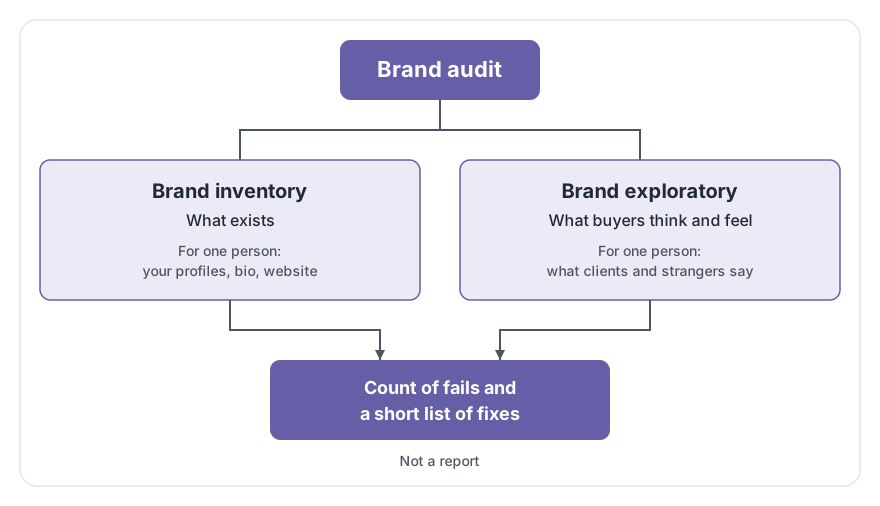
For a company, the inventory catalogues names, logos, packaging and pricing, and the exploratory is consumer research. For one person, the inventory is your profiles, bio, website and proposals, and the exploratory is a few honest conversations with buyers.
Why most brand audit guides do not fit a solo expert
Company brand audit guides assume employees, a survey budget and several departments. A solo expert has none of these, so needs a test that one person can run alone, with a pass line. Competitor matrices and employee surveys can wait until these five checks show a problem worth that effort.
How to run a brand audit on yourself
Send the client messages for checks 1 and 5 first, run checks 2, 3 and 4 while you wait, then count your fails. Checks 2, 3 and 4 inventory what exists and what a stranger finds. Checks 1 and 5 test how buyers see you.
Does your positioning survive three clients?
Write one sentence: who you help, what changes, and how. Send it to three past clients and ask how they would describe what you do. Pass: two of three use the same audience and result as your sentence. Fail: they describe something else. See brand positioning for how to write the sentence.
Do your profiles describe the same person?
Put your LinkedIn headline, website About page, speaker bio and latest proposal side by side. Pass: the same job title, the same one-line description, the same photo style. Fail: any two job titles differ. The guide to writing an About Me page fixes the page most often wrong.
Does a stranger find you by search?
In a private browser window, search your name, then your name plus your service. Pass: your own site or LinkedIn profile is in the top three results for both searches and no result lists a role or service you no longer offer. Fail: either condition is not met.
Can a stranger verify your proof?
Count dated, checkable proof on your site and profile: named testimonials, named client results, recorded talks, published work. Pass: at least three a stranger can check. Fail: fewer. The guide to building a personal brand on LinkedIn shows where proof sits.
Do buyers' reasons match your message?
Ask your last three buyers: "Why did you pick me, and what almost stopped you?" Pass: at least two give reasons that match your sentence from check 1. Fail: they praise something you never mention. Rewrite your personal brand statement around their words.
What your brand audit score tells you to do next
Your count of fails decides the next step. With zero or one fail, fix it yourself this month: one rewritten bio or one request for testimonials. With two or three fails where checks 1 and 2 do not both fail, rewrite your positioning sentence first, then every profile to match it. If checks 1 and 2 both fail, or four or five checks fail, rebuild positioning and identity; polishing profiles will not hold.
How Rohini Mundra handles it
If checks 1 and 2 both fail, Rohini Mundra rebuilds through Brand-new Brand YOU, a 40-day programme of simple, exact, actionable tasks for new speakers, trainers and coaches, including people without a first client. Stage 1 is called Decode Yourself, and the masterclass covers personal branding, positioning, visual identity and audience connection. Start from the programme page.
As of October 2026 the programme costs ₹1,50,000 (programme prices). Brand-new Brand YOU suits you if you are new to speaking, training or coaching and failed checks 1 and 2. If you already have clients, rewrite your positioning sentence yourself first.
Decode Yourself in 40 days.
Example
A leadership coach calls herself an "executive coach" on LinkedIn, a "leadership catalyst" on her website and an "organisational consultant" in proposals. Asked what she does, three clients each say she fixed how their leadership team runs meetings. The inventory finds three titles. The exploratory finds that buyers value something none of the titles names. The fix is one sentence built from her clients' words, then three profiles rewritten to match.
Frequently asked
Sources
- 1.Personal brand audit: definition and five steps, Harvard Business School Online, Harvard Business School Online, 29 July 2025
- 2.Brand-new Brand YOU programme page