
Glossary
Brand Archetypes
Brand archetypes are twelve human character types, such as Hero, Sage and Caregiver, that a brand borrows to fix its voice. Pick one lead type by testing it against what clients say.

By Rohini Mundra, Founder · Updated 24 Oct 2026
On this page
- 01Definition
- 02Quick facts
- 03The twelve types and where they come from
- 04Why client words beat a quiz
- 05How to find your lead archetype from what clients say
- 06Can you have more than one archetype, and do they hold up?
- 07Brand archetypes vs neighbouring ideas
- 08What to do with your archetype once you have chosen it
- 09How Rohini Mundra handles it
- 10Example
- 11Related terms
- 12Frequently asked
What are brand archetypes?
Brand archetypes are twelve human character types, such as Sage, Hero and Caregiver, that a brand adopts so it sounds and behaves consistently.
Key takeaways
- Find your lead type by tagging ten real phrases clients have used about you, not by taking a quiz.
- Use one lead type and at most one secondary. The lead passes when it has at least three of the ten phrases, and more than the none count; otherwise collect more phrases before you choose.
- An archetype is a lens for voice, not a strategy. Positioning and identity still have to be built on top of it.
Quick facts
- Number of types
- Twelve
- Origin of the brand version
- The Hero and the Outlaw (2001) by Margaret Mark and Carol S. Pearson
- Underlying idea
- Carl Jung's archetypes
- Evidence status
- A branding framework, not a validated scientific scale
- Best test
- Ten real client phrases, tagged and counted
A solo expert cannot pick a brand archetype from a logo wheel, because the brand is a person whose clients already describe how they come across. For a company, an archetype is a design choice. For a coach, speaker or consultant, it is a description of how you already sound, and you can check it.
This page defines the term, gives you a ten-phrase tally for finding your lead type, and shows where the result goes next.
The twelve types and where they come from
Twelve are in common use: Sage, Innocent, Explorer, Ruler, Creator, Caregiver, Magician, Hero, Outlaw, Lover, Jester and Regular Person (Wikipedia, Jungian archetypes).
The brand version comes from Margaret Mark and Carol S. Pearson's 2001 book The Hero and the Outlaw. It built on Pearson's 1991 book Awakening the Heroes Within (Wikipedia, Carol S. Pearson). Carl Jung supplied the underlying idea: archetypes are universal, inherited patterns present in the collective unconscious of all people (the collective unconscious is Jung's term for a layer of the mind shared by all people). He named figures such as the shadow and the wise old man, not these twelve.
Why client words beat a quiz
Quizzes ask how you see yourself. That is a start, but a voice only works when it matches how clients experience you. Their own words are better evidence than your self-image, and if you have clients, you already hold some of them: testimonials, messages, feedback forms.
That changes what a brand archetype is for. It is a vocabulary for naming the voice clients already respond to, so you can use it on purpose in your bio, your talks and your posts, instead of drifting between tones.
How to find your lead archetype from what clients say
Tag ten real phrases that clients, colleagues or audiences have used about you, then count. A quiz measures how you see yourself. This measures how you are seen, which is what your voice has to match.
From ten client phrases to a lead type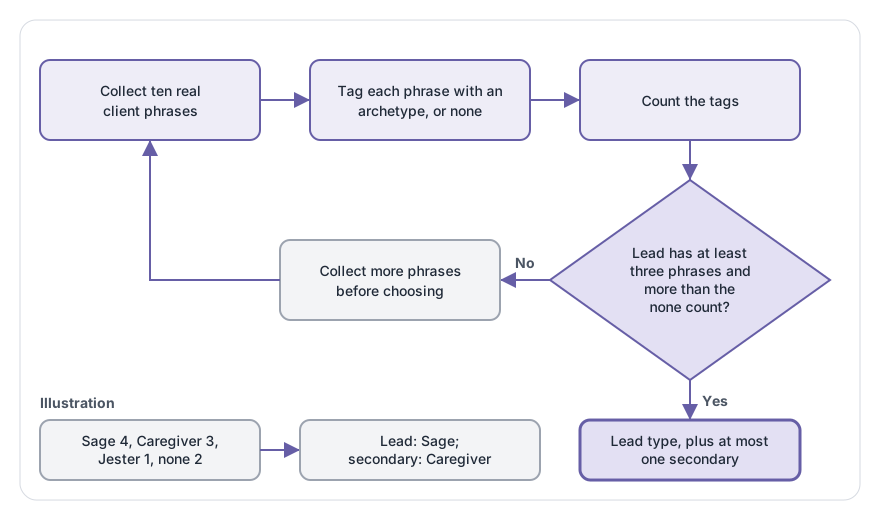
- Collect ten phrases. Use testimonials, WhatsApp messages, feedback forms and LinkedIn recommendations. Keep their exact words. Testimonials are phrases you chose to keep, so include critical or neutral feedback, not only praise. No clients yet? Use feedback from mentors, workshop attendees, colleagues or beta clients, and treat the result as provisional until you have ten client phrases.
- Tag each phrase with a type from the table. Tag it "none" if nothing fits.
- Count. The highest count is your lead type. The second highest is your secondary. If two types tie for first, collect five more phrases and recount.
- Run the pass test. Pass: the lead has at least three of ten phrases, and more than the none count. Fail: collect ten more phrases before choosing. This threshold is a rule of thumb, not a published standard.
- Write your voice card: how the voice sounds, how it never sounds, and what it opens with.
The client phrases in the table are examples.
- Type
- Regular Person
- Motivation group (Mark and Pearson)
- Belonging and enjoyment
- What it means
- Belongs by being relatable and unpretentious
- Client phrases that count as a match (examples)
- "treats you like an equal", "down to earth"
- Type
- Lover
- Motivation group (Mark and Pearson)
- Belonging and enjoyment
- What it means
- Builds closeness, warmth and personal attention
- Client phrases that count as a match (examples)
- "made me feel valued", "warm and personal"
- Type
- Jester
- Motivation group (Mark and Pearson)
- Belonging and enjoyment
- What it means
- Brings lightness and enjoyment
- Client phrases that count as a match (examples)
- "made it fun", "had us laughing and learning"
- Type
- Hero
- Motivation group (Mark and Pearson)
- Risk and mastery
- What it means
- Proves strength by mastering a challenge
- Client phrases that count as a match (examples)
- "pushed me to finish", "made me believe I could"
- Type
- Outlaw
- Motivation group (Mark and Pearson)
- Risk and mastery
- What it means
- Breaks rules and challenges the usual way
- Client phrases that count as a match (examples)
- "challenged the usual way", "said what others won't"
- Type
- Magician
- Motivation group (Mark and Pearson)
- Risk and mastery
- What it means
- Makes change feel possible
- Client phrases that count as a match (examples)
- "changed how I see it", "made the impossible feel doable"
- Type
- Ruler
- Motivation group (Mark and Pearson)
- Stability and control
- What it means
- Creates order, control and authority
- Client phrases that count as a match (examples)
- "brought order", "took charge of the room"
- Type
- Creator
- Motivation group (Mark and Pearson)
- Stability and control
- What it means
- Builds something new
- Client phrases that count as a match (examples)
- "made something new", "ideas I'd never seen"
- Type
- Caregiver
- Motivation group (Mark and Pearson)
- Stability and control
- What it means
- Protects and looks after others
- Client phrases that count as a match (examples)
- "felt looked after", "stayed with me till I was okay"
- Type
- Innocent
- Motivation group (Mark and Pearson)
- Independence and fulfilment
- What it means
- Keeps things simple, honest and optimistic
- Client phrases that count as a match (examples)
- "simple and honest", "kept it clean and trustworthy"
- Type
- Sage
- Motivation group (Mark and Pearson)
- Independence and fulfilment
- What it means
- Seeks and shares truth and understanding
- Client phrases that count as a match (examples)
- "clear thinker", "explained it so I understood"
- Type
- Explorer
- Motivation group (Mark and Pearson)
- Independence and fulfilment
- What it means
- Seeks freedom and new ground
- Client phrases that count as a match (examples)
- "opened new ground", "took me somewhere new"
Can you have more than one archetype, and do they hold up?
Use one lead type and at most one secondary. The twelve types are a framework, not a validated scale, so test your pick against client words. The recommendation is not to blend three or four, because a voice that tries to be everything stops sounding like anyone. The ten-phrase tally gives you the evidence for the split.
On reliability, be straight with yourself. The twelve types come from a 2001 book. The Drum's opinion piece of 8 April 2025 concedes that brand archetypes are pseudoscience, and argues they can still be useful as a creative tool. The view here is that they work as a shared vocabulary for choosing a voice, and they fail when used as proof of who you are. That is why the tally starts from client words.
Brand archetypes vs neighbouring ideas
Brand archetypes are easy to mix up with five neighbouring ideas.
- Buyer persona: a profile of your typical customer. An archetype describes you.
- Brand voice: how you write and speak. An archetype is one input to it.
- Brand identity: the whole visual and verbal system. Your voice card is one part.
- Brand positioning: the place you hold against alternatives in a buyer's mind. An archetype does not decide who you serve or what you promise.
- Personal brand statement: one line about who you help and how. Your lead type helps you word it.
- Aspect
- What it is
- Brand archetype
- A character type a brand adopts so it sounds and behaves consistently
- Buyer persona
- A profile of your typical customer
- Brand voice
- How you write and speak
- Brand positioning
- The place you hold against alternatives in a buyer's mind
- Aspect
- Relation to an archetype
- Brand archetype
- The archetype describes you
- Buyer persona
- Describes the customer, where an archetype describes you
- Brand voice
- An archetype is one input to it
- Brand positioning
- An archetype does not decide who you serve or what you promise
What to do with your archetype once you have chosen it
Use your lead type and voice card to write your positioning (who you serve, against whom) and your identity (how that looks and sounds). Without them, voice choices are guesses; with them, they are checkable. For what an expert needs in place first, see the guide to personal branding services.
How Rohini Mundra handles it
Brand New Brand You is Rohini Mundra's 40-day programme for establishing your name. It breaks the work into simple, exact steps you can do immediately, and is built for aspiring speakers, trainers and coaches who are new and need their first clients. As of October 2026 it costs ₹1,50,000, and you can ask whether it fits where you are.
Example
Illustration (invented for this page, not a real client). A corporate trainer tags ten phrases: four point to Sage, three to Caregiver, one to Jester, two to none. The lead is Sage and the secondary is Caregiver, and the lead passes the test.
Frequently asked
Sources
- 1.Wikipedia, Jungian archetypes, Wikipedia
- 2.Wikipedia, Carol S. Pearson, Wikipedia
- 3.Yes, brand archetypes are pseudoscience. Does that make them completely useless?, The Drum, 2025-04-08
- 4.Brand New Brand You, 2026-10