

TL;DR
We show how an established coach or consultant can pursue ₹1 crore in gross revenue without full-time employees, using a model that separates delivery from calendar hours. We compare four delivery models, test capacity math, identify the minimum systems and fractional support, and lay out a 90-day pilot that protects client outcomes.
Professional coaching is a crowded, expanding field. The ICF study counted 122,974 coach practitioners worldwide in 2025, which makes a clear offer and sustainable delivery model more important than simply adding more appointments.
A coaching business without employees can pursue ₹1 crore, but only when revenue no longer rises one-to-one with the founder’s calendar. We need a focused premium offer, cohort or reusable delivery, automated administration, and tightly scoped external support. The real limits are delivery capacity, operational complexity, and client outcomes, not payroll alone.
We will compare four models, show the capacity math to test before scaling, map the minimum operating system, and set out a ninety-day transition that does not assume demand will appear on command.
Can a Coaching Business Without Employees Reach ₹1 Crore?
We treat ₹1 crore as annual gross revenue, not profit, personal income, or proof that a particular model will work. The distinction matters because a business can have no employees while still carrying software, payment, acquisition, contractor, tax, refund, and founder-time costs.
The first question is therefore not, “How do we hire less?” It is, “Which constraint is stopping revenue from growing without lowering delivery quality?” A full calendar is usually a capacity signal, not a cue to add more private calls. Use our calendar ceiling diagnostic before deciding whether the real problem is pricing, demand, positioning, administration, or delivery design.
A lean model can work when the offer is narrow enough to repeat, the client group shares a meaningful problem, and the founder can protect the moments that require judgement. It becomes fragile when every client receives a different process, every sales conversation needs reinvention, or every community question needs an immediate founder response.
Compare Lean Coaching Business Models Before Choosing One
We do not recommend selecting a model because it looks scalable from the outside. The right choice depends on how similar clients are, how much live judgement their progress needs, how reliably leads arrive, and how much of the delivery process can be standardised without making the experience generic.
The scoring below is our decision framework, not an industry benchmark. A score of one means lower demand on that dimension, while five means higher demand.
| Model | Founder Hours | Client Intimacy | Recurring Operational Load | Margin-Input Exposure | Team Dependence | Main Constraint |
|---|---|---|---|---|---|---|
| Premium One-to-One Coaching | 5/5 | 5/5 | 2/5 | 1/5 | 1/5 | Founder calendar |
| Cohort Coaching | 3/5 | 3/5 | 3/5 | 2/5 | 2/5 | Group fit and participation |
| High-Ticket Digital Programme | 2/5 | 2/5 | 4/5 | 4/5 | 2/5 | Support and outcome quality |
| Hybrid Cohort Plus Selective Private Work | 3/5 | 4/5 | 4/5 | 3/5 | 3/5 | Operating discipline |
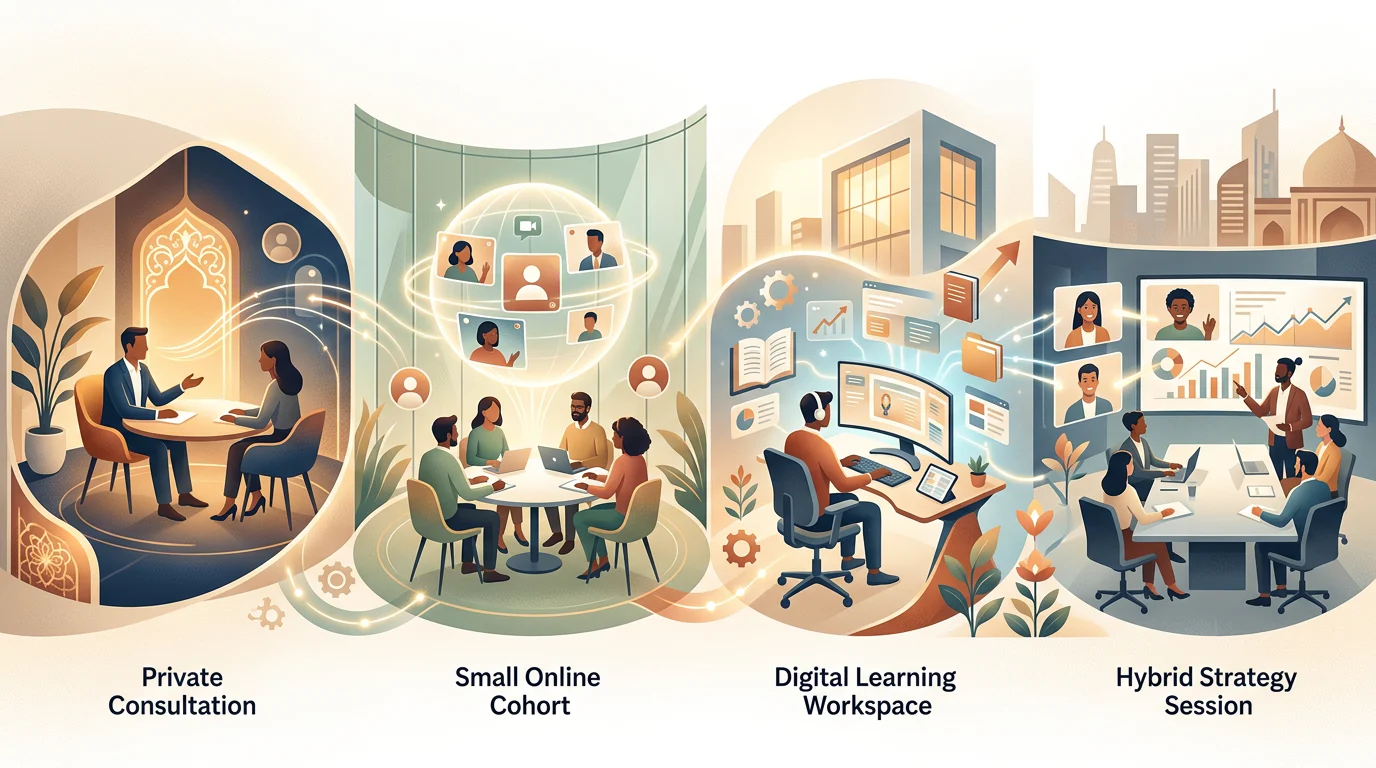
Preserve One-to-One Work Where It Creates Distinct Value
Private coaching is strongest when the client needs diagnosis, confidential judgement, or decisions that cannot be usefully standardised. It is weakest when we repeat the same education, prompts, templates, and accountability cycle separately for every client.
We would keep a selective private layer for complex cases and convert only the repeatable middle of delivery into a shared structure. Our lean model comparison helps established service founders decide whether that transition fits their current stage.
Use Cohorts When Clients Share the Same Milestones
A cohort works when clients can move through a common sequence while still receiving meaningful attention. Shared calls, peer learning, office hours, worksheets, and milestone reviews can increase value without requiring the founder to repeat the entire process in separate appointments.
The risk is putting unrelated clients into one group simply to improve the maths. If their starting points, urgency, or goals differ too widely, the group becomes harder to facilitate and client outcomes can suffer.
Treat Digital Delivery as a Product, Not an Escape from Service
A high-ticket digital programme reduces live delivery only when clients can make progress through a tested curriculum, clear milestones, and deliberate support boundaries. Recording material does not eliminate questions, onboarding issues, accountability needs, or the responsibility to notice when a client is stuck.
A hybrid model is often more realistic for an established coach or consultant: reusable learning and a cohort structure handle repeatable work, while selective private access protects the high-value moments.
Turn ₹1 Crore into Capacity Math, Not a Promise
The useful revenue target is ₹10,000,000 per year. We use that fixed number to expose the assumptions underneath a growth plan, rather than presenting a price point, conversion rate, or client count as if it applies to every coaching business.
Start with the revenue equation: annual client count × annual revenue per client = annual gross revenue. Then add the time equation: clients × live sessions × session length + preparation + support + sales + administration = founder workload. If the workload cannot fit inside the founder’s intended working capacity, the model is not lean, regardless of the revenue target.
Use a Scenario Calculator with Clear Inputs
| Calculator Input | What We Verify Or Assume | Why It Matters |
|---|---|---|
| Annual Revenue Target | Verified target: ₹10,000,000 | Keeps the model anchored to the stated goal |
| Programme Price | Assumption selected by the founder | Determines required client or enrolment count |
| Private Client Count | Assumption based on delivery capacity | Shows whether private work consumes the calendar |
| Cohort Size And Frequency | Assumption based on client fit | Tests leverage without disguising support load |
| Founder Live Hours | Assumption capped before launch | Protects time for sales, preparation, and recovery |
| Support, Refund, And Acquisition Costs | Assumptions tracked separately | Prevents gross revenue from being mistaken for margin |
Test Each Model Against Its Hidden Work
For one-to-one work, divide the annual target by the annual value of one private engagement, then calculate every session, follow-up, preparation block, reschedule, and sales conversation needed to support that client count. The result often explains why a calendar can feel full before revenue reaches the intended level.
For a cohort, multiply planned cohort size by price and number of cohorts, then calculate live sessions, office hours, onboarding, participant support, attendance management, and post-programme review. For a digital or hybrid offer, include platform support, client engagement, and outcome review rather than assuming recorded material has no operating load.
We recommend using this capacity diagnosis before adding a new offer. It is better to find an impossible workload in a spreadsheet than during a demanding launch.
Build Lean Systems Before You Create More Demand
A lean business needs fewer tools than a large company, but it still needs one reliable path from enquiry to measurable client outcome. We would build the operating system around seven jobs: lead capture, sales, onboarding, scheduling, delivery, support, measurement, and improvement.
The ICF ethics code calls for clear agreements, confidentiality, appropriate record handling, and responsibility for support personnel. That makes a basic system more than an efficiency project. It protects the client experience as work moves beyond one person’s inbox.
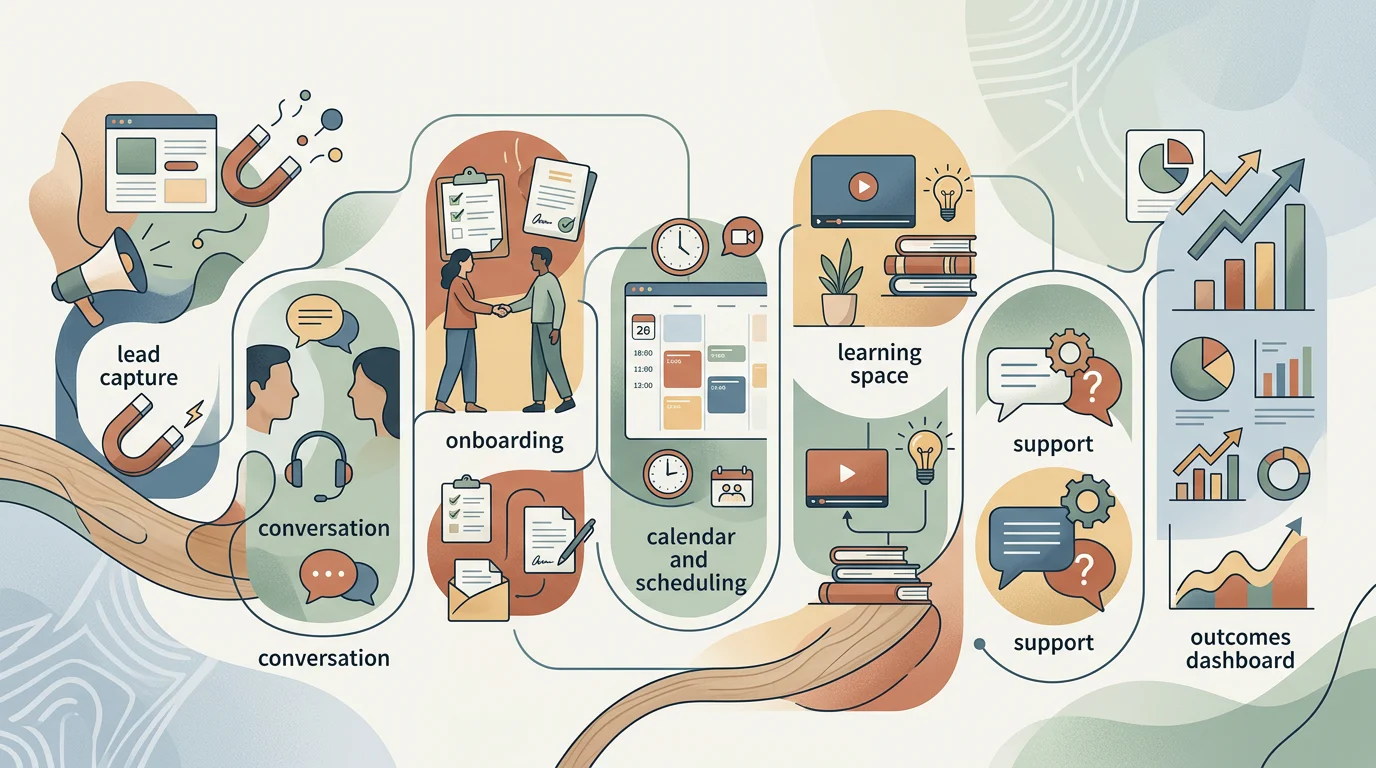
Automate Workflow, Not Judgement
| Task | Best Default Owner | Safeguard |
|---|---|---|
| Payment Reminders And Receipts | Automation | Founder handles exceptions |
| Scheduling And Attendance Reminders | Automation | Clear rescheduling rules |
| Offer Fit And Client Diagnosis | Founder | Defined qualification criteria |
| Welcome Sequence And Access | Automation With Review | Check first-cohort completion |
| Cohort Delivery And Outcome Review | Founder | Document milestones and escalation |
| CRM Updates And Inbox Triage | Virtual Assistant | Restricted access and response rules |
| Specialist Implementation | Contractor Or Fractional Support | Written scope and quality review |
India’s official 2023 to 2024 survey found that 26.7% of unincorporated establishments used the internet for entrepreneurial purposes. The official survey is not a coaching statistic, but it reinforces why reliable digital operations should be designed deliberately rather than assumed.
The founder should continue to lead positioning, nuanced sales conversations, client diagnosis, sensitive escalations, and outcome review. We can automate confirmation emails, reminders, access, receipts, routine data collection, and repeatable follow-ups after those steps are stable.
For a deeper look at whether the real issue is effort or process design, use our bottleneck diagnostic.
Add Fractional Support Without Quietly Building a Team
No employees does not mean no help. It means we choose support based on the decision risk, confidentiality requirement, and consistency of the work rather than adding permanent payroll because the founder is overwhelmed for one month.
A virtual assistant suits repeatable administration. A contractor suits a bounded specialist task. A fractional specialist suits ongoing expertise that is valuable but does not justify a full-time role. A delivery partner is the most sensitive option because they directly affect client outcomes and brand trust.
Choose Support by Task, Not Job Title
- Virtual assistant: Use for scheduling, payment follow-up, CRM hygiene, event logistics, and routine inbox triage.
- Contractor: Use for a clearly scoped build, such as editing, design, technical implementation, or reporting.
- Fractional specialist: Use for recurring operations, finance, technical, or growth judgement that needs senior expertise but not daily employment.
- Delivery partner: Use only after we have documented the method, quality standard, client boundary, and escalation path.
The red flags are founder-dependent communities, constant live launches, sales systems that require aggressive handoffs, and over-automated delivery that hides struggling clients. Each can produce revenue while making the business less sustainable.
We would use lean-team support to decide what to delegate first, then add permissions, documented workflows, weekly review, and a clear route back to the founder for decisions that affect the client relationship.
Create a Ninety-Day Transition Without Assuming Demand
We prefer a small, evidence-led pilot to a sudden rebuild. The goal of ninety days is not to guarantee revenue. It is to discover whether a defined group, offer, delivery sequence, and operating model can work without turning the founder into a full-time event manager.
Set decision gates before the pilot begins. We should know the minimum participation, attendance, client progress, and founder-hour limits that would justify repeating the offer. If the evidence does not meet those conditions, revise or pause instead of layering on paid acquisition, a sales team, or additional delivery support.
Follow the Thirteen-Week Checklist
| Week | Focus | Evidence To Capture |
|---|---|---|
| 1 | Baseline revenue, clients, and founder hours | Current constraint |
| 2 | Identify the bottleneck | Demand, conversion, delivery, or administration |
| 3 | Define one repeatable client problem | Eligibility and outcome boundary |
| 4 | Interview suitable clients | Language, objections, and milestones |
| 5 | Design a fixed pilot | Group fit, scope, and capacity cap |
| 6 | Build onboarding and agreements | Completion and access flow |
| 7 | Invite qualified prospects | Lead source and sales objections |
| 8 | Deliver the first module | Attendance and engagement |
| 9 | Review client progress | Support and delivery bottlenecks |
| 10 | Document repeated work | Automation candidates |
| 11 | Add stable operating rules | Escalation and response standards |
| 12 | Review time and cost inputs | Actual operating load |
| 13 | Decide whether to repeat, revise, or pause | Evidence against pre-set gates |
This approach keeps the founder close enough to hear what clients need while making repeated work visible. If the business is already beyond an early pilot, our growth-stage coaching guide can help frame the next decision around the actual constraint rather than a generic scaling playbook.
Work with Rohini Mundra
At Rohini Mundra, we work with established coaches and consultants who have proof of demand but need a business model that does not turn every new client into another hour on the calendar. We start by identifying the constraint, whether it is offer design, sales qualification, delivery capacity, client retention, or operating complexity. Then we help you choose one testable leveraged offer, define its economics and boundaries, and build only the systems and scoped support that protect client outcomes. Our work is practical: we use your current revenue, commitments, and available hours instead of borrowed funnel targets. If private delivery remains the best fit, we will say so. If a cohort or hybrid model is justified, we will help you pilot it before expanding it. We are here to make the next decision clearer, not to prescribe a larger team. Talk With Rohini Mundra
FAQs on Coaching Business Without Employees
We answer the practical questions that matter before changing a delivery model. Each answer assumes that client outcomes and founder capacity matter as much as revenue.
Can a Coaching Business Without Employees Reach ₹1 Crore?
Yes. It requires an offer, price, client volume, delivery schedule, support load, and costs that work together. We treat ₹1 crore as gross revenue, not a guarantee.
How Many Clients Does a Solo Coach Need?
The client count depends on price and model. Our calculator compares private engagements, cohort seats, and hybrid revenue, then tests live delivery and support hours.
Is Cohort Coaching Better Than Private Coaching?
Cohorts are better when clients share a clearly defined problem, starting point, and milestone path. We keep private coaching for complex diagnosis and high-stakes decisions.
Which Tasks Should a Founder Automate?
We automate scheduling, reminders, payments, access, and routine reporting. We keep discovery, offer fit, nuanced coaching, outcome review, and sensitive escalations under careful founder direct oversight.
When Should a Coach Use Fractional Support?
We use a virtual assistant for repeatable administration, contractors for bounded specialist work, and fractional specialists for recurring expertise that does not justify a full-time role.