Lean-Scale Coaching for ₹50-Lakh Service Founders: Which Model Helps?


TL;DR
We help ₹50-lakh service founders choose lean-scale coaching that removes the real constraint before they hire more people or add more marketing. This guide shows how we diagnose capacity, design repeatable workflows, choose between automation, contractors, and employees, and assess coaching support by evidence.
At ₹50 lakh in annual revenue, a service business remains well below India’s current ₹10 crore turnover ceiling for a micro enterprise, provided it also meets the investment criterion. That makes careful capacity design more useful than copying a large-company hiring plan. Udyam guidance
A ₹50-lakh founder seeking more capacity without a large team needs lean-scale coaching for ₹50-lakh service founders: help redesigning the offer, standardising delivery, automating repeatable work, and assigning bounded specialist tasks without adding unnecessary management layers. The right program diagnoses the current constraint before recommending employees, advertising, or a more complex funnel.
We will show how to select the right coaching type, diagnose the bottleneck, choose a leverage path, make a resourcing decision, and assess whether a program can actually help you operate more leanly.
What Kind of Coaching Does a ₹50-Lakh Founder Actually Need?
We start with the bottleneck, not the label on the program. A founder with weak demand needs a different intervention from one whose delivery calendar is full, and neither problem is solved automatically by joining a community, adding a sales script, or buying another tool.
| Coaching Type | Primary Job | Use It When | Poor Fit When |
|---|---|---|---|
| Startup coaching | Test customer, problem, and offer fit | Your offer is inconsistent or unproven | Demand and delivery are already proven |
| Scale-up coaching | Remove the constraint limiting repeatable growth | Capacity, systems, or role design cap revenue | One measurable marketing issue is the only problem |
| Marketing coaching | Improve positioning, demand, lead quality, and conversion | Qualified lead flow or conversion is weak | Fulfilment is already overloaded |
| Operations coaching | Standardise delivery, workflow, quality, and margin | Founder time and fulfilment complexity are high | The offer itself is unclear |
| Executive coaching | Improve founder decisions, delegation, and leadership | The founder is the decision or management bottleneck | A missing workflow needs an operator |
We also separate operating models from coaching types. A team-heavy model can use paid acquisition, sales calls, account management, and specialist delivery. A founder-heavy model can rely on the founder’s expertise, live teaching, email, community, and personal trust. Lean scale sits between them: we keep strategic judgement founder-led, then document, automate, or delegate the work that should not require the founder every time.
Coaching is a broad category, which is why buyers need this distinction. In the 2025 global study, 60% of coaches also provided training, 57% consulting, 55% facilitation, and 49% mentoring. We use that overlap as a reason to ask precisely what work will happen in your business. ICF study Our support formats guide can help clarify whether private coaching is the right format before you choose a provider.
Which Constraint Should You Fix Before Adding People or More Acquisition?
A founder does not need an industry-average benchmark to find the next constraint. We need a four-week view of the business: calendar time, lead source, sales pipeline, direct delivery costs, client mix, and the exceptions that keep appearing in client work.
| Factor | Evidence to Collect | What a Weak Result Means | First Response |
|---|---|---|---|
| Offer repeatability | Share of work sold from a defined scope | Bespoke delivery is consuming capacity | Narrow and productise the offer |
| Gross margin | Revenue less direct delivery costs | More sales may create more workload, not profit | Reprice, redesign scope, or remove manual steps |
| Founder delivery time | Weekly client-delivery hours | The founder is the throughput limit | Standardise or delegate a bounded task |
| Lead quality | Qualified leads divided by total leads | More traffic may worsen sales effort | Tighten qualification and positioning |
| Conversion | Closed opportunities divided by qualified opportunities | A sales message or process constraint exists | Review offer, proof, and proposal flow |
| Fulfilment complexity | Handoffs, exceptions, and revision loops | The process is not ready to automate | Create a standard operating procedure first |
| Client concentration | Revenue share from the largest clients | Revenue risk limits safe fixed hiring | Diversify the pipeline before adding fixed cost |
India’s MSMEs contribute nearly 30% of GDP and employ more than 230 million people, but those sector figures do not tell us what your next hire should be. We treat your own data as the decision-maker, especially when a founder is already doing meaningful revenue without a large management layer. WEF report
If gross margin is healthy but your calendar is full, the problem is capacity. If the calendar is open but qualified opportunities are thin, it is likely positioning or demand. If delivery creates repeated exceptions, hiring more people can multiply the disorder. Our consulting plateau guide provides a useful companion check.
How Can Lean-Scale Coaching Create Capacity Without a Full Team?
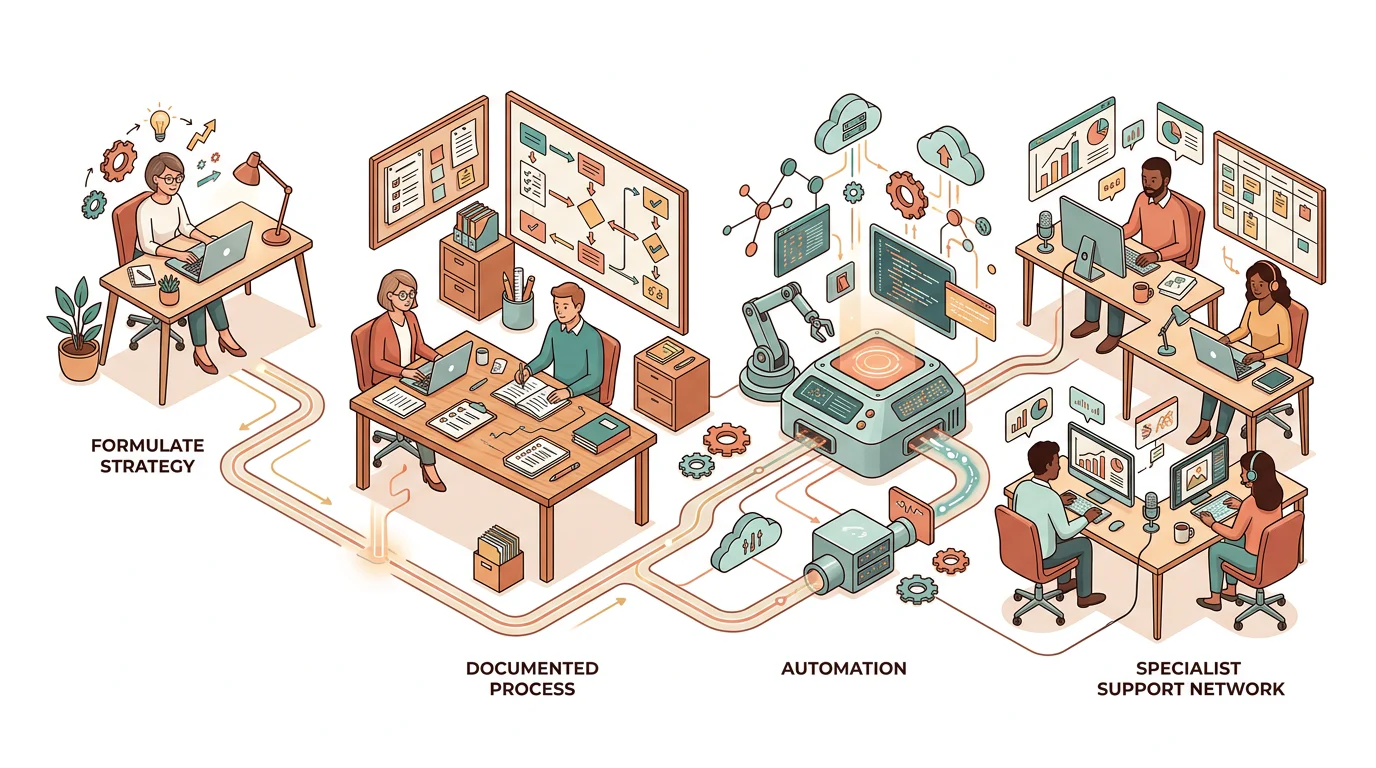
We look for leverage before headcount. That means improving the value and clarity of the offer, making delivery more repeatable, removing routine handoffs, and bringing in specialist help only where the work has a defined outcome and owner.
Use Higher-Value Positioning Before Chasing More Volume
Better positioning does not mean making a vague premium claim. We define a narrower outcome, the buyer who values it, the proof needed to support it, and the boundaries that stop every engagement becoming custom work. This can improve lead quality while protecting delivery time.
A founder who sells a clearly scoped outcome can decide which conversations deserve senior attention and which do not. If every prospect needs a unique explanation, the offer may still be doing too much work through the founder. This is often the underlying pattern behind a solo-founder ceiling.
Productise Delivery Before You Delegate It
Productised delivery is a repeatable client experience, not a rigid service. We document the starting condition, promised outcome, stages, assets, handoffs, revision limits, quality checks, and exception path. A specialist can then own a contained portion without making the whole client relationship feel impersonal.
The practical test is simple: can a competent person follow the process and know when to escalate? If the answer is no, the process is still founder knowledge. We first turn that knowledge into a usable operating asset.
Automate Routine Work, Then Keep Human Judgement Where It Matters
We use automation for rule-based tasks such as tagging a lead, creating a project workspace, sending a standard intake reminder, or assembling a first draft of a report. We do not automate strategic proposals, sensitive client updates, or unusual delivery decisions before the workflow has a human-approved quality gate.
For client-facing AI or automation, we use the four functions in the Govern, Map, Measure, Manage sequence: define the purpose, identify risk, test the output, and keep ownership clear. NIST framework We apply the same evidence-led review in our capacity diagnostic.
| Workflow | Lean Blueprint |
|---|---|
| Lead qualification | Form, eligibility rules, CRM tag, human review, booking |
| Proposals | Discovery notes, scope template, founder approval, signature, CRM update |
| Onboarding | Payment and contract check, intake, kickoff booking, shared workspace, owner assignment |
| Content production | Insight bank, draft, editorial review, brand check, publishing queue |
| Client reporting | Data pull, draft dashboard, delivery-owner validation, client narrative, send and archive |
| Repeatable delivery | Standard scope, checklist, quality gate, exception path, closeout and referral request |
When Should You Build, Automate, Contract, or Hire?
The resourcing choice is not a status decision. It is a practical answer to five questions: how strategic is the work, how often does it happen, how mature is the process, what is the risk of error, and how much management would it create for the founder.
A role that is frequent but poorly defined is rarely ready for a hire. A task that is strategic but infrequent may suit a fractional executive. A repetitive workflow with low exception risk may suit automation. We use the matrix below to stop a temporary pain point becoming a permanent payroll commitment.
| Route | Choose It When | Avoid It When | Management Load |
|---|---|---|---|
| Build internally | The capability is strategic and differentiating | Existing tools or partners can do it reliably | High at the start |
| Automate | Steps are frequent, rules-based, and measurable | Exceptions or client sensitivity dominate | Low after setup |
| Contract | A specialist skill or deliverable is bounded | Knowledge or quality control cannot be defined | Moderate |
| Hire | Work is recurring, stable, strategic, and needs internal context | The role is vague or demand is unstable | High and ongoing |
Build Only What Is Strategic
We build internal capability when it protects the offer, customer insight, or a differentiating method. A founder should retain ownership of positioning, senior judgement, and quality standards even when other work becomes systematised.
Automate Only What Is Stable
We automate after documenting the task, measuring errors, and setting an escalation rule. Automation should reduce handoffs and response delay, not create a hidden second job of correcting unreliable outputs.
Contract Before You Create a Role
Contractors, freelancers, and agencies fit bounded work with a clear brief, deadline, owner, and acceptance criterion. A fractional COO can help establish operating cadence, a fractional CMO can guide positioning and channel decisions, and a fractional CTO can assess technology architecture and vendor choices.
A business coach remains the better intervention when the real problem is founder prioritisation, accountability, offer choice, or delegation judgement. If client data enters a workflow, we also set access boundaries and review consent and data handling because India notified its Digital Personal Data Protection Rules in 2025. MeitY rules Our lean-team coaching page explains how we make that decision without defaulting to headcount.
How Do You Assess Whether a Coaching Program Supports Lean Outcomes?
A credible program should make its method inspectable. We want to see what it teaches, how implementation is reviewed, who provides feedback, and what evidence shows that a founder left with more usable capacity rather than a more complicated calendar.
| Evaluation Factor | Buyer Question | Evidence to Request |
|---|---|---|
| Curriculum | Does it cover offer, delivery, automation, and resourcing? | Module list, templates, and tools |
| Implementation support | Will someone review data, workflows, and decisions? | Cadence, feedback method, and response window |
| Access | Who delivers the work and how often? | Named access model and boundaries |
| Business-stage fit | Is this designed for an established service founder? | Stage criteria and relevant case evidence |
| Cost | What is included, optional, or refundable? | Current written proposal or invoice |
| Lean outcomes | Did founder hours, margin, handoffs, or quality improve? | Baseline, method, timeline, and attributable evidence |
Credentials can be a useful trust signal, but they are not proof that a program can redesign a service business. In the 2025 coaching study, 73% of respondents said clients and organisations expect coaches to have a certification or credential. ICF research We still ask for business-stage fit, transparent scope, implementation detail, and evidence tied to a client’s starting point.
We also prefer a program that tells you when not to hire, automate, or spend on acquisition. That discipline matters more than a generic growth promise. If you are weighing formats, our guide to private coaching can help you compare the level of access and implementation support you need.
Work with Rohini Mundra on a Lean-Scale Plan
If you are already generating revenue but your calendar, delivery load, or decision backlog is starting to set the pace, we can work with you privately on the next constraint. At Rohini Mundra, we begin with your actual offer, client mix, margin, calendar, and workflow evidence. We do not begin by prescribing a larger team, a heavier funnel, or more software.
Together, we turn that evidence into a focused operating plan: what to keep founder-led, what to document, what to automate, what to delegate, and what not to add yet. You leave with priorities, decision criteria, and an implementation cadence that suits a high-trust service business. That makes the engagement useful whether the issue is positioning, delivery capacity, lead quality, or role design. If you want a lean-scale plan built around your business rather than a generic growth formula, start with Rohini Mundra
FAQs on Lean-scale Coaching for ₹50-lakh Service Founders
What Does Lean-Scale Coaching Include?
Lean-scale coaching begins with a constraint diagnosis, then helps a founder standardise delivery, improve positioning, automate proven tasks, and use specialists only where their role is bounded.
Can I Scale Without Hiring a Full-Time Team?
Yes. A founder can often create capacity by narrowing scope, using templates, automating routine handoffs, and contracting defined work, provided quality control, client data, and exceptions remain owned.
When Should I Choose a Fractional Executive Instead of a Business Coach?
Choose a fractional executive when cross-functional operating decisions need temporary senior ownership. Choose coaching when the founder needs clarity, accountability, and better decisions rather than another operating layer.
How Do I Measure Whether Coaching Created Capacity?
Measure founder delivery hours, gross margin, qualified leads, conversion, workflow exceptions, client concentration, and client-ready quality against the documented starting point for four weeks before changes begin.