Zero Visibility: Three-Month Personal Branding Program vs. Private Coaching?


TL;DR
At Rohini Mundra, we help zero-visibility consultants choose a three-month personal branding program vs private coaching by comparing the work each format solves, the time it requires, and the support it should include. We also provide a five-day audit, a 12-week build sequence, a scorecard, and outcome measures that do not depend on follower promises.
For consultants, visibility affects the sales conversation long before a discovery call. In a 2024 survey, 9 in 10 B2B decision-makers said consistent, high-quality thought leadership makes them more receptive to outreach.
For a consultant with zero visibility, the three-month personal branding program vs private coaching decision should be made by scope, not follower promises. Choose a structured build when positioning, proof, LinkedIn, and publishing all need work. Choose private coaching when your foundation exists but a sensitive, complex market or offer decision needs bespoke support.
We will help you assess both paths, audit your starting point, map a credible 12-week build, and decide what progress should look like.
How Do You Make a Three-Month Personal Branding Program vs. Private Coaching Choice?
The central question is not whether coaching is more personal than a program. It is whether you need to build a complete, usable brand foundation or resolve a specific strategic problem before you can move.
Choose a Structured Build When the Foundation Is Missing
A three-month program makes sense when several core assets are absent at once: a clear niche, an evidence-backed point of view, a profile that explains your value, and a realistic way to publish. The sequence matters because content cannot compensate for vague positioning, and a sharp profile cannot compensate for absent proof.
Choose Private Coaching When the Decision Is Unusually Specific
Private coaching earns its place when your work is difficult to reduce to a repeatable framework. You may be navigating a confidential career move, changing offers, entering a tightly defined market, or deciding which expertise to leave behind. In those situations, rapid feedback and contextual judgment matter more than a shared curriculum.
Do Not Expect Either Format to Solve Everything
Neither route can create credible proof from nothing, repair a service that lacks buyer value, or make implementation happen when there is no time to do it. Visibility amplifies a useful message. It does not replace a viable offer, delivery capacity, or the willingness to speak to a defined market.
| Decision Factor | Three-Month Structured Build | Private Coaching |
|---|---|---|
| Personalization | Framework tailored at planned checkpoints | Tailored to the consultant’s context and decisions |
| Access | Defined sessions and support windows | Terms agreed in the individual scope |
| Cadence | Sequential milestones across 12 weeks | Cadence set around decisions and availability |
| Assignments | Regular implementation tasks | Flexible work between conversations |
| Artifact Review | Scheduled review of agreed assets | Review rights agreed in writing |
| Deliverables | Core positioning, proof, profile, and content assets | Proposal-specific assets and decisions |
| Accountability | Milestones and deadlines create momentum | Direct follow-through around priorities |
| Time Commitment | Requires dependable weekly implementation time | Varies with scope and urgency |
| Verified Price | No publicly listed consultant-specific 12-week price | No publicly listed private-coaching price |
| Best-Fit Condition | Several foundational assets are missing | A high-stakes, bespoke decision is blocking progress |
Price deserves its own discipline. At the time of writing, our public 40-day program is aimed at speakers, trainers, and coaches, so it does not establish a verified price for a 12-week consultant format. Ask for written scope before comparing cost, including sessions, feedback access, artifact reviews, duration, and cancellation terms.
Use examples from our projects to test whether the format you choose produces visible working assets, not just good intentions.
What Can Each Format Solve, and What Can Neither Solve Alone?
Zero visibility usually means the market has too little information to place you. A buyer may see your job title, credentials, or general services, yet still fail to understand who you help, what problem you solve, why your approach differs, and what proof makes that claim believable.
A structured build is suited to this broad diagnosis. Private coaching is suited to the narrower issue that appears after the diagnosis, such as choosing between two credible niches or reframing a mature offer without exposing sensitive context.
- Positioning gap: A structured build can turn broad experience into a defined audience, problem, and promise.
- Proof gap: Either format can organize outcomes, methods, credentials, and client language into a proof library.
- Publishing gap: A program can establish content pillars and a repeatable cadence when the issue is consistency.
- Differentiation gap: Private coaching is stronger when the distinction depends on nuance, confidential context, or a decision only you can make.
- Business constraint: Neither route should become a distraction from a broken offer, weak delivery model, or lack of available capacity.
If you are unsure whether the real issue is visibility or the business beneath it, start with our constraint map. It helps separate a message problem from a capacity, offer, or revenue problem before you invest in promotion.
How Do You Complete a Five-Day Zero-Visibility Audit?
Before choosing support, gather a baseline. The point is not to grade yourself. It is to replace a vague feeling of invisibility with evidence about what buyers can currently see, understand, and act on. LinkedIn also lets you control which parts of a profile can be public, so check your LinkedIn controls before judging search visibility.
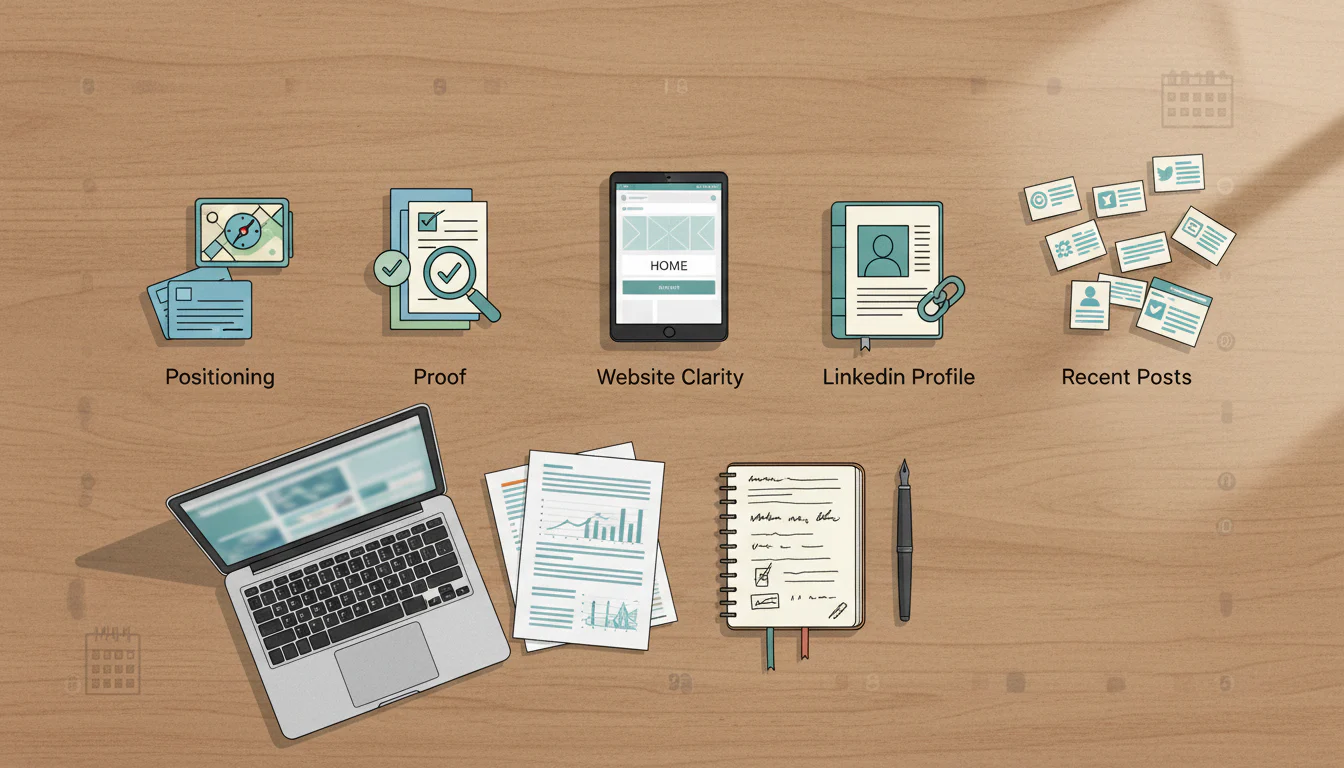
| Day | Audit Area | Evidence to Gather | Decision It Informs |
|---|---|---|---|
| 1 | Positioning | Your one-sentence explanation, buyer, problem, and alternative | Whether your niche is intelligible |
| 2 | Proof Points | Outcomes, methods, credentials, examples, and client language | Whether your claim has evidence |
| 3 | Website Clarity | Homepage message, services, proof, and contact path | Whether a stranger can understand and act |
| 4 | LinkedIn Profile | Headline, About, Featured section, experience, and public settings | Whether your profile supports credibility |
| 5 | Last Five Posts | Topic, target reader, evidence, call to action, and resulting conversations | Whether you have a repeatable point of view |
Save the audit in one document, then circle the two gaps with the greatest effect on buyer understanding. If you lack every core asset, a structured build is usually easier to implement. If the audit reveals one difficult decision beneath otherwise solid materials, private coaching is more likely to help.
For context on the perspective behind this work, visit about Rohini.
What Should a Credible 12-Week Personal Brand Build Deliver?
A credible short program should leave you with assets you can use without ongoing dependence on the program. It should not promise that a certain number of followers, leads, or speaking invitations will appear by a fixed date.
Weeks 1 and 2: Niche and Audience
Define the market you want to be known in, the buyer who feels the problem, the trigger that creates urgency, and the alternatives they may consider. The output is an audience brief and a set of positioning hypotheses worth testing.
Weeks 3 and 4: Positioning and Proof
Turn the strongest hypothesis into a positioning statement, message architecture, and proof library. A proof library can include client outcomes, relevant experience, methods, credentials, original observations, and language buyers use to describe the problem.
Weeks 5 Through 8: LinkedIn and Credibility Assets
Create a profile rewrite plan covering the headline, About section, experience framing, featured evidence, contact path, and public visibility. The goal is not to make the profile sound impressive to everyone. It is to make it relevant to the audience you chose. If the offer itself still needs a sharper commercial case, read why working harder before building visibility around it.
Weeks 9 Through 12: Content System and Activation
Build three or four content pillars, an achievable publishing cadence, a review loop for drafts, and an inbound-conversation process. This is where visibility work becomes practical: publish, observe the quality of response, and improve the next piece.
| Weeks | Milestone | Working Artifact | Implementation Action |
|---|---|---|---|
| 1 And 2 | Niche and audience chosen | Audience brief | Test the problem language with trusted market contacts |
| 3 And 4 | Positioning and proof clarified | Positioning statement and proof library | Refine claims until each has evidence |
| 5 And 6 | Profile plan completed | LinkedIn rewrite plan | Update the highest-impact sections first |
| 7 And 8 | Credibility assets organized | Featured proof and supporting examples | Make evidence easy to inspect |
| 9 And 10 | Content system prepared | Content pillars and publishing calendar | Draft useful points of view |
| 11 And 12 | Activation process running | Response prompts and measurement baseline | Publish, track, and improve |
Use short videos as practice for explaining your value with clarity before turning that language into profile copy or posts.
When Does Private Coaching Earn Its Extra Customization?
Private coaching is warranted when the cost of a wrong decision exceeds the value of following a standard sequence. That may be true when your differentiation is complex, your career context is confidential, your offer is being repositioned, or you need rapid decision support around a market move.
It is also useful when the difficult work is not “what should I post?” but “what should I be known for now?” In that case, implementation still matters, but it follows a sharper decision rather than leading it.
Use This Five-Factor Decision Rubric
Score each line from 1 to 5 using your current situation. A low score means the left description is more accurate. A high score means the right description is more accurate.
| Factor | 1 Means | 3 Means | 5 Means | What It Signals |
|---|---|---|---|---|
| Starting Clarity | No clear niche or message | Partial clarity | Foundation exists, nuance is the issue | Higher scores lean private |
| Urgency | Exploratory work | Moderate deadline | Imminent, high-stakes decision | Higher scores lean private |
| Implementation Capacity | Very little time | Some weekly time | Reliable weekly implementation time | Higher scores support a program |
| Need for Customization | Repeatable foundation needed | Mixed needs | Highly context-specific support needed | Higher scores lean private |
| Budget Clarity | No approved scope | Rough range only | Written scope can be evaluated | Low scores mean clarify before buying |
A structured build is usually the stronger fit when starting clarity is low, implementation capacity is high, and the need for customization is limited. Private coaching is usually the stronger fit when clarity is already strong but urgency and customization are high. If budget clarity or implementation capacity is low, pause before committing.
Measure progress against your Day 1 baseline: qualified profile views, relevant conversations, inbound inquiries, speaking invitations, and opportunities that explicitly reference your expertise. LinkedIn’s post analytics can show post-driven profile viewers, followers, reactions, comments, saves, sends, and link visits, but activity alone is not proof that the right market is responding.
If visibility is not creating the business movement you expected, use our revenue diagnostic to investigate the bottleneck rather than posting more by default.
Why Work with Rohini Mundra?
Rohini Mundra helps consultants turn experience into a market position people can recognise and act on. We begin by getting clear about the work you want to be known for, the evidence that supports it, and the time you can realistically give to implementation. Then we help you decide whether a structured build, focused private support, or a pause to solve a deeper business constraint is the responsible next move.
Our aim is not to manufacture a persona or chase a vanity metric. It is to make your expertise legible to the buyers who should understand its value. Before we recommend visibility work, we ask whether your offer, delivery, and available capacity can support the attention you want to earn.
If the issue sits beside a capacity constraint, we can surface it before you invest in promotion. To discuss your context and decide what should happen first, contact us.
FAQs on Three-month Personal Branding Program vs Private Coaching
These answers address the decision points consultants most often face when they are choosing between a structured build and individualized support.
What Is Personal Branding Coaching for Consultants?
Personal branding coaching gives you outside diagnosis, sharper positioning, proof selection, profile feedback, and implementation accountability, so your expertise becomes easier for the right buyers to understand and remember.
How Long Does It Take to Build a Consultant Personal Brand?
Twelve weeks can create usable positioning, proof, a profile plan, and a publishing system. Recognition, relevant conversations, and inquiries still depend on execution, market fit, and time.
Can a Personal Branding Coach Help with LinkedIn Specifically?
Yes. We cover profile positioning, public visibility, proof placement, content review, and analytics for relevant buyer discovery. This includes search appearances, profile views, and post-driven activity.
Which Format Is Better When I Am Starting from Zero?
Choose the structured route when several foundation assets are missing and you can implement weekly. Choose private coaching when a particular decision is confidential, urgent, nuanced, or difficult.
What Deliverables Should Personal Branding Support Include?
Look for a positioning statement, proof library, profile rewrite plan, content pillars, publishing cadence, review moments, and a clear process for responding to relevant inbound conversations.
How Should I Measure Progress Without Relying on Follower Count?
Use a baseline, then watch qualified profile views, relevant conversations, inbound inquiries, speaking invitations, and brand-attributed opportunities. Follower counts alone cannot show whether the right market is responding.