Why Working Harder Won’t Break Your Service-Business Revenue Plateau
Why coaching, consulting, and boutique agencies plateau despite long hours, and the redesigns that remove the constraint.

By Rohini Mundra, Founder · Updated 11 Oct 2026

In brief
We see a service-business revenue plateau as a structural constraint, not a personal failure. This guide helps coaches, consultants, and boutique agency owners separate seasonality from a true ceiling, diagnose acquisition, conversion, pricing, capacity, or retention, then measure and redesign the constraint that stops growth.
In this article
- 1Is This a Service-Business Revenue Plateau or a Seasonal Dip?
- 2Why Does Working Harder Fail to Break the Plateau?
- 3More Hours Do Not Create Capacity
- 4More Marketing Can Worsen Fulfilment
- 5Where Do Structural Revenue Ceilings Form?
- 6Acquisition Is Not Conversion
- 7Pricing Is Not Capacity
- 8Owner Dependency Is Operational and Personal
- 9Retention Is a Separate Constraint
- 10What Do the Numbers Reveal About the Constraint?
- 11Use Your Verified Inputs
- 12Which Redesign Fits Each Constraint?
- 13Follow a Four-Step Redesign Cycle
- 14What Should You Measure Next?
- 15Work with Rohini Mundra
- 16FAQs on Service-business Revenue Plateau
India’s MSME dashboard recorded more than 3.37 crore service registrations as of 2 August 2026, which makes clear how many founders are building businesses around their own expertise and time. MSME dashboard
Working harder rarely breaks a service-business revenue plateau because the binding constraint is usually structural, not motivational. When delivery depends on you, the offer’s economics are too thin, conversion leaks, or acquisition is inconsistent, extra hours push more activity into the same ceiling. Growth resumes when the limiting constraint changes.
We will help you tell a plateau from a temporary dip, identify the actual constraint, use your numbers to test it, and choose a redesign that protects client outcomes.
Is This a Service-Business Revenue Plateau or a Seasonal Dip?
A difficult month is not automatically a ceiling. We treat a plateau as a persistent flat underlying trend: comparable-period revenue, pipeline quality, and delivery capacity stop improving even though you continue making a credible effort to sell and serve well.
Seasonality is different because it repeats around a recognisable calendar pattern. Compare this month with the same month last year, then review three-month trends in qualified leads, conversion, revenue, and active clients. Seasonal-adjustment methods exist precisely because recurring holidays, business cycles, and timing effects can obscure the underlying trend. BLS methodology
| Signal | More Likely a Temporary Dip | More Likely a Structural Plateau |
|---|---|---|
| Revenue pattern | Drops during a familiar period, then recovers | Remains flat across comparable periods |
| Pipeline | Returns as normal sales activity resumes | Qualified opportunities remain weak or unchanged |
| Capacity | Team and delivery have room to absorb demand | Founder workload or backlog is already full |
| Response | Maintain proven activity and monitor | Identify and redesign the binding constraint |
A plateau does not require panic or a dramatic reinvention. It requires evidence. Start with a clear plateau diagnosis before deciding that you need more content, more ads, or more hours.
Why Does Working Harder Fail to Break the Plateau?
Long hours can conceal the real problem because they keep the business moving just enough to avoid a full stop. We often see founders fill every gap themselves: answering prospects, delivering client work, fixing errors, managing follow-ups, and approving every decision. That effort can preserve revenue while preventing the work that would change the business model.
More Hours Do Not Create Capacity
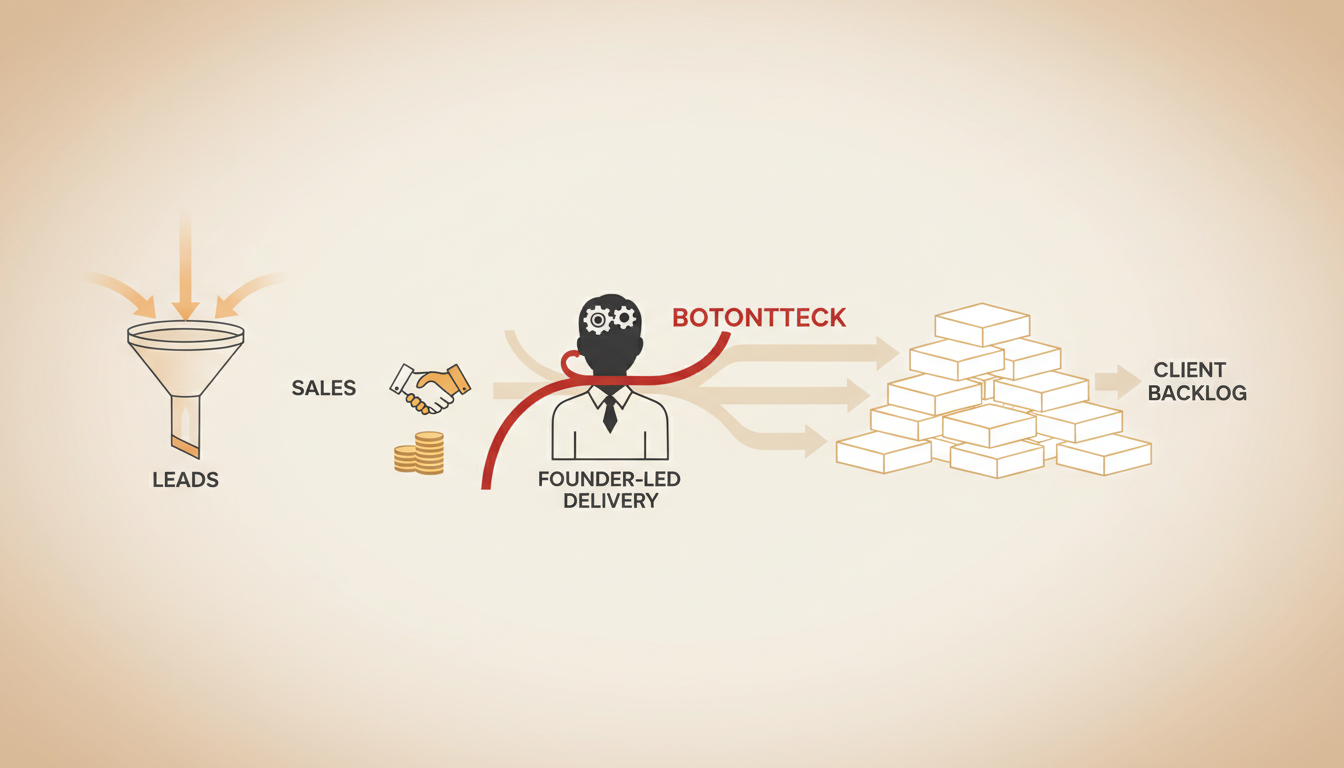
If each sale, strategy call, client decision, and deliverable needs you, your business has a personal-capacity ceiling. You may be highly productive, but revenue still depends on a finite number of founder hours. More work can raise strain without creating leverage.
This is not only an operational concern. WHO and ILO research associates workweeks of 55 hours or more with higher health risks than 35 to 40-hour weeks, which is a useful reminder that overwork is not a durable growth plan. WHO and ILO
More Marketing Can Worsen Fulfilment
Marketing works when qualified demand is the constraint. It makes an existing delivery constraint worse when new clients enter a system already limited by your availability, unclear hand-offs, or slow approvals. The result is often a fuller calendar, a longer backlog, and weaker client experience rather than meaningful growth.
We prefer to make the constraint visible before adding volume. For founders who need outside rhythm while doing that work, our founder accountability groups can help turn a diagnosis into weekly decisions.
Where Do Structural Revenue Ceilings Form?
A ceiling is not one universal revenue number. It forms where one part of the business cannot keep pace with the rest. For private coaches, consultants, and boutique agency owners, five constraints create different symptoms and need different responses.
| Symptom | Constraint | Confirming Metric | Misleading Response | Structural Response |
|---|---|---|---|---|
| Too few suitable sales conversations | Acquisition | Qualified leads by source and booked-call rate | Publish more without tracking quality | Develop channels and sharpen positioning |
| Enough conversations, few clients | Conversion | Qualified-call-to-client conversion rate | Buy more traffic | Improve qualification, proof, and sales process |
| Full calendar, thin revenue or margin | Pricing and offer economics | Average client value, discount rate, contribution margin | Work nights or discount further | Repackage scope, pricing, and value |
| Backlog and founder approval queues | Delivery capacity | Founder hours per client, backlog age, utilisation | Increase marketing before fixing delivery | Redesign process and delegate decisions |
| Constant replacement of departing clients | Retention | Renewal rate, repeat revenue, cohort retention | Chase acquisition alone | Improve onboarding, outcomes, and renewal process |
Acquisition Is Not Conversion
An acquisition problem means too few qualified people enter the pipeline. A conversion problem means qualified people enter, but the offer, qualification process, proof, or sales conversation does not convert them. Treating both as “a marketing problem” makes the wrong metric look busy.
Pricing Is Not Capacity
A pricing problem exists when the value you retain from each client cannot support the required quality, delivery time, and margin. A capacity problem exists when the offer may be profitable, but the founder remains the delivery engine. They can appear together, but they should not be solved with the same move.
Owner Dependency Is Operational and Personal
Founders often hesitate to hand over important client decisions because quality, reputation, and identity feel tied to their personal involvement. A recent field study found delegation rose with perceived employee capability and trust, while perceived venture risk discouraged it. Recent field study
We do not frame that resistance as a character flaw. We treat it as an operating risk to reduce with decision rights, quality standards, documented hand-offs, and deliberate practice. That is the kind of practical work we address through hands-on coaching.
Retention Is a Separate Constraint
Retention becomes the issue when new sales mostly replace clients who leave or fail to renew. Client value depends on future earnings, retention, and margin, not only the first invoice. Customer value research
What Do the Numbers Reveal About the Constraint?
We recommend using verified records from your CRM, invoices, delivery calendar, and cost data. The purpose is not to create a perfect spreadsheet. It is to identify which input is holding the rest of the system back.
Use Your Verified Inputs
- Revenue for the period:
[qualified leads] × [sales conversion rate] × [average client value] - Qualified leads needed:
[target revenue] ÷ [average client value] ÷ [sales conversion rate] - Founder delivery load:
[active clients] × [owner delivery hours per client per period] - Maximum client capacity:
[available delivery hours per period] ÷ [delivery hours per client per period] - Capacity-limited revenue:
[maximum client capacity] × [average client value] - Contribution margin:
([revenue] − [variable delivery costs]) ÷ [revenue] - Retained cohort revenue:
[prior-period client revenue] × [retention rate]
The capacity formulas matter because work in progress, throughput, and flow time are connected. A growing backlog is not just inconvenience. It is evidence that demand is entering faster than your delivery system can complete it. Little’s law paper
Read the figures together. More leads cannot compensate for weak conversion forever. Better conversion cannot fix an offer that produces too little margin. Better pricing cannot solve a founder who has no remaining delivery capacity. Our ceiling guide can support a deeper review when the numbers point in more than one direction.

Which Redesign Fits Each Constraint?
A useful redesign changes the limiting condition, not merely the appearance of activity. We ask one question before making a major move: if this improves, will the business be able to turn that improvement into healthier revenue without creating a new bottleneck immediately?
| Confirmed Constraint | Primary Redesign | Guardrail |
|---|---|---|
| Acquisition | Channel development and stronger positioning | Track qualified leads, not attention alone |
| Conversion | Clearer offer, proof, and qualification process | Preserve client fit |
| Pricing and economics | Repackage scope, price, and client value | Protect contribution margin |
| Delivery capacity | Standardise delivery and delegate decisions | Maintain client outcomes |
| Retention | Improve onboarding, milestones, and renewals | Track retained revenue by cohort |
Follow a Four-Step Redesign Cycle
- Verify the constraint with recent sales, delivery, and financial records.
- Choose one structural move, such as repositioning, pricing, packaging, process redesign, delegation, or channel development.
- Run a controlled operating cycle with one owner, one metric, one deadline, and clear quality safeguards.
- Document what works before adding marketing spend, headcount, or more complexity.
The right intervention depends on readiness as much as urgency. Our readiness guide helps founders distinguish a strategic reset from a broader scaling commitment, while digital systems are relevant when process visibility and hand-offs are the actual issue.
What Should You Measure Next?
Revenue is a lagging signal. By the time it changes, the cause may have been building for weeks. We want you to review a small set of leading indicators every week, then use monthly revenue and margin to confirm whether the change is working.
- Qualified leads by source: Shows whether demand is both sufficient and relevant.
- Booked consultations and show rate: Shows where interest leaks before a sales conversation.
- Qualified-call-to-client conversion: Shows whether your sales process turns fit into commitment.
- Average client value and discount rate: Shows whether the offer can support your target economics.
- Founder delivery hours per active client: Shows whether your own time remains the constraint.
- Backlog age and milestone completion: Shows whether delivery can absorb new demand.
- Contribution margin and retained revenue: Shows whether growth is healthy rather than merely busy.
We encourage founders to review these measures in one weekly operating conversation, not as isolated reports. Our business growth guide offers further support for building that discipline into how you run the business.
Work with Rohini Mundra
At Rohini Mundra, we work with private coaches, consultants, and boutique agency owners who are tired of trading a fuller calendar for the same revenue. Our role is not to hand you another generic growth checklist. We help you read the numbers, identify the constraint that actually governs the business, and build a practical change around the offer, sales process, delivery system, or team decision that needs attention. That can mean clarifying a premium package, removing founder approvals, documenting a repeatable client journey, or creating the accountability to make the change stick. The goal is a business that protects client outcomes while becoming less dependent on your daily availability. We bring the discussion back to evidence so the next action is matched to the actual bottleneck, not the loudest symptom. If you want structured support for that work, explore Rohini Mundra.
FAQs on Service-business Revenue Plateau
These answers are designed to help you decide whether your next move should be more demand, a better offer, stronger delivery, or a clearer operating system.
Can More Marketing Fix Flat Revenue?
More marketing works only when qualified demand is the constraint and delivery capacity, conversion, and margin can absorb new clients without weakening client outcomes or experience.
Why Can’t a Solo Consultant Scale Past Their Hours?
A solo consultant hits a ceiling when selling, delivery, client decisions, and quality approval all need the founder. Capacity increases only after process, packaging, or delegation changes.
Should I Raise Prices Before Hiring?
Test the economics first. Raise prices when value, positioning, and client outcomes support it, but redesign delivery or delegation first when owner capacity is the proven constraint.
How Long Does a Revenue Dip Need to Last Before It Is a Plateau?
Treat it as a potential plateau after like-for-like seasonal comparisons show flat underlying revenue and leading indicators. One weak month, without that pattern, is insufficient evidence.
What Is the First Metric to Review?
Review qualified leads, conversion, average client value, owner delivery hours, margin, and retention together. The slowest or most constrained measure directs the first redesign decision.