

TL;DR
We see flat revenue persist when a coaching, consulting, or boutique agency model still depends on founder hours for sales, delivery, or approvals. This article shows how to separate seasonality from a true plateau, identify the active constraint, calculate capacity and contribution, and test one structural change before adding staff or marketing.
In our private coaching work, we often find that a consultant’s real capacity is far smaller than a full workweek suggests. Established consultants may have only about 1,200 billable hours available in a year, once selling, preparation, administration, and client communication are accounted for.
A service-business revenue plateau rarely yields to more effort because the bottleneck is usually structural: founder-dependent sales, delivery, pricing, retention, or approvals. Extra hours push more work into the same limited system. We see growth restart when we identify the narrowest constraint, redesign it, and track whether capacity and contribution improve.
We will help you distinguish a real plateau from seasonality, locate the constraint, and test a structural change without assuming you need a full team.
Is This a Sustained Revenue Plateau or a Seasonal Dip?
We do not diagnose a plateau from one disappointing month. A slow period can be normal for your market, while a plateau is a repeated failure to grow after you compare like with like across a full annual cycle.
| Test | Sustained Plateau | Seasonal Movement | Evidence To Inspect |
|---|---|---|---|
| Comparison Period | Revenue stays broadly flat across four quarters | The same months rise or fall predictably each year | Monthly revenue against the same month last year |
| Qualified Demand | Lead quality and conversion do not improve | Enquiries fluctuate around a known buying cycle | Qualified leads, show rate, sales-cycle length |
| Capacity | Founder hours rise without more margin | Capacity relaxes after the seasonal peak | Delivery hours, waitlist, gross contribution |
| Next Move | Test one structural constraint | Forecast the next known cycle | A 12-month revenue and capacity view |
Seasonality is not guesswork. The Census Bureau defines it as a pattern that recurs in the same calendar period, and explains why year-over-year comparison helps reveal the underlying trend in its seasonality guidance. If your like-for-like numbers remain flat while your effort rises, we would treat that as a reason to inspect the model.
Before changing offers or channels, use our capacity diagnostic to separate a demand issue from a delivery or founder-dependence issue.
Why Do Founder Hours Create a Service-Business Revenue Plateau?
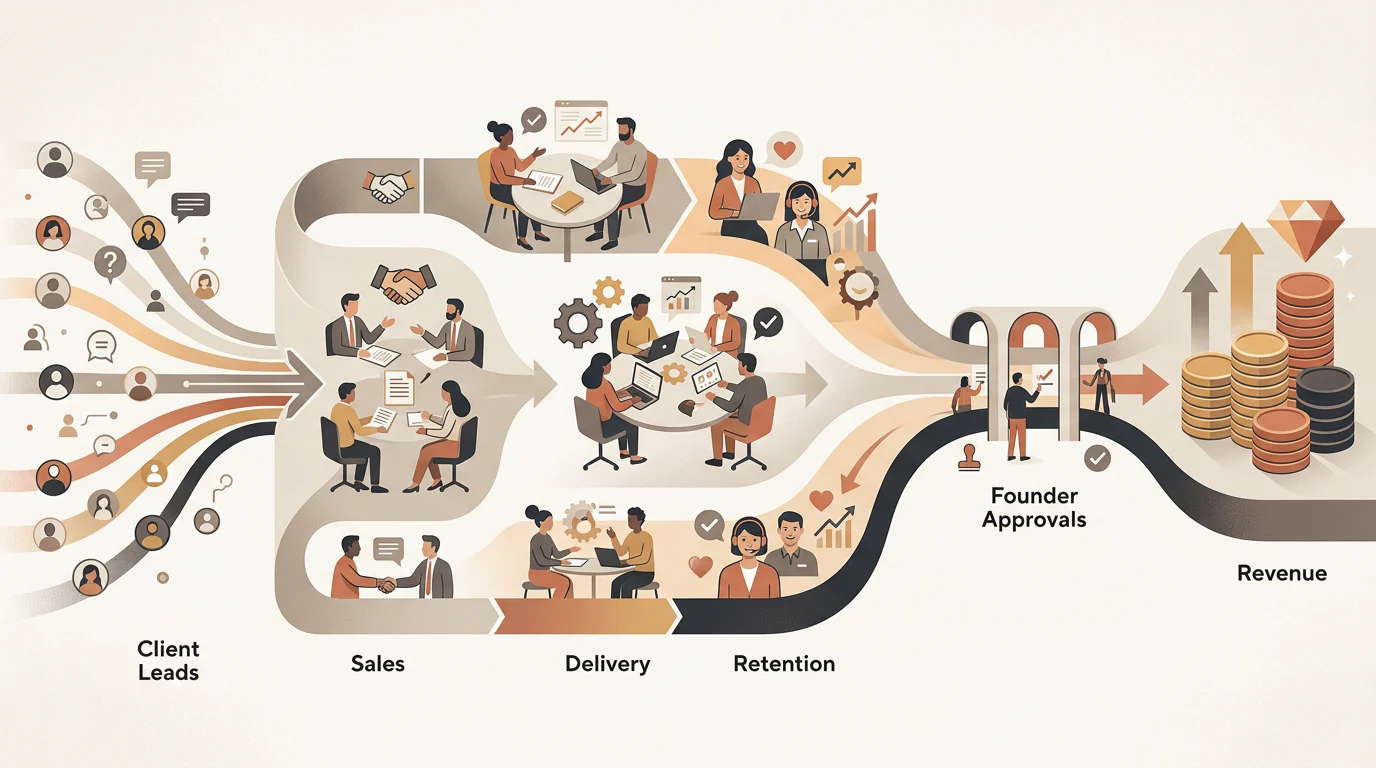
A founder-led business becomes constrained when the founder is still required to generate demand, close the sale, deliver the work, solve exceptions, and approve decisions. That is common in one-to-one coaching, consulting, and boutique agency work because each new client can add several kinds of labour at once.
Billable Time Is Not Available Time
A full calendar does not equal a full delivery capacity. Client preparation, follow-up, proposals, revisions, invoicing, and recovery time all compete with billable delivery. When we map a founder’s week, the first useful number is not total hours worked. It is the number of hours that can reliably produce the promised client outcome.
More Work Can Lengthen the Queue
A bottleneck behaves like a narrow doorway. Adding demand behind it does not widen it. MIT’s explanation of Little’s Law captures the point: work in process, throughput, and lead time move together. When delivery or approvals are constrained, more client work often means longer waits, more rushed decisions, and weaker margins.
Founder Dependence Is a Design Choice to Measure
We look for the moments where only the founder can move work forward. Some are valuable, such as specialist judgement or a high-stakes client decision. Others are habits that can become templates, defined handoffs, or decision rules. Our founder capacity guide helps identify the difference.
Which Constraint Is Actually Capping Revenue?
A service-business revenue plateau is rarely explained by one vague word like “marketing.” We get a clearer answer by reviewing evidence from each part of the model, then changing the smallest constraint that can release profitable capacity.
| Constraint | Symptom | Evidence To Inspect | False Fix | Structural Response |
|---|---|---|---|---|
| Lead Flow | Too few qualified conversations | Source, qualified leads, show rate | Promote everywhere | Test one buyer and one acquisition message |
| Conversion | Calls do not become clients | Close rate, objections, proposal delay | Buy more leads | Improve qualification and the sales decision |
| Pricing | Calendar is full but value is low | Realised price, discounts, contribution | Add lower-priced clients | Repackage or raise price for a defined segment |
| Offer Capacity | Every sale becomes bespoke work | Variants, scope changes, hours per client | Sell more custom work | Narrow the offer and standardise milestones |
| Delivery | Backlog and rework increase | Lead time, delivery hours, revisions | Work evenings | Remove, automate, or document repeatable steps |
| Retention | Revenue resets every month | Renewals, expansion, churn reasons | Replace every departing client | Improve onboarding and renewal design |
| Founder Approvals | Work waits for one person | Approval count, decision wait time | Respond faster | Set decision rights and escalation rules |
We do not assume that every business at the same revenue has the same problem. OECD research finds that productivity differences within firms of similar size account for around 95% of variation within an industry. Your own records are more useful than a generic revenue-stage rule.
For a deeper review of the evidence behind each row, use our constraint map. It can help us frame the right measurements before you change an offer, channel, or delivery process.
When Does More Marketing Amplify Overload?
More marketing is useful when qualified demand is the active constraint and delivery has room to absorb new clients. It is harmful when it fills a system that is already late, over-customised, dependent on founder approvals, or barely profitable after direct delivery costs.
We would pause acquisition expansion when new enquiries would lengthen client delivery times, create a waitlist without a capacity plan, or force the founder to do more low-value coordination. The goal is not fewer leads. It is to avoid creating demand that the current model cannot fulfil well.
A service-operations study covering 1,726 appointments found a process redesign increased intake capacity by 27%. That does not predict the same result for every service firm, but it is a useful reminder that redesigning delivery can increase capacity before a new hire is necessary.
Use this short readiness check before you spend more on acquisition:
- Delivery Capacity: Can the current team take on another client without delaying outcomes?
- Founder Load: Will another sale add founder approvals or specialist delivery time?
- Contribution: Does each additional client create enough value after direct delivery costs?
- Client Experience: Will new demand weaken onboarding, responsiveness, or retention?
If any answer is no, the next investment belongs inside the operating model. Once capacity is stable, our coaching revenue diagnostic can help you decide whether acquisition is the next lever.
How Do You Test a Structural Change Without a Full Team?
We recommend a four-step test rather than a sweeping transformation. It gives you an observable way to learn whether the constraint is real and whether a change creates capacity without reducing quality.
Measure the Constraint
Choose one constraint and establish a baseline from your calendar, CRM, invoices, and delivery records. Track qualified conversations, conversion, delivery hours per client, direct delivery cost, renewal patterns, or approval wait time. Do not try to fix every row in the matrix at once.
Choose One Structural Change
Raise prices when demand and outcomes are strong but realised value no longer supports the work. Productise delivery when the same milestones repeat. Narrow the offer when scope variation is consuming capacity. Automate repeatable administration, and delegate decisions that have clear quality rules.
When the constraint is offer structure rather than headcount, our format comparison can help you evaluate delivery choices before you add another person.
Run a Time-Bound Test
Set a fixed review date and one leading indicator. For example, a standardised onboarding sequence should reduce delivery hours or decision wait time without creating more rework or worse client outcomes. We want a controlled test, not a promise that every change will work.
Review Capacity and Contribution
Use the equation below to see whether the model can grow profitably:
Monthly Revenue Capacity
= Minimum Of Sales Capacity, Delivery Capacity, And Founder Decision Capacity
  Multiplied By Average Client Value

Monthly Gross Contribution
= Monthly Revenue Less Direct Delivery Cost Per Active Client
A founder can test this without hiring a full team. If their records show that bespoke onboarding is consuming delivery capacity, we would define a repeatable onboarding path, preserve only the high-judgement parts, and compare delivery time and client outcomes after the test. If the change releases time without weakening results, that is evidence to extend it.
How Can Rohini Mundra Help You Test a Revenue Constraint?
At Rohini Mundra, our private coaching support works with established coaches, consultants, and boutique agency founders who have already proved demand but feel trapped inside the model that created it. Our private coaching starts with the evidence: revenue by offer, qualified conversations, conversion, delivery hours, client outcomes, renewal patterns, direct delivery costs, and the decisions that still wait for the founder. We do not begin by prescribing a larger team or a louder marketing plan. Together, we identify the narrowest constraint, select one structural change, and set leading indicators that tell us whether it is creating capacity without weakening the client experience. That might mean clarifying an offer, strengthening a sales decision, designing a repeatable delivery path, or delegating an approval with a clear rule. The goal is a business that can grow with more intention, not a founder who has to work longer. Meet Rohini Mundra
FAQs on Service-Business Revenue Plateau
How Long Does Flat Revenue Need to Last Before It Is a Plateau?
We treat it as a plateau when a full year of like-for-like monthly or quarterly comparisons stays flat after known seasonal swings are accounted for.
Can I Raise Prices Before I Hire?
Price can be the first test when demand and outcomes are strong, delivery capacity is tight, and realised value no longer supports the work required.
Should I Add Marketing When My Calendar Is Full?
Do not add marketing first when new enquiries would lengthen delivery queues, delay client results, require more founder approvals, or reduce contribution from each additional client.
Does Productising Make a Service Generic?
Productising means standardising the repeatable path to a result while preserving judgement where it matters. We keep the client problem, outcome, and boundaries clear from the outset.
What Should I Automate or Delegate First?
Automate repeatable, low-judgement work and delegate decisions with clear escalation rules. Seek structured outside review when follow-through is weak before adding staff to your operating model.