Why Has My Service Business Revenue Plateaued? Diagnose Your Service Business Revenue Plateau
Diagnose a service business revenue plateau with a constraint-first audit of capacity, leads, sales, pricing, delivery, and founder dependency.

By Rohini Mundra, Founder · Updated 11 Oct 2026

In brief
We help coaching, consulting, and agency owners diagnose a service business revenue plateau before adding more work or marketing. This article maps six constraints, supplies a revenue-leak calculation and priority matrix, and turns the evidence into a focused 30-day plan that protects client outcomes.
In this article
- 1Is It Really a Revenue Plateau?
- 2Where Is the Constraint Behind Your Service Business Revenue Plateau?
- 3Track the Inputs Before Choosing Tactics
- 4Separate the Six Constraints
- 5Why More Effort Often Misses the Problem
- 6Has One-To-One Delivery Reached Capacity?
- 7Are Demand or Conversion Losing Revenue?
- 8Is Referral Dependence Hiding a Demand Problem?
- 9Is Follow-Up Leaking Qualified Opportunities?
- 10Use a Revenue-Leak Calculation
- 11What Should You Fix First?
- 12How Rohini Mundra Helps You Find the Constraint
- 13FAQs on Service Business Revenue Plateau
India’s official 2025 survey counted 7.92 crore unincorporated establishments, up 7.97% from 2023 to 2024, while other-services GVA also grew. A flat business can therefore be a business-specific problem, not proof that the market has stopped moving. ASUSE report
We see a service business revenue plateau when its tightest constraint no longer responds to more founder effort. For coaches, consultants, and agency owners, the limiting stage is usually capacity, lead predictability, conversion, pricing, delivery load, or founder decisions. Measure that stage, change one thing, then review the next 30 days before adding tactics.
Below, we show how to separate a real plateau from normal variation, find the bottleneck with your own numbers, and choose a focused next action. We also show how to protect client outcomes while reducing founder dependence.
Is It Really a Revenue Plateau?
A revenue plateau is not one slow month, a delayed invoice, or a predictable quiet season. It is a repeated pattern in comparable periods where revenue, capacity, or profit stops progressing despite continued effort and a stable enough view of the business.
Start by pulling the last 12 months of collected revenue, booked revenue, active clients, gross margin, and pipeline. Compare each month with similar months where possible. If you have not operated through a full cycle, call the issue a constraint hypothesis rather than a confirmed ceiling.
Then look beneath the headline number. A coaching business holding at ₹8 lakh per month may have stable revenue but declining close rates, or more sales with less profit, or a full delivery calendar that makes another client impossible. Google recommends mapping the journey from lead to final sale value so that drop-offs and delays become visible instead of assumed. Google guidance
The point is not to wait for perfect data. We want enough evidence to tell whether the business has a demand issue, a delivery issue, or a measurement issue before choosing a response.
Where Is the Constraint Behind Your Service Business Revenue Plateau?
Most owners describe the problem as “I need more clients.” In our experience, that is often a symptom rather than a diagnosis. More enquiries will not repair an offer that is already at capacity, a sales process that leaks, or a founder who must approve every decision.
Use this table to identify the stage that deserves attention first.
| What You See | Inspect First | Likely Constraint | Confirming Test | First Move |
|---|---|---|---|---|
| A full calendar with flat revenue | Delivery hours per client | Offer capacity | Model the hours required for one more client | Remove or repackage repeatable delivery |
| Leads arrive mostly through referrals | Leads and sales by source | Lead predictability | Compare source mix across recent months | Test one repeatable owned acquisition channel |
| Calls happen but sales stall | Qualified-call and close rates | Conversion | Review lost opportunities and follow-up timing | Improve qualification and follow-up ownership |
| Revenue rises but profit does not | Average sale value and gross margin | Pricing | Compare scope, direct cost, and margin by offer | Re-scope or test value-based packaging |
| Delivery consumes growth time | Founder delivery and admin hours | Delivery load | Time-track one client journey | Standardise a repeated workflow |
| Everyone waits for the owner | Decision queue and owner time | Founder dependency | Record blocked decisions for one week | Delegate one recurring decision |
Track the Inputs Before Choosing Tactics
Record leads by source, qualified-call rate, close rate, average sale value, delivery hours, gross margin, retention, and owner time allocation. If one number is missing, do not guess. Mark it as unmeasured and build a simple way to capture it during the next review period.
Your sales funnel can be expressed simply: new-client revenue equals leads multiplied by qualified-call rate, close rate, and average sale value. This calculation reveals which input is limiting revenue without relying on a generic industry benchmark.
Separate the Six Constraints
Offer capacity means your current service needs more founder or team time for every additional client. Lead predictability means enquiries depend on irregular referrals, one partner, or inconsistent activity. Conversion means qualified prospects are not becoming paying clients.
Pricing becomes the constraint when the scope, value, and direct delivery cost no longer support the margin you need. Delivery load appears when onboarding, rework, client administration, or fulfilment consumes the time required to improve the business. Founder dependency exists when sales, client decisions, approvals, or problem-solving cannot move without you.
A practical Business Growth Guide can support the work, but it cannot replace the evidence from your own business. It works best when each new idea is tested against the constraint you have actually measured.
Why More Effort Often Misses the Problem
Working longer hours can produce more output inside the same broken structure. It does not make referrals predictable, improve weak positioning, shorten a delayed follow-up process, or create another decision-maker.
That is why we focus on the tightest stage first. When the constraint changes, the right tactic changes with it, and effort can finally support growth instead of concealing the bottleneck.
Has One-To-One Delivery Reached Capacity?
One-to-one work is not a flawed model. It becomes a ceiling when revenue can rise only when your personal delivery hours rise, and your availability is already committed. The question is not whether you should remove yourself from every client interaction. It is which parts of delivery truly require you.
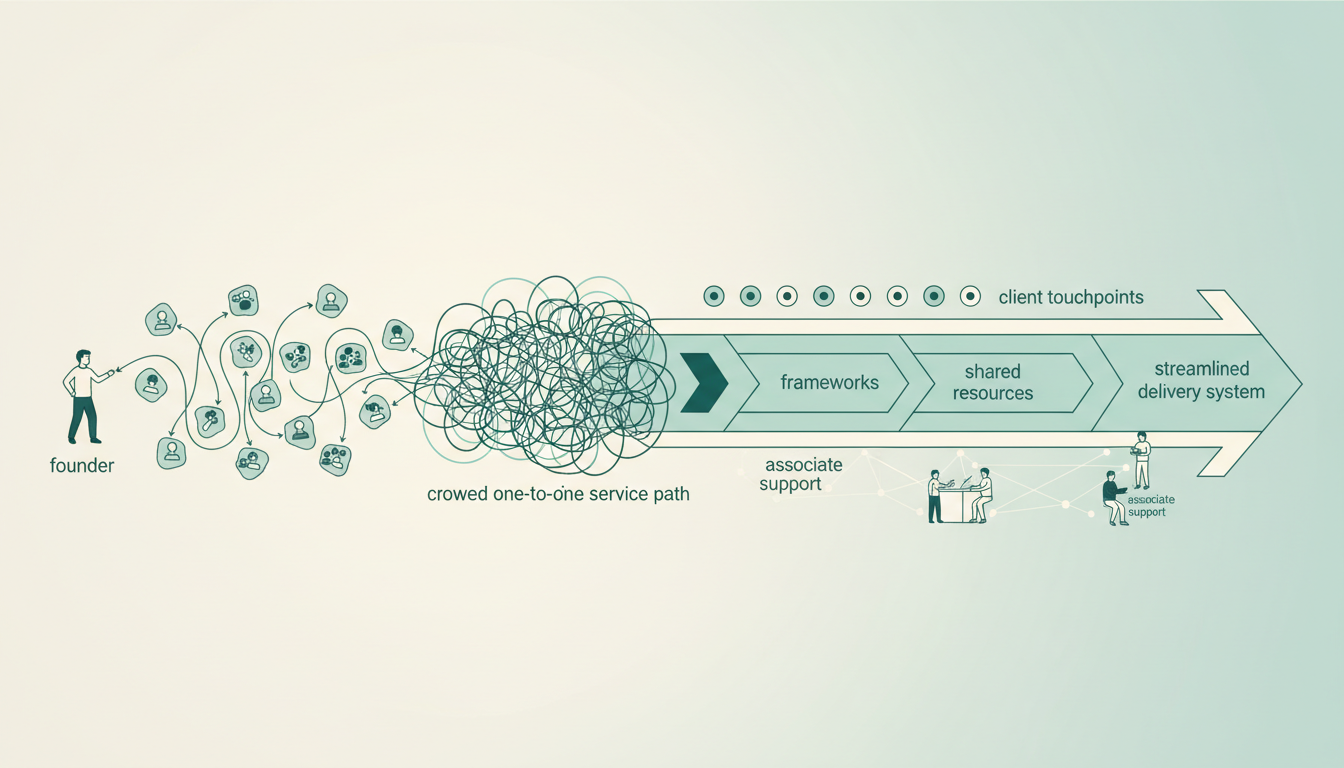
Calculate the practical ceiling before launching another offer. Monthly capacity revenue equals available delivery hours divided by delivery hours per client, then multiplied by average sale value. This makes the trade-off visible before your calendar, margins, and energy are under pressure.
Then examine each delivery step. Repeated discovery questions, onboarding tasks, templates, reporting, routine feedback, and scheduling often create workload without requiring the founder’s full expertise. Our Extraordinary Coach Guide is useful when the goal is to preserve meaningful client outcomes while making delivery more repeatable.
Leverage can mean a productised diagnostic, documented resources, a small-group format, associate-led implementation with quality checks, or structured office hours. It does not automatically mean a course, less support, or lower standards.
Are Demand or Conversion Losing Revenue?
Demand and conversion are different constraints. Demand asks whether enough of the right people enter your pipeline. Conversion asks whether qualified people move from interest to a paid, well-onboarded client relationship.
Is Referral Dependence Hiding a Demand Problem?
Referrals can be valuable, but they are not a predictable growth system if they are the only source of qualified conversations. Tag every lead and sale by source, then review the monthly pattern, lead quality, sales value, and time to close.
A single source does not become dangerous at a universal percentage. It becomes a constraint when the business cannot explain what will replace it if that source slows. Better positioning can improve the quality of every source, which is why Brand New Brand You belongs in the conversation when prospects do not clearly understand who you help and why your offer matters.
Is Follow-Up Leaking Qualified Opportunities?
Measure response time, contact attempts, booked-call show rate, proposal turnaround, payment completion, and stalled opportunities. Do not label an enquiry “unqualified” until you know whether someone responded clearly and consistently.
A Harvard Business Review study examined three years of data from more than 15,000 leads and 100,000 call attempts, reinforcing that speed and persistence in follow-up are measurable sales variables. HBR research
Onboarding friction matters too. If a buyer says yes but gets stuck in contracts, payment, scheduling, or unclear next steps, that is a conversion problem with an operational cause. The best response is to assign an owner and a measurable next step to every stage.
Use a Revenue-Leak Calculation
Use your actual numbers, not generic benchmarks, to test possible improvements. Calculate capacity leak by subtracting current client capacity from desired client capacity, then calculate retention revenue as eligible renewals multiplied by retention rate and renewal sale value.
Calculate gross profit by subtracting direct delivery costs from revenue, then divide gross profit by revenue to find gross margin. Change one input at a time in a worksheet, so the choice between traffic, positioning, follow-up, and delivery redesign becomes less emotional and more specific.
When the question is whether your current offer and operating model are ready for a wider scaling commitment, Purpose Workshop vs Business Scaling Program can help frame the next decision without skipping the diagnostic work.
What Should You Fix First?
The best first fix is the one with strong evidence, meaningful impact, acceptable risk, and fast feedback. Owners often choose the most familiar action, such as posting more content or hiring help, rather than the action their numbers support.
Run this five-step audit over 30 days:
- Pull comparable revenue, pipeline, margin, retention, and time data.
- Assign each weakness to one of the six constraints.
- Calculate the likely revenue or capacity leak.
- Run one confirming test for the highest-evidence constraint.
- Review the leading metric weekly and decide whether to continue, change, or stop.
If the process is scattered across spreadsheets, inboxes, and manual handoffs, the Digital Transformation Program can help make the required information visible. Use the matrix below to prevent a familiar task from outranking a more important constraint.
| Evidence And Severity | Effort, Risk, And Feedback | Decision |
|---|---|---|
| High severity and strong evidence | Low to moderate effort, short feedback loop | Act now |
| High severity and weak evidence | Any effort level | Validate first |
| Proven issue with long feedback or higher risk | Significant implementation work | Schedule with safeguards |
| Low severity | Any effort level | Deprioritise |
For founder dependency, track which tasks and decisions wait for you. Stop work that does not protect client outcomes, delegate defined decisions, automate repeatable handoffs, and measure whether the decision queue shrinks. Founder Accountability Groups can provide the structure needed to keep those commitments visible.
A plateau does not require ten initiatives. It requires one informed priority, a clear owner, and a scheduled review. Choose the action that gives you meaningful feedback before committing to the next major growth investment.
How Rohini Mundra Helps You Find the Constraint
At Rohini Mundra, we work with service business owners who are tired of receiving generic advice to post more, hustle harder, or copy someone else’s playbook. Our role is to help you slow the diagnosis down long enough to see the real limiting stage, then turn that evidence into a focused operating decision. We can review the numbers behind your leads, sales conversations, delivery time, margins, retention, and founder workload, so the next move fits the business you actually have. That may mean sharpening an offer, repairing follow-up, redesigning a handoff, building decision ownership, or choosing not to spend on acquisition yet. We keep the conversation anchored to client outcomes and measurable progress, not activity for its own sake. Together, we create a 30-day plan with a single accountable owner and review date. If you want a clearer next step, start with Rohini Mundra Home.
FAQs on Service Business Revenue Plateau
These questions address the most common uncertainty we hear after an owner has identified flat revenue but has not yet identified the stage causing it. Use them to decide what evidence to collect before taking your next action.
How Do I Know Whether My Service Business Has a Real Revenue Plateau?
A real plateau appears when comparable months remain flat and funnel or capacity data is stable. A single slow month or seasonal dip is insufficient evidence.
What Is the First Metric to Check When Coaching Revenue Is Stuck?
Check leads by source, qualified-call rate, close rate, average sale value, delivery hours, gross margin, retention, and founder time allocation. Together, these figures locate constraints.
Can I Scale Beyond One-To-One Client Work Without Reducing Outcomes?
Scale past one-to-one delivery when repeated work is documented, quality is checked, and a new format preserves the client outcome people actually pay to achieve.
Should I Fix Lead Generation or Delivery Capacity First?
Fix the stage with the strongest evidence and greatest impact first. More demand cannot solve a delivery ceiling, and better operations cannot repair weak qualification alone.
Why Does Working Longer Hours Not Solve an Agency Revenue Ceiling?
Longer hours help only when capacity is limiting revenue. If positioning, conversion, pricing, or approvals cause the leak, more owner effort reinforces the ceiling rather than removing the cause.