Why Service Businesses Stay at the Same Revenue
Diagnose a service business revenue plateau and choose the right fix before adding more leads, hours, or services.

By Rohini Mundra, Founder · Updated 11 Oct 2026

In brief
We see service businesses plateau when the operating structure, not the founder’s effort, becomes the limiting factor. This guide helps coaching, consulting, and boutique-agency founders identify whether demand, conversion, offer design, delivery capacity, or margin is binding, then build a focused plan to change it.
In this article
- 1What Counts as a Revenue Plateau?
- 2Which Constraint Is Binding in a Service Business Revenue Plateau?
- 3Is Qualified Demand the Constraint?
- 4Is Conversion the Constraint?
- 5Is Offer Design or Pricing the Constraint?
- 6Is Delivery Capacity the Constraint?
- 7Why Does More Effort Fail?
- 8What Does Each Service-Business Model Cap, and Which Intervention Matches It?
- 9What Should Change First?
- 10Work with Rohini Mundra
- 11FAQs on Service Business Revenue Plateau
India’s MSME dashboard recorded 3,20,45,063 service registrations as of June 2026, a reminder that a large number of founders are building businesses where growth depends on people, judgement, and delivery capacity. The MSME dashboard also makes clear why generic growth advice rarely fits every business.
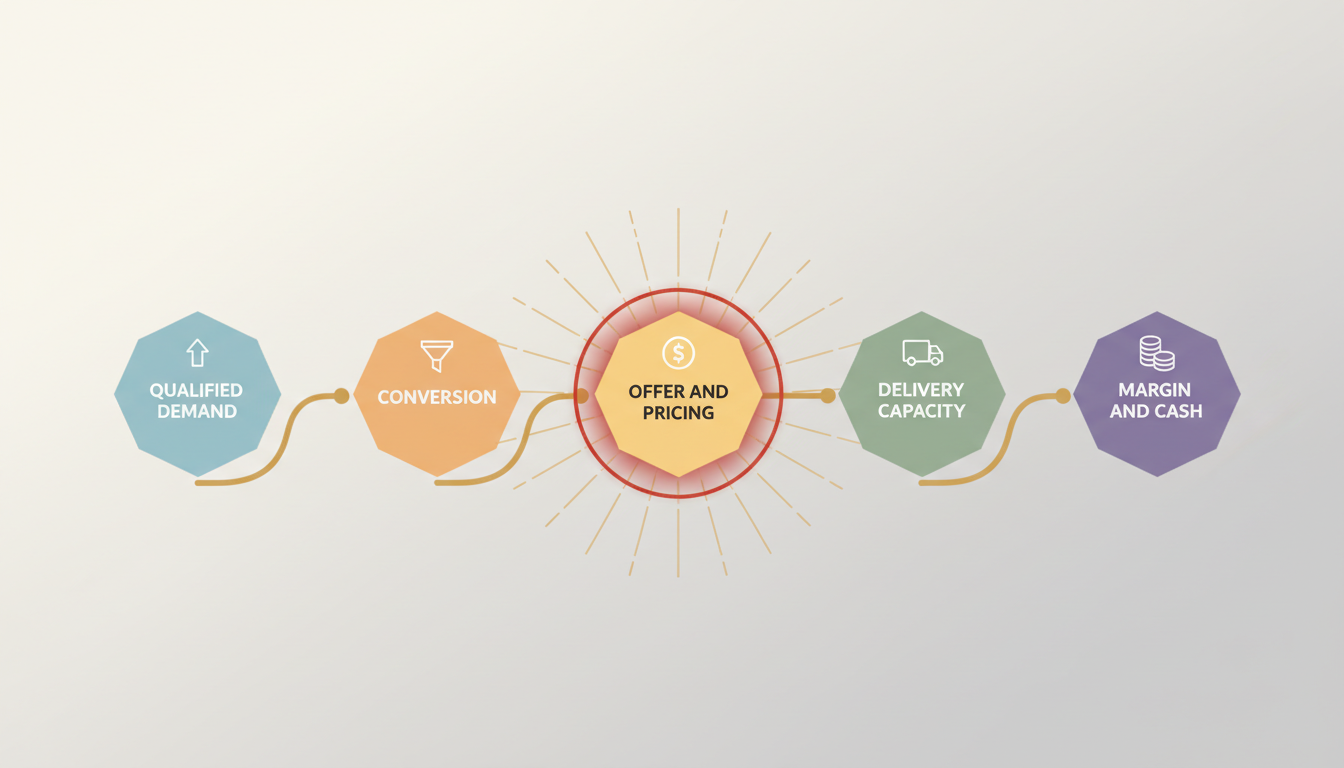
A service business revenue plateau occurs when growth is constrained by operating structure, not owner effort. The usual ceiling is insufficient qualified demand, weak conversion, an offer or price buyers resist, founder-tied delivery capacity, or margins and cash too thin to fund support. Diagnose the binding constraint before adding leads, hours, or services.
We will show you how to tell a true plateau from a slow month, map the constraint, and choose the first change that matches your coaching, consulting, or agency model.
What Counts as a Revenue Plateau?
A slow month is not automatically a structural problem. A plateau is a repeated pattern: revenue stays in the same band even though you keep selling, delivering, and trying to grow. For most service businesses, we recommend reviewing at least six consecutive months of trend data, then checking the same months across a full year if your work is seasonal.
Track booked revenue, invoices sent, cash collected, gross margin, and the founder hours required to create that revenue. These are different numbers. A project may be sold in January, invoiced in February, and paid in March. The SBA guidance distinguishes cash and accrual accounting for this reason.
A practical first audit is to calculate a rolling three-month revenue average. If it has not moved for six months, investigate. If the business has predictable seasonal peaks and troughs, compare each month with the same month last year before calling it a plateau. Our revenue-plateau diagnosis can help you organise those numbers before you choose a solution.
| Revenue Driver | Simple Equation | What Creates The Ceiling | Metric To Inspect |
|---|---|---|---|
| Qualified demand | Qualified leads × show-up rate | Too few suitable sales conversations | Qualified leads per week |
| Conversion | Sales conversations × close rate | Enough interest, too few signed clients | Close rate and lost reasons |
| Average sale value | New clients × average sale value | Pricing or scope cannot support the target | Average contract value |
| Repeat purchases | Active clients × renewals or expansions | Every month starts from zero | Renewal and expansion revenue |
| Capacity | Available delivery hours ÷ hours per client | Founder or team cannot fulfil more work | Utilisation and turnaround time |
| Churn | Starting clients minus clients lost | New sales only replace departures | Client and revenue churn |
Which Constraint Is Binding in a Service Business Revenue Plateau?
The binding constraint is the one issue that limits the next unit of profitable revenue right now. A founder can have several weaknesses at once, but only one usually deserves the first focused intervention. That is why we do not begin with “more leads” as the default answer.
The following diagnostic matrix separates the visible symptom from the evidence you need. It also protects you from expensive false diagnoses, such as increasing ad spend when the team is already at capacity or hiring before the work is defined.
| Symptom | Evidence To Collect | False Diagnosis | Corrective Action | Leading Metric |
|---|---|---|---|---|
| Few sales conversations | Lead source, qualification rate, show-up rate | “My sales skill is weak” | Improve one acquisition channel | Qualified calls per week |
| Many calls, few clients | Close rate, objections, proposal cycle | “I need more leads” | Tighten qualification and sales process | Close rate |
| Busy calendar, late delivery | Utilisation, turnaround time, founder hours | “Marketing is working” | Systemise or delegate delivery | Turnaround time |
| Revenue holds, cash feels tight | Gross margin, collections, scope changes | “I need more clients” | Reprice, collect faster, control scope | Cash collected |
| New clients replace departing clients | Churn, renewal, expansion data | “Acquisition is the only issue” | Improve onboarding and retention | Revenue churn |
Is Qualified Demand the Constraint?
Qualified demand is the issue when your pipeline has too few people who fit your offer and can realistically buy it. Inspect leads by source, not just total enquiries. A hundred unqualified conversations do not solve a shortage of suitable prospects.
If qualified calls are low and delivery has room, improve acquisition. For coaches, that may mean clearer authority and message consistency. Our personal-brand coaching guide is relevant when visibility is the actual constraint, not simply a new marketing tactic.
Is Conversion the Constraint?
Conversion is the problem when relevant prospects speak with you but few become clients. Review close rate by offer, average time from first conversation to purchase, and the repeated reasons prospects decline.
A weak close rate can signal poor qualification, unclear outcomes, a vague proposal, insufficient proof, or an offer that makes buying feel risky. Do not change all of those at once. Pick the repeated failure point and test one revision over a defined number of conversations.
Is Offer Design or Pricing the Constraint?
Offer and pricing problems appear when founders discount often, scope work differently for every client, or discover that a sold project consumes far more hours than planned. The issue is not automatically that the market will not pay. It may be that the offer is difficult to understand, difficult to buy, or costly to deliver.
Track actual delivery hours against estimated hours by service line. When your promise is clear but work keeps expanding, narrow the scope, establish paid change requests, or separate a diagnostic phase from implementation. Founders building a stronger coaching practice can also use our extraordinary coach guide to improve the value and clarity clients experience.
Is Delivery Capacity the Constraint?
Capacity is binding when demand exists but projects wait for founder approval, quality checks, client decisions, or core delivery. Service businesses cannot add unlimited clients without risking slower delivery and weaker outcomes. The capacity research explains why limited service capacity changes the economics of acquiring additional customers.
Start by measuring what percentage of client delivery, client communication, and internal decisions can happen without the founder. If the answer is low, more demand will amplify the wrong system.
Why Does More Effort Fail?
Working harder can increase output for a short time, but it cannot expand a structure built around one person’s hours and decisions. If every sales call, client escalation, approval, proposal, and quality check routes through the founder, revenue rises only until that person’s week is full.
More leads make the situation worse when delivery is already congested. More services add complexity when the current offer is not profitable or repeatable. More hours remove time from strategic work, which is often the very work needed to change the model. Research on growth constraints in SMEs supports treating constraints as distinct operational problems rather than one generic motivation issue. Operations research points to the value of identifying the specific constraint.
Run a two-week time audit before making a major investment. Divide every working hour into selling, delivery, management, administration, and strategic work. Be honest about where “quick questions,” client messages, and approval requests go. If delivery and reactive management consume the founder’s calendar, the ceiling is likely capacity or decision flow, not ambition.
- Selling: Prospecting, discovery calls, proposals, follow-up, partnerships, and nurture.
- Delivery: Client sessions, strategy, implementation, review, quality control, and project rescue.
- Management: Hiring, performance conversations, decision-making, team direction, and financial review.
- Administration: Email, scheduling, invoicing, data entry, tools, and compliance.
- Strategic Work: Offer design, pricing, systems, partnerships, positioning, and capacity planning.
A useful test is simple: if the founder disappeared for one working day, what work would stop? The answer identifies the dependency to remove first. Our business growth guide can support the wider operating review once you have named that dependency.
What Does Each Service-Business Model Cap, and Which Intervention Matches It?
The same monthly revenue can hide completely different ceilings. A coaching business, a consulting practice, and a boutique agency may each reach ₹8 lakh a month, yet the right next move can be entirely different because their revenue equations are different.
| Model | Illustrative Monthly Maths | Ceiling Revealed | Best First Test |
|---|---|---|---|
| Coaching | 20 clients × ₹40,000 = ₹8 lakh, with four founder hours per client | Founder delivery time | Test defined group delivery or delegate client operations |
| Consulting | 4 projects × ₹2 lakh = ₹8 lakh, with 45 delivery hours per project | Custom scope and founder utilisation | Sell a diagnostic separately and document delivery |
| Boutique Agency | 8 retainers × ₹1 lakh = ₹8 lakh, with founder approval on strategy and quality | Approval flow and founder-held relationships | Define decision rights and account ownership |
For a coach, group delivery is not automatically the answer. Use it only where clients can receive a meaningful part of the outcome together, while private work remains available where judgement or confidentiality requires it. The goal is not to make delivery impersonal. It is to stop using founder time for repeatable work that can be designed once and delivered consistently.
For a consultant, the ceiling often sits inside custom scoping. If every sale produces a new method, timeline, and project plan, each new client creates fresh design work. Narrowing the offer, charging for diagnosis, and documenting a repeatable delivery sequence can protect margin before you add more volume.
For an agency, the friction is often hidden in approvals and client relationships. A team may have the technical capacity to deliver, but work stalls if the founder must approve every strategy choice and resolve every client concern.

What Should Change First?
Choose the smallest intervention that directly relieves the binding constraint, then measure it before adding another initiative. The sequence matters. A sales campaign is sensible when qualified demand is low and delivery has headroom. It is wasteful when clients already wait for work that only the founder can complete.
Raise prices when you know the actual cost and time to deliver, the required margin, and the value you create. Narrow or repackage an offer when custom scope, discounts, or long proposal cycles make buying and fulfilment difficult. Add group delivery when the outcome can be achieved through a shared component. Systemise or delegate when repeatable work has a clear quality standard and escalation point.
Cash deserves its own check. A business can look busy and still lack the cash to hire support if payment arrives late or margin disappears in unpriced work. The RBI report notes that information gaps, documentation, and transparency can complicate MSME credit access, which makes clean numbers especially important before seeking financing.
Use this three-step worksheet for the next 90 days:
-
Name One Constraint: The founder completes a six-month revenue review, a 12-month seasonal comparison where relevant, and a two-week time audit within 48 hours. The leading metric is a completed scorecard. Stop condition: do not launch a new channel, service, or hire until the constraint is named.
-
Run One Bounded Intervention: Assign one owner and a 30-day deadline. Choose one action, such as improving qualified calls, revising qualification, tightening scope, documenting delivery, or improving collections. The leading metric must match the constraint. Stop condition: revise the test after four weekly reviews if the metric does not move.
-
Install A Weekly Review: Review the revenue equation, cash collected, founder time, and one leading metric every week. Stop condition: if a different constraint becomes limiting, pause expansion and diagnose again.
A reliable workflow makes these reviews easier to sustain. Our digital transformation program can help when your next constraint is building clearer systems, reporting, and hand-offs across the business.
Founders who want outside accountability can explore our founder accountability groups. The useful conversation is not “How do I grow faster?” It is “What must change before this business can grow safely?”
Work with Rohini Mundra
At Rohini Mundra, we work with founders who are tired of treating a structural ceiling like a personal failure. Our private coaching starts with the numbers behind your week: qualified conversations, close rate, average sale, renewal pattern, delivery capacity, margin, cash collection, and the decisions that still wait for you. Then we help you choose one constraint, define the smallest useful intervention, and review the leading metric before you invest more money or energy. This is not about adding a generic growth plan to an already full calendar. It is about building a business that can sell, deliver, and make decisions with less dependence on the founder. If your revenue has stayed flat while your effort rises, bring the evidence, not a hunch, and let us help you turn it into a focused operating plan you can execute this quarter. Meet Rohini Mundra
FAQs on Service Business Revenue Plateau
How Do I Know If I Have a Plateau or a Slow Month?
A plateau is a repeated trend across at least six months, or matched months across a full year for seasonal businesses, not one disappointing month or delayed invoice.
Is Leads or Delivery Capacity My Bottleneck?
Leads are the bottleneck when qualified conversations are scarce. Capacity is the bottleneck when demand exists but delivery, decisions, or client work repeatedly wait for you.
Why Does Working Harder Not Fix a Revenue Plateau?
Extra effort can increase short-term output, but it cannot expand a model where sales, fulfilment, approvals, and client relationships all depend on one founder’s finite time.
Can a Consultant Break a Revenue Ceiling Without Hiring?
Yes, if pricing, scope, conversion, or time allocation is constrained. Hiring becomes necessary when delivery capacity or essential expertise remains limited after you systemise the work.
When Should a Service Business Raise Prices?
Raise prices after measuring delivery costs, margin, outcomes, and buyer value. Do not use a price increase to hide unclear scope, weak proof, or inefficient fulfilment.