Are You Ready to Become a Coach? A 20-Point Check
Answer five quick questions. Each option is worth 0 to 4 points, for a total from 0 to 20.
Question 1 of 5
How do you usually respond when someone brings you a difficult problem?
Pick an answer to continue. Your result appears after question 5.
By Rohini Mundra, Founder · Updated 26 Sept 2026
In brief
Coaching readiness is not decided by enthusiasm alone. This five-question assessment scores your communication, experience, scope, practice commitment and business focus from 0 to 20, then points you to a next step.
A score is a next step, not a qualification
Each answer earns 0 to 4 points, so your total ranges from 0 to 20. Higher points consistently mean more evidence that you can begin testing a narrow, non-clinical coaching offer. The three equal-width bands are 0–6 Explore, 7–13 Practise, and 14–20 Pilot.
This assessment measures five parts of readiness:
- communication and reflective listening
- relevant personal or professional experience
- scope, boundaries and referral readiness
- willingness to practise and receive feedback
- a defined audience, problem and first offer
Scope is part of readiness
A coaching score does not authorise clinical work. India's Mental Healthcare Act defines mental healthcare to include analysis, diagnosis, treatment, care and rehabilitation for mental illness or suspected mental illness. If the work you want to offer involves those activities, use the appropriate mental-health route instead of treating it as a coaching-business decision. The Act's definition is the boundary to keep in view.
For an immediate safety emergency in India, call 112. For mental-health support and referral, Tele-MANAS is available at 14416 or 1800-89-14416.
Five answers create one practical route
The assessment uses the same equal-weight structure as our coaching-niche check. A strong score in one area does not cancel a weak scope answer. Treat your lowest-scoring area as the first capability to strengthen.
Five answers, one next move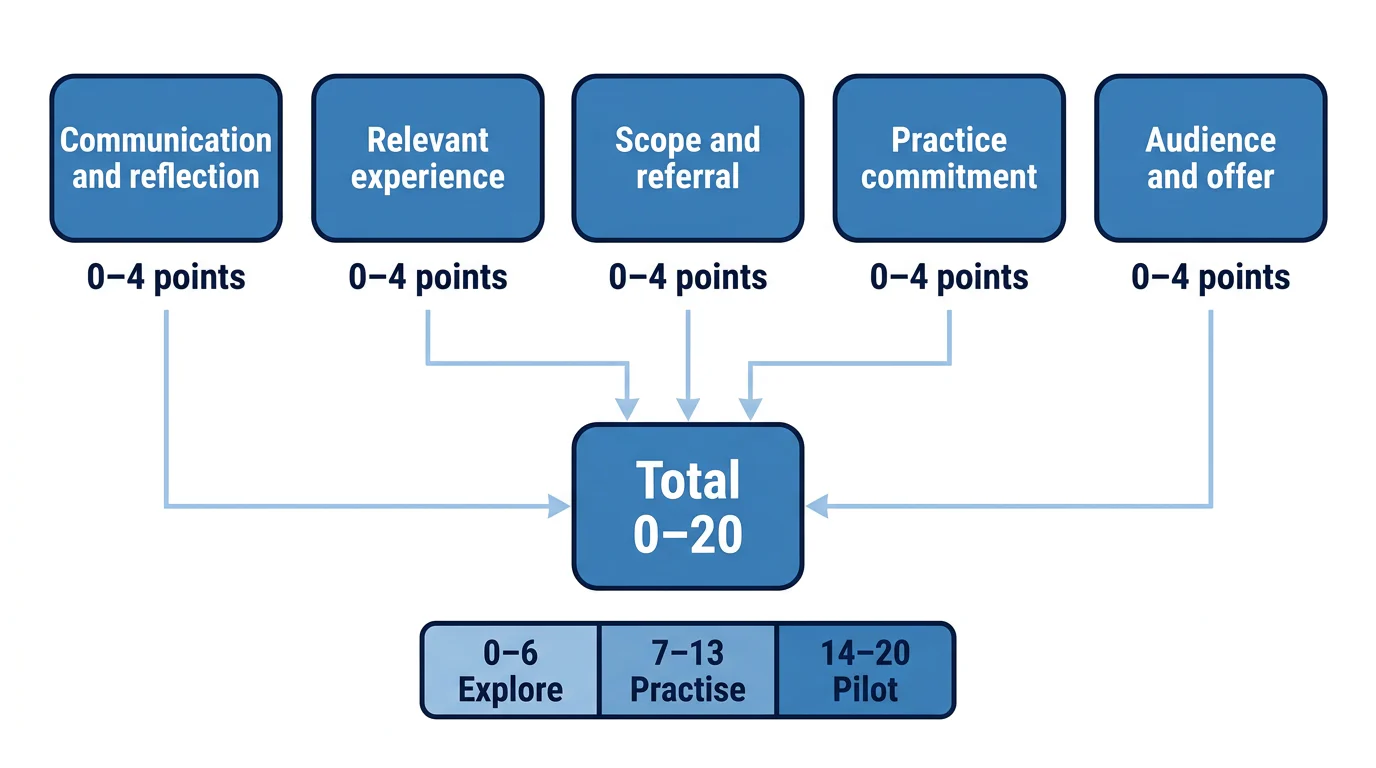
An International Coaching Federation credential is an optional, separate route. Its ACC requirements include 60 education hours, 100 coaching-experience hours, including 75 paid hours, 10 mentor-coaching hours over three months, a performance evaluation and an exam. A readiness score cannot replace those requirements. ICF's ACC requirements provide the detail.
Read the result as a decision
Use a low score to clarify your expert path before making a client promise. Use a middle score to practise within a narrow scope, record what you learn and test whether one audience understands your offer. Use a higher score to run a small pilot with written boundaries, then review what needs strengthening before expanding.
If you are weighing formal education against launch support, use our credential-versus-business-training comparison. If your immediate uncertainty is whom you can help, take the coaching-niche assessment. When your scope and niche are clear, the first coaching-business guide can help you shape a defined offer.
India's 2024 coaching-advertising guidelines apply to advertisements by people engaged in the coaching sector. Keep any future claims about your experience, qualifications, fees and likely results accurate, specific and supportable. The CCPA guidelines set that expectation.
What this assessment asks
5 questions. Each answer carries points; your total picks the result band below.
01How do you usually respond when someone brings you a difficult problem?
- I can listen without rushing to solve the problem.
- I usually tell them what they should do.
- I can hold a client-led conversation that turns reflection into an agreed action.
- I ask some questions before offering a view.
- I listen, but quickly move to my own solution.
02What evidence supports the problem you want to help people work on?
- I can name some relevant work or lived experience.
- I am interested in the topic, but have little relevant experience.
- I can describe several relevant examples, the audience and what I do not help with.
- I have personal interest, but cannot yet explain a useful example.
- I can explain repeatable examples and the limits of my experience.
03How would you handle a request outside your coaching scope?
- I would explain the boundary and seek an appropriate referral option.
- I am not sure where coaching ends.
- I can state my scope in writing, work within it and refer appropriately.
- I would try to diagnose, treat or manage the issue myself.
- I would pause if the request felt beyond me.
04What commitment can you make to building coaching skill?
- I can make time for occasional practice.
- I want a course to make me ready straight away.
- I can sustain practice, feedback and reflection over time.
- I can learn concepts, but practice feels optional.
- I can schedule regular practice and ask for feedback.
05How clearly can you describe the coaching business you want to test?
- I can name one audience, one practical problem and a delivery preference.
- I want to help anyone who needs motivation.
- I can state one audience, one problem, a bounded first offer and a way to test it.
- I have a broad topic, but no defined audience or problem.
- I can name an audience or a problem, but not both clearly.
How to read your score
| Score | Result | What it means |
|---|---|---|
| 0–6 | Explore Before You Offer Coaching | Your answers suggest you are still choosing an expert direction. Start by identifying experience you can describe accurately and the kind of work you genuinely want to do. Do not make a client promise or market a coaching service yet. |
| 7–13 | Practise With a Narrow Scope | You have an emerging direction, but your skills, scope or evidence need more structure. Focus on regular practice, feedback and a clearly bounded audience before you market a coaching offer. |
| 14–20 | Run a Small, Scope-Safe Pilot | Your answers show strong readiness to test a narrow coaching offer. Start with a limited pilot, clear client agreements and accurate claims about your experience. Keep reviewing your scope as real client needs emerge. |