Presentation Skills Training in India: What It Costs
Presentation skills training in India: UrbanPro lists tutors from ₹300 an hour and The Knowledge Academy lists a one-day course at ₹154,995 before GST. Compare rupees per presentation you get feedback on.
By Rohini Mundra, Founder · Updated 3 Nov 2026

Key takeaways
- UrbanPro lists tutors from ₹300 an hour, and The Knowledge Academy lists a one-day course at ₹154,995 before GST, equal to about 517 hours of tutoring at ₹300 an hour. Judge a course by rupees per reviewed presentation, not by the headline fee.
- A reviewed presentation is one you deliver in full, aloud, then get specific feedback on from a person who watched or from your own recording. Our recommendation is to count only those.
- Record a three-minute talk and score three things before you pay anyone. The test takes ten minutes and costs nothing.
- Choose the route by how often it makes you present: a tutor for repetitions, an open course for a method, a club for volume, a team workshop for a shared standard.
In this article
- 1What does presentation skills training cost in India?
- 2Why is the headline fee the wrong number to compare?
- 3What five questions should you ask a provider before you pay?
- 4How do you test your own presentation before paying for anything?
- 5Which route fits: a tutor, an open course, a club or a team workshop?
- 6How does Rohini Mundra help with presentation skills?
- 7Frequently asked questions
Whether a presentation course is worth its fee depends on one count that few buyers ask about: how many times you stand up, present and hear specific feedback.
In our view, most people who say they need presentation skills are short of repetitions, not knowledge. Reading a slide deck or a list of tips does not change that count. A presentation improves when you give one, see or hear what happened, and give it again with one thing changed.
This page sets out the fees listed in India as of November 2026. It gives a formula that turns any fee into rupees per reviewed presentation, five questions to put to a provider, and a ten-minute recording test you can run tonight for free. It is written for people who present to managers, clients or a room, not for students looking for a slide template.
What does presentation skills training cost in India?
As of November 2026, UrbanPro lists presentation skills tutors from ₹300 an hour, and The Knowledge Academy lists a one-day course at ₹154,995 before 18% GST (Goods and Services Tax), which applies on top for most buyers. The table shows fees listed on UrbanPro, a tutor marketplace, and on a provider's own page.
| Route | Listed fee | Source |
|---|---|---|
| Private tutor, Bangalore | ₹300 to ₹700 an hour for individual classes, average ₹500; 12 individual classes ₹3,600 to ₹8,400 | |
| Private tutor, Delhi | ₹300 to ₹650 an hour for individual classes; 12 individual classes ₹3,600 to ₹7,800 | |
| Private tutor, Pune | Average ₹500 an hour | |
| Private tutor, Mumbai | ₹300 to ₹700 an hour; 12 classes ₹3,600 to ₹8,400 | |
| Open course (a public class anyone can book) | ₹154,995 before GST for one day |
Our model: ₹154,995 divided by an hourly rate gives the hours of tutoring that one day costs. The lowest hourly rate stated on the Bangalore, Delhi and Mumbai pages is ₹300. Dividing the one-day fee by the tutor figures gives:
- ₹154,995 ÷ ₹500 average hourly rate = about 310 hours of tutoring.
- ₹154,995 ÷ ₹300 lowest hourly rate = about 517 hours of tutoring.
- ₹154,995 ÷ ₹8,400 (top of a 12-class block) = about 18 twelve-class blocks.
- ₹154,995 ÷ ₹3,600 (bottom of a 12-class block) = about 43 twelve-class blocks.
These are listed fees, not what buyers negotiate or pay, and tax treatment differs by seller.
We publish this page, and we are not one of the providers in the table.
Why is the headline fee the wrong number to compare?
The headline fee is the wrong number because it hides what you are buying: repetitions. Two courses at the same price can give you one turn at the front of the room or eight. Our recommendation is to divide every fee by the number of reviewed presentations it buys.
A reviewed presentation is one you deliver in full, aloud, then get specific feedback on from a person who watched or from your own recording. A talk you give and never hear about again does not count. A lecture about presenting does not count either.
The formula, which is our model and not an official figure:
Rupees per reviewed presentation = (fee + 18% GST, if charged) ÷ number of reviewed presentations you will give
Worked example 1, private tutor. A block of 12 one-to-one classes costs ₹3,600 to ₹8,400 (UrbanPro Bangalore). Assume you present once per class and get feedback each time. That is ₹300 to ₹700 per reviewed presentation (3,600 ÷ 12 and 8,400 ÷ 12).
Worked example 2, one-day course. ₹154,995 plus 18% GST is ₹182,894 (The Knowledge Academy). To match the top of the tutor figure (₹700), you would need about 261 reviewed presentations in a day (182,894 ÷ 700). No day holds that many.
That does not make the day poor value. An employer may be paying, or a team may need one shared method. It means the fee has to be justified by something other than repetitions, and you should know what that something is before you pay.
What five questions should you ask a provider before you pay?
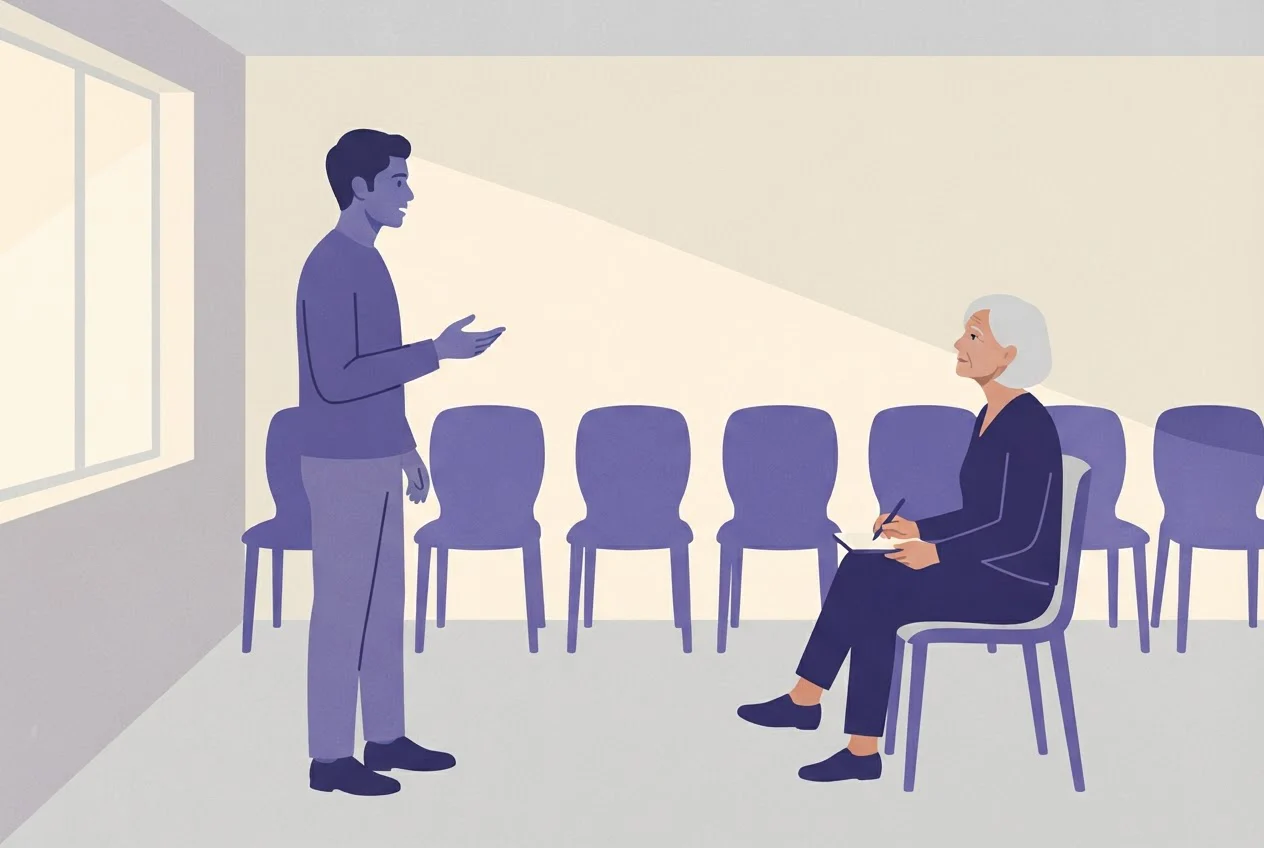
Ask five questions, and treat any vague answer as a fail. Each one is a test you can run on a phone call or an email.
- How many times will I present, and for how long each time?Pass: a number, in writing. Fail: "plenty of practice."
- Who gives the feedback, and is it recorded?Pass: a named person responds to your talk in the session, and you keep the recording. Fail: general comments to the whole group.
- How many people share the session?Pass: you can divide session minutes by participants and see your share. Fail: no cap on numbers.
- What is the total with GST, and what is the refund or reschedule rule?Pass: one all-in figure in writing. Fail: "plus taxes, as applicable."
- What will I rehearse next week, and who checks it?Pass: one defined behaviour to practise and a follow-up check. Fail: a handout and a certificate.
How do you test your own presentation before paying for anything?
Record a three-minute version of a real presentation on your phone and score it on three counts. It takes ten minutes, costs nothing and tells you which skill to pay to improve. The thresholds below are our recommendations, not research findings.

- TimeRecord the first three minutes of your talk. Pass: you cover the opening point within three minutes. Fail: the opening point is still unsaid when the three minutes end.
- Slide wordsOpen your slides and look at each one. Pass: no more than 30 words per slide. Fail: any slide above that.
- FillersWatch the recording and tally each "um", "so" and "basically". Pass: no more than 3 fillers in 3 minutes. Fail: more than that.
Repeat after seven days, changing only the one count that failed. If it passes, the problem was practice, not training. If it keeps failing, you know exactly what to bring to a tutor or workshop.
For the delivery craft behind these counts, see our guides on body language for public speaking and how to engage an audience.
Which route fits: a tutor, an open course, a club or a team workshop?
A tutor gives the most reviewed presentations per rupee, an open course gives a method and a certificate, a club gives volume, and a team workshop gives a shared standard. Pick by how often you need to present, not by price.
| Route | Best when | Watch for |
|---|---|---|
| Private tutor | You have a specific talk coming and need feedback on it | Trainer quality varies widely; ask for a free demo and a written count of presentations |
| Open course (one to three days) | You want a structured method away from work | The fee per reviewed presentation can be high; use the five questions |
| Toastmasters club | You want regular, low-cost practice | Dues are $72 per six months plus a $25 one-time new-member fee, billed in US dollars (Toastmasters International, page updated July 2026). Individual clubs may charge extra club dues. See our cost and 3-visit test |
| Team workshop | A group needs one shared standard | Agree a baseline and a follow-up check before the day, or the effect fades |
How does Rohini Mundra help with presentation skills?
We run interactive group coaching workshops and seminars for coaches, speakers, leaders, entrepreneurs and professionals, listed on our projects page. Our three-month private coaching programme runs through Inner Awareness, Soul and Karma, then Living the Wisdom.
For speaking specifically, see our page on public speaking coaches.
See Rohini Mundra programme prices, then call +91 7760095707, email rohinimundra@rohinimundra.com or contact us here.
Work on your presentations with Rohini Mundra
Frequently asked questions
Give the same three-minute talk twice in a week and change only one thing between versions. Record both and compare time, slide words and fillers. Repeating one talk with one change teaches more than reading ten tip lists. For unplanned talks, try our 30-second plan.
Sources
- 1.UrbanPro, presentation skills training in Bangalore, accessed November 2026
- 2.UrbanPro, presentation skills training in Delhi, accessed November 2026
- 3.UrbanPro, presentation skills training in Pune, accessed November 2026
- 4.UrbanPro, presentation skills training in Mumbai, accessed November 2026
- 5.The Knowledge Academy, Presentation Skills Training, Bangalore, accessed November 2026
- 6.Toastmasters International, Membership Dues and Payments, last updated July 2026