Body Language for Public Speaking: A 90-Second Self-Audit
Body language for public speaking works when gestures illustrate your words, your eyes finish each thought on one face, and you pause after key points. Test it in 90 seconds.
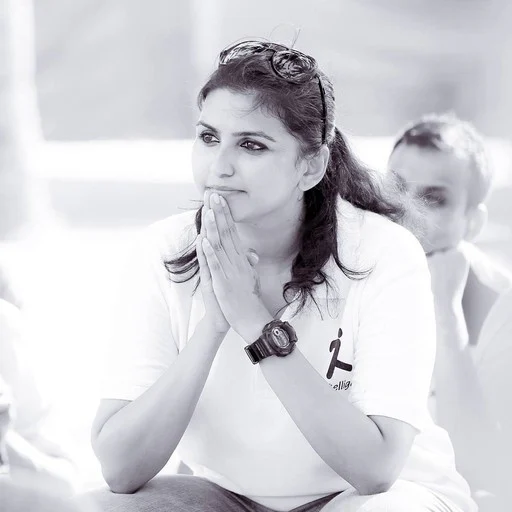
By Rohini Mundra, Founder · Updated 10 Oct 2026
Key takeaways
- Good body language for public speaking means hands that rest loose and lift to illustrate a point, planted feet, a face that matches the point, one face at a time for your eyes, and a pause of about two seconds after each key point.
- Record 90 seconds of your real talk, watch it three times, and fix only the first check that fails.
- The "55% of communication is body language" figure does not apply to speeches. Its author says so himself.
- In Indian rooms, avoid folded arms and hands behind your back. Do not assume an audience head bobble (a side-to-side tilt of the head common in India) means yes; check understanding aloud.
In this article
- 1What does good body language for public speaking look like?
- 2How do you check your body language in 90 seconds?
- 3Do your hands illustrate, or do they fidget?
- 4Do your feet stay planted while you speak?
- 5Does your face match your words?
- 6Do you pause after every key point?
- 7Do your eyes finish each thought on a different face?
- 8What do you do with the results?
- 9Do more hand gestures make a better speaker?
- 10What should you do with your hands when you are not gesturing?
- 11Why does your body shake when you speak, and how do you steady it?
- 12Is body language really 55% of communication, and why does it matter in a speech?
- 13How should body language change for Indian classrooms, panels and offices?
- 14How can a coach help you improve your delivery?
- 15Frequently asked questions
Telling a nervous speaker to "be natural" does nothing, because the problem is not attitude. Nobody has told you which of your movements help and which only show your nerves.
A University of British Columbia (UBC) study of 2,184 TED Talks (the talks from the Technology, Entertainment, Design conferences), published in the Journal of Marketing Research, found that gestures which illustrate what is being said, such as showing a size or a direction with your hands, made speakers seem more knowledgeable and easier to follow. Pointing and random movement made little difference.
In practice, a speaker who flicks a hand at every sentence and one who lifts both hands to show a size can look equally energetic, yet the audience reads them very differently. You do not need more gestures, you need the right ones.
Below is a 90-second check that shows which kind you make, with a pass or fail for each habit, and the changes that matter in Indian classrooms and offices.
What does good body language for public speaking look like?
Good body language for public speaking has five parts. Your hands rest loose and lift to illustrate a point. Your feet stay planted while you speak. Your face matches the point you are making. Your eyes finish each thought on one face. You pause for about two seconds after a key point. Each part can be tested on a recording.
Record yourself using the 90-second check below.
How do you check your body language in 90 seconds?
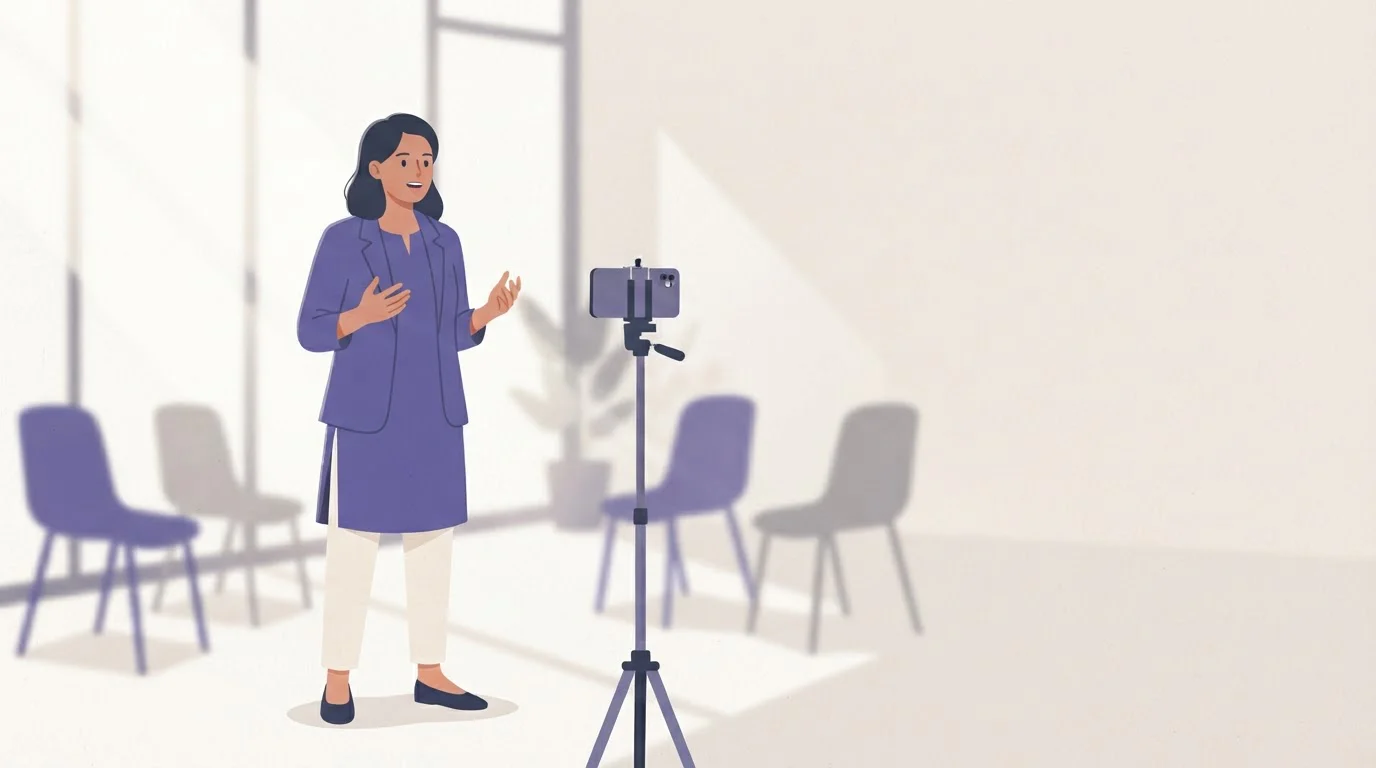
Record 90 seconds from the middle of your real talk, not the opening. Watch it three times: sound off for hands, feet and face; sound on for pauses; then once more for where your eyes land. Every check below has a pass or a fail. Fix only the first one that fails.
Set-up. Prop your phone at chest height, 2 to 3 metres away, with your whole body in frame. Stand. Place four objects or people around the room at different angles, so you have faces to look at. Speak from keyword notes only, not a script.
Do your hands illustrate, or do they fidget?
Watch with the sound off and count every gesture in one 60-second stretch. Mark each as an illustrator (it shows a size, a direction, a list, a contrast or a sequence) or a fidget (touching your hair, a ring or a pocket, or playing with a pen). A clicker or card held still at waist level does not count as a fidget.
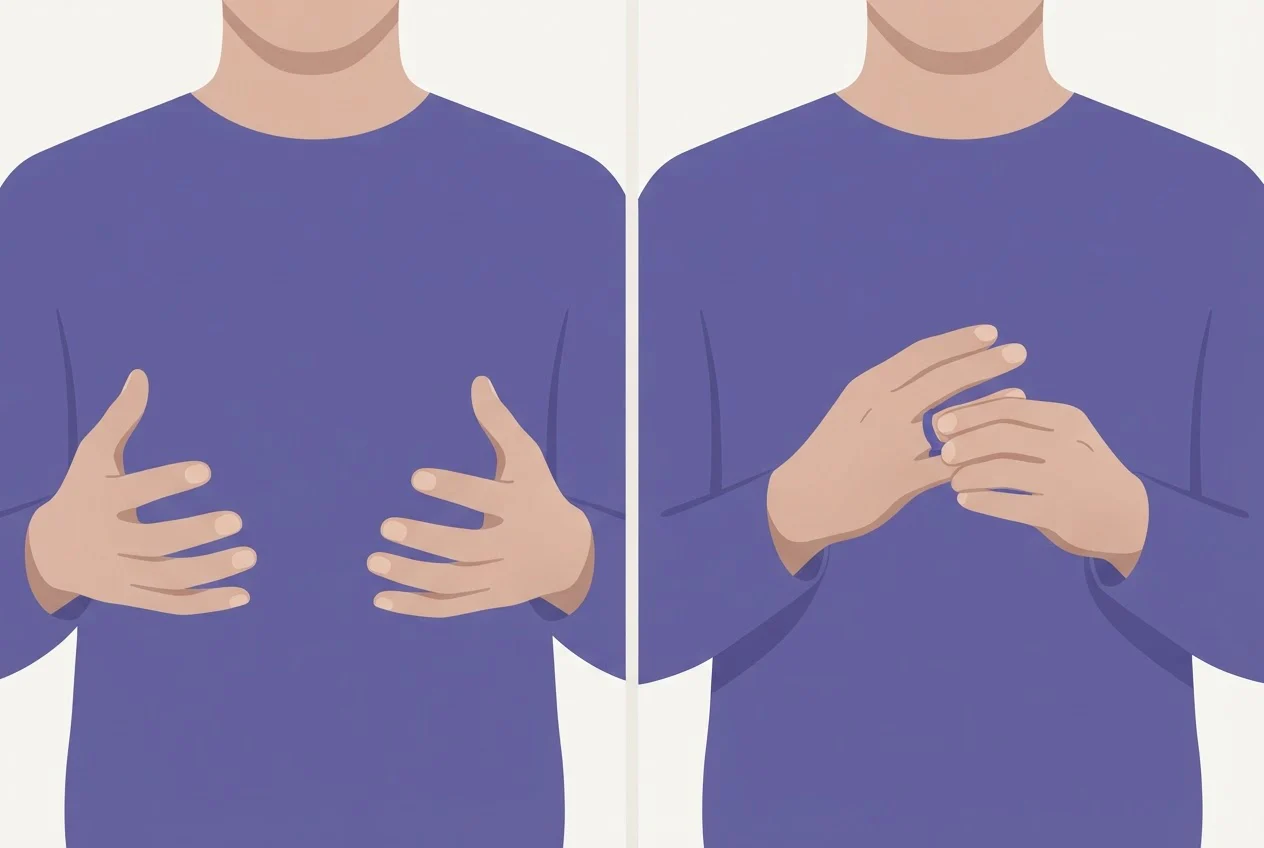
Pass: you make at least one gesture, at least half of your gestures are illustrators, and you make three or fewer fidgets. Fail: anything else. No gestures at all is a fail: lift your hands at the next size, direction, list or contrast.
Do your feet stay planted while you speak?
Keep the sound off. Watch your feet and shoulders.
Pass: no sway, weight shift or step during a sentence. Fail: one or more. If you need to cross the room, do it in the pause between sentences, then stop, look up and speak.
Does your face match your words?
Still with the sound off, watch your face as the points change.
Pass: your face visibly changes at least once to match the tone of a point (warm, serious, curious) and you do not hold one fixed smile or frown. Fail: the same expression throughout.
Do you pause after every key point?
Switch the sound on. List your key points, then count "one, two" silently after each.
Pass: every key point is followed by at least two seconds of silence, with no "um", "so" or "okay" in it. Fail: any key point without that gap. Fast talking reads as nervousness, and a pause is the cheapest way to slow down. The two-second length is our recommendation.
Do your eyes finish each thought on a different face?
Watch a third time and note where your gaze rests at the end of each sentence.
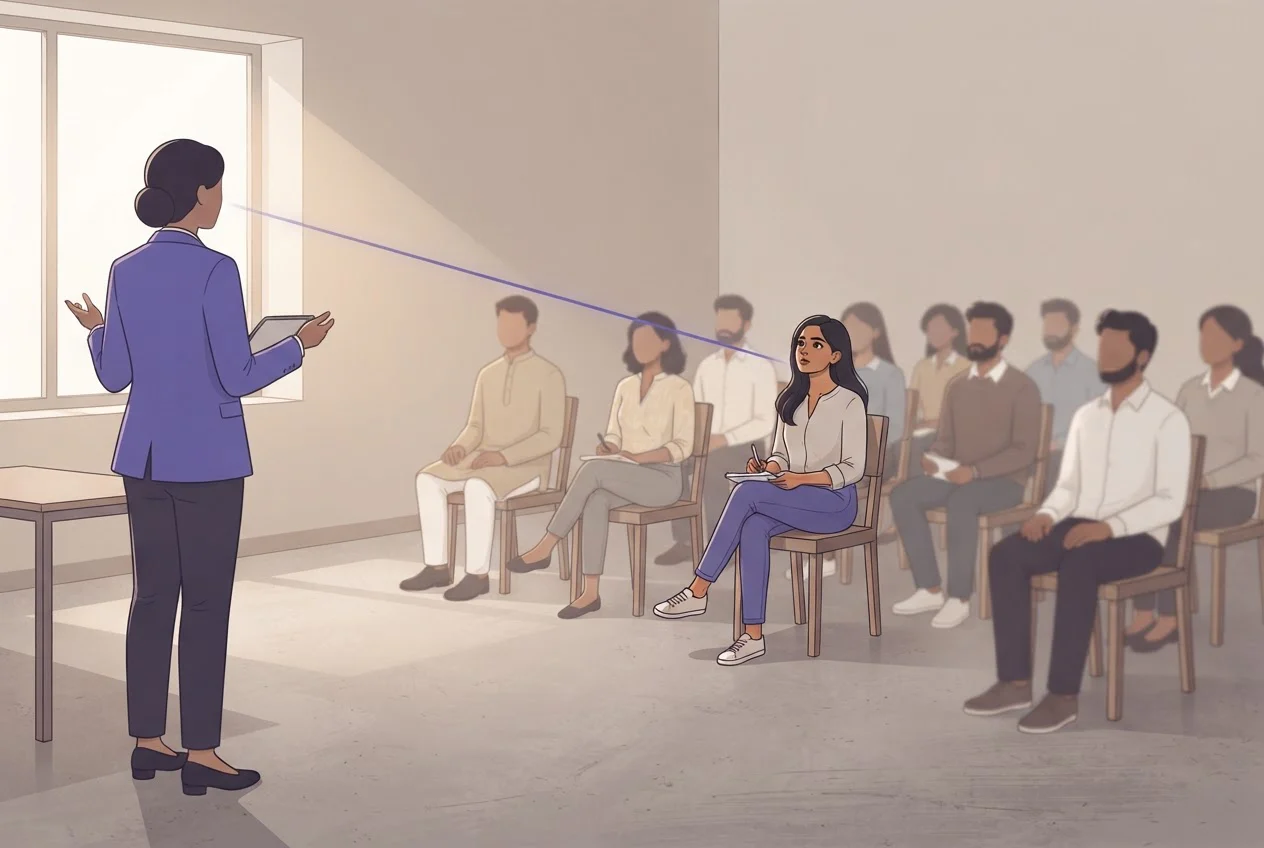
Pass: you land on four or more different spots in the 90 seconds, no single spot takes more than half of your sentence endings, and every glance at your notes lasts under two seconds. Fail: otherwise. We suggest holding each spot for one thought, roughly 3 to 4 seconds. If direct eye contact frightens you, look at the forehead of a friendly person, then move to another face after each thought. The National Programme on Technology Enhanced Learning (NPTEL) lecture on oral presentation from the Indian Institute of Technology (IIT) Kanpur gives the same trick and warns against staying fixed on one person.
What do you do with the results?
Pick the first check that failed and work only on that. Re-record on days 3, 5 and 7, changing one thing each time. Rehearse your first 15 seconds standing still with your hands loose, so you begin from a calm base. Our guide on how to start a speech helps you build that opening.
Do more hand gestures make a better speaker?
No. The type of gesture matters more than the number. In the UBC study, which isolated more than 200,000 hand gestures into 10-second clips, illustrators had the strongest effect, while highlighters (pointing at things) and random gestures showed little to no impact (UBC News).
In randomised experiments with 1,600 participants, speakers delivered identical scripts with different hand movements. Those who illustrated were rated more clear, competent and persuasive (The Conversation, Phys.org). Random waving, fidgeting and pointing at things in the room gave no benefit and sometimes distracted. The reason is that the audience gets the same idea twice, in words and in a picture.
That is why the hands check counts the share of illustrators, not the total. Do not choreograph your gestures. Rehearse the talk aloud, mark the three moments that involve a size, a direction or a list, and let your hands show them.
What should you do with your hands when you are not gesturing?
Let your hands hang loose at your sides, then lift them when you have something to illustrate. It will feel awkward to you and look normal to the room. Avoid gripping the lectern, clasping your hands in a prayer position, hiding them in pockets or behind your back, and fiddling with rings, watches or pens.
Many speakers want one fixed hand position to return to when they feel lost, and steepling (fingertips together) is the usual choice. Use it briefly if you must, but do not live there. If you have always spoken from behind a lectern, stepping out will feel exposed at first. Start by standing beside it for the first minute, then move into open space once you have your rhythm.
Why does your body shake when you speak, and how do you steady it?
Shaking, a thumping heart and tight muscles are your body's normal stress response to speaking in front of people, and they usually ease once you are a few sentences in. Steady them by giving your hands a job, slowing your breath and making the room smaller.
- Hold something light. A clicker or a single card, held still at waist level, gives trembling hands somewhere to be. A loose sheet of paper amplifies a tremor, so use a card.
- Breathe out slowly before you start. Take two or three slow breaths with a long exhale, then pause before your first sentence.
- Make the room smaller. Pick three friendly faces in different parts of the room and speak to each in turn, so the room feels like three conversations.
Avoid coffee and energy drinks before you speak, and keep your notes to keywords, as the University of Sydney's speaking tips advise. If fear is the bigger problem than technique, our ladder and script for overcoming fear of public speaking takes it in steps.
Is body language really 55% of communication, and why does it matter in a speech?
No. The "7-38-55" split (7% words, 38% tone of voice, 55% body language) comes from experiments on how people communicate feelings and attitudes, such as like and dislike. Its author, Albert Mehrabian, states on his own site: "Unless a communicator is talking about their feelings or attitudes, these equations are not applicable."
So do not quote the 55% figure, or the claim that 93% of communication is non-verbal (the 38% tone plus 55% body language), in an essay or a presentation.
There is better evidence that body language matters in a speech. In a Science of People study led by Vanessa Van Edwards (not peer-reviewed; 760 volunteers rating TED Talks of 15 to 20 minutes posted on TED.com in 2010), viewers who watched without sound rated speakers almost exactly the same as those who heard them, including on charisma, credibility and intelligence. Those are impressions, and they do not show that words do not matter. The UBC findings above add the other half: illustrating gestures improve understanding.
For a ppt (PowerPoint presentation), face the audience, glance at your slides only occasionally, and never read them aloud, because reading costs you the eye contact you built at the start.
How should body language change for Indian classrooms, panels and offices?
Keep the core habits and adjust four things for an Indian room. Do not fold your arms or put your hands behind your back. Do not assume an audience head bobble means yes. Sweep your eyes from face to face rather than staring. Point with an open palm, not one finger. These adjustments are our recommendations, built on the sources in the table.
| Situation | What we recommend | Basis |
|---|---|---|
| Folded arms, hands behind your back, hands in pockets | Keep arms open and hands visible | BusinessCulture.org advises avoiding hands on the back and folded arms in Indian business communication. We extend this to pockets |
| Audience head bobble | Check understanding aloud: "What should I go deeper on?" | The head bobble can mean yes, good, maybe, okay or "I understand", and an unenthusiastic one can be a polite way of declining. It is more frequent in South India |
| Eye contact with teachers, seniors and panels | Finish a thought on each person, then move on | BusinessCulture.org notes that constant eye contact is not usual, particularly with women and people in lower positions. A sweep suits every member of a panel |
| Pointing | Use an open palm | A palm reads as an invitation and a finger can read as an accusation (our judgement) |
If your audience speaks several languages, lean on illustrating gestures. They carry meaning when a word may not land (our inference, in line with the UBC finding on understanding).
How can a coach help you improve your delivery?
A coach watches the recording with you, picks the one habit that costs you most, and has you repeat it until it holds. The audit works alone, but a second pair of eyes catches habits you have stopped noticing.
We have spoken from a TEDx stage ourselves: Rohini Mundra is listed as a speaker at TEDxDSCE in Bengaluru, held on 31 May 2017. Our Group Coaching Workshops-Seminars help coaches, speakers, leaders, entrepreneurs and professionals discover their niche, improve communication and leadership skills, and turn their knowledge into programmes and businesses. If you are comparing options, our guide to public speaking coaches shows how to choose a fit for business speaking.
If you want feedback on delivery, send us your details with a 90-second recording and tell us what you present and where. We will tell you whether a workshop suits you.
Get feedback on your delivery from Rohini Mundra
Frequently asked questions
Sources
- 1.Talk with your hands to be more persuasive, UBC News, November 2025
- 2.Journal of Marketing Research paper on hand gestures in TED Talks, SAGE Journals, 2025
- 3.People who talk with their hands seem more clear and persuasive, The Conversation
- 4.Hand gestures that illustrate speech boost persuasiveness, Phys.org, November 2025
- 5.Body language survey points to 5 nonverbal features that make TED Talks take off, TED Blog
- 6.Mehrabian's note on the 7-38-55 equations, Albert Mehrabian
- 7.Communication Skills, Lecture 33: Oral Presentation, NPTEL, IIT Kanpur
- 8.Speaking tips, University of Sydney
- 9.Indian business communication, BusinessCulture.org
- 10.Head bobble, Wikipedia
- 11.TEDxDSCE, TED, 31 May 2017