Advisers Encouraged to Remind Clients About Health Tools: What Nib’s Update Means for a Health Coach


TL;DR
We explain what nib’s August 2026 adviser reminder confirms: it points clients to existing health tools, with more than 21,700 member engagements in FY25. For a Health Coach, the useful signal is demand for measurable, care-connected support, alongside clear clinical and insurance boundaries.
nib New Zealand’s preventive-health update has put practical health support back into advisers’ client conversations. In FY25, more than 21,700 members engaged with a health and wellbeing tool or programme, according to nib’s August update.
On 21 August 2026, RiskinfoNZ reported that nib encouraged advisers to remind clients about existing health tools. The primary record confirms a Health Coach sits within an established prevention offer, not a newly announced insurance benefit. For coaches, the development highlights demand for care-connected, measurable support while leaving clinical decisions with qualified professionals.
We unpack what was reported, what the available evidence actually supports, and how independent coaches can respond without overstating their role.
What Happened on 21 August 2026
The RiskinfoNZ report said nib was encouraging advisers to remind clients about proactive and preventative support available through private health insurance. Its publication date was 21 August 2026, following nib’s member-facing update four days earlier.
This is important because the development is about awareness of established services, not a confirmed launch of a new health-coaching product. For founders, it is a useful reminder that a good offer needs clear access, positioning, and follow-through. The same principle applies when we help clients choose business support formats that match the problem they are trying to solve.
What It Means for a Health Coach
Health coaching has a defined but limited role in a care-connected system. Health NZ guidance says coaches can help people and whānau build knowledge, confidence, goals, and connections to support, while noting that general-practice health coaches are not registered health professionals.
nib’s own service has a more specific staffing model. Its update says its two health coaches are registered nurses, which means their service should not be treated as a universal description of every coach using the title. For independent practitioners, scope is part of the value proposition, not an awkward disclaimer added at the end.
| Role | Appropriate Contribution | Boundary |
|---|---|---|
| Health Coach | Goal setting, confidence, behaviour support, and resource navigation | Does not independently diagnose or prescribe |
| Registered Clinician | Clinical assessment, treatment, and escalation | Works within a regulated professional scope |
| Financial Adviser | Insurance advice and policy suitability | Does not provide clinical advice |
| Insurer Or Programme Provider | Eligibility, tools, programme access, and administration | Does not guarantee individual outcomes |
Delivery format matters too. A coach may use individual sessions, groups, or structured education, but each calls for a different promise and operating model. Our guide to workshop, group, and private formats can help clarify that choice.
The Numbers Behind Nib’s Prevention Signal
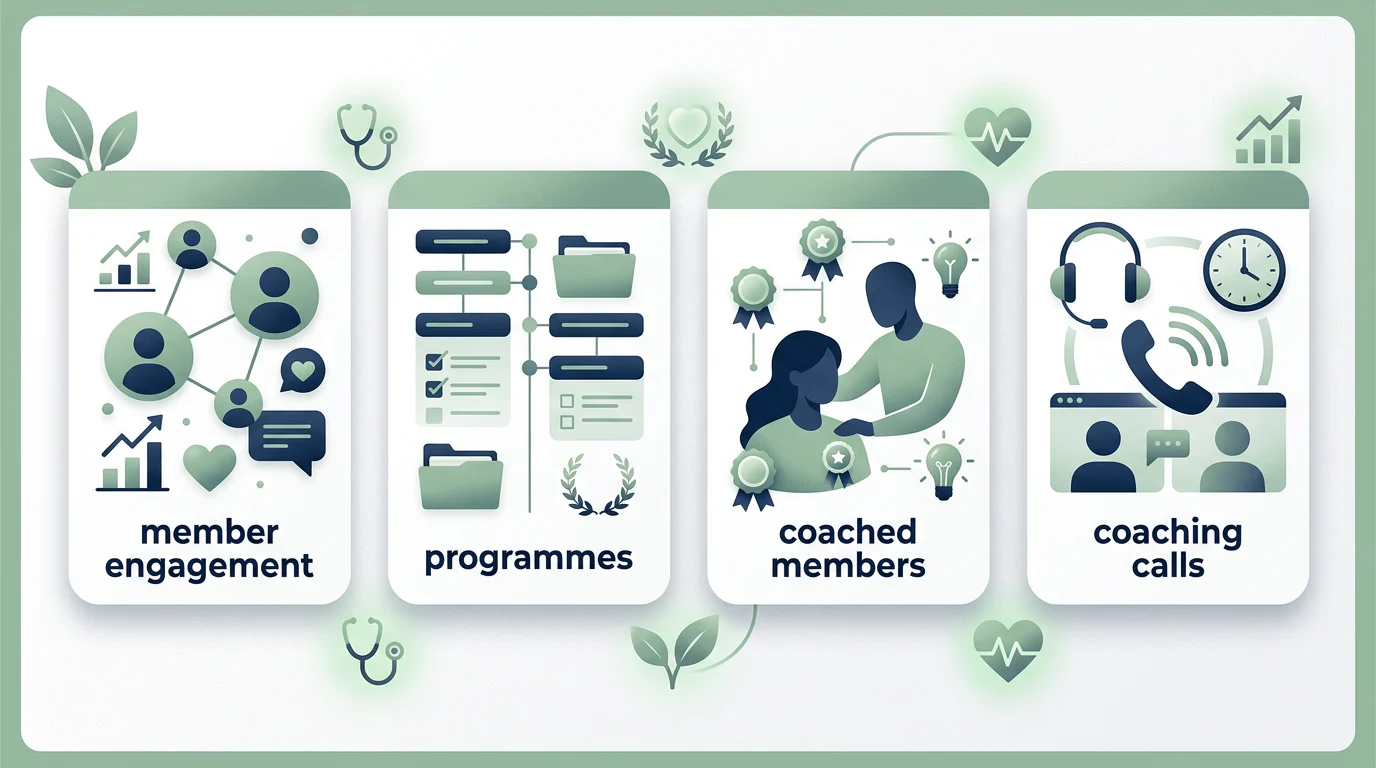
nib says it offers 11 Health Management Programmes and that more than 21,700 members engaged with a tool or programme during FY25. Those FY25 figures establish usage, not a published measure of reduced claims, lower system costs, or improved clinical outcomes.
Engagement Is Not Clinical Proof
The member-engagement total matters because it shows that people are using preventive-health support attached to insurance. It does not reveal how many completed a programme, what changed for them, or whether results held over time.
That distinction protects both clients and coaches. A Health Coach can say that a service supports action, accountability, and navigation, but should not turn an engagement figure into a promise of treatment, recovery, or savings. Our constraint map uses the same discipline: identify the real constraint before prescribing the solution.
What 192 Members Shows
From July 2024 to June 2025, nib says its health coaches supported 192 members, with each member able to access up to six 45-minute calls. This indicates a structured, bounded support service, with coaching positioned alongside health navigation rather than as a replacement for clinical care.
For an independent practice, the practical lesson is to make delivery measurable. Track how clients enter, what they work on, which referrals they complete, and what progress they report. Those records make the service easier to improve and easier for potential partners to understand.
Recognition Is Not an Outcome Study
Rebekka Costello received the 2025 Health Equity Award, as confirmed by the award announcement. It is fair to describe that as professional recognition for work in health equity.
It is not evidence that every health-coaching model produces the same result. We should keep public claims proportionate to the evidence available, especially where people may interpret wellbeing support as medical care.
The Evidence Needs a Measure
Research supports careful optimism, not sweeping claims. A systematic review of 30 studies found health-and-wellness coaching improved several patient-important outcomes, but reported mostly low or very low certainty because of bias, variation, and imprecision.
That is why the strongest coaching businesses define a specific client problem, a specific delivery process, and a small set of outcome measures they can responsibly track.
How Coaches Can Build Care-Connected Offers
The news does not mean every coach should pursue insurer work. It does show why organisations may value services that help people follow through on goals, understand their next step, and connect with the right support. We also caution founders against simply adding hours or services when working harder is the real response to an unclear offer.
Start with a Narrow Problem
Choose a problem that coaching can genuinely support, such as building routines after a clinician’s plan, preparing questions for an appointment, or sustaining lifestyle changes. Keep diagnosis, prescribing, and treatment decisions with the appropriate professional.
New Zealand’s need for coordinated support is substantial. The Ministry’s 2024 report estimated that 35.9% of adults had multimorbidity in 2024, up from 31.3% in 2020. Complexity makes scope and referral pathways more important, not less.
Track What Matters
| Measure | What It Can Show | What It Cannot Prove Alone |
|---|---|---|
| Attendance | Whether clients engage with the service | Whether health improved |
| Goal Progress | Whether clients report movement on agreed actions | A clinical outcome |
| Referral Completion | Whether a client reached the next support step | The quality of clinical treatment |
| Client Feedback | Whether the service felt useful and understandable | Long-term impact across all clients |
Use the table as an operating tool, not a marketing shortcut. When results are mixed, they point to a service-design question: onboarding, fit, frequency, follow-up, or referral quality.
Build the Referral Boundary in Early
A sound offer tells clients what happens when their needs move beyond coaching. Document when to pause, refer, or encourage urgent professional support. This is good client care and protects the trust that lets coaching work.
If your business feels active but its promise is unclear, start by diagnosing the bottleneck before adding new services, tools, or audiences.
What to Verify Before You Make a Claim
Before describing any insurer-supported programme, verify who can use it, what the programme includes, and whether access has changed. nib’s programme terms say eligibility can depend on age, hospital cover, paid premiums, programme-specific requirements, recent enrolment, exclusions, and available places.
We also recommend separating three statements in your own copy: what a client can access, what coaching helps them do, and what clinical outcome they may experience. The first is an eligibility fact, the second is a service description, and the third requires evidence.
This keeps the offer useful without confusing prevention support with treatment. It also keeps capacity visible, which matters if your business can only grow as far as your time and systems allow. Use our capacity check to assess that limit before you expand.
Work with Rohini Mundra
At Rohini Mundra, we help expert-led businesses turn useful work into a focused, repeatable offer. For health coaches, that means defining the client problem you solve, the evidence you can responsibly track, the referral boundaries you protect, and the delivery model your time can sustain. We do not ask you to imitate clinical teams or make promises that your data cannot support. We help you build commercial clarity around the expertise you already have.
Together, we turn scattered sessions and generic messaging into a client journey that is easier to communicate, sell, deliver, and improve without stepping outside your professional scope. If your services feel busy but hard to explain, we can work with you to diagnose the constraint, choose an offer format, and shape a clearer growth plan. Start by assessing your offer, then tell us what you want to build through contact Rohini.
FAQs on Health Coach
We answer plainly.
Did Nib Launch a New Health Coaching Benefit in August 2026?
No. Advisers were asked to remind eligible clients about existing tools and programmes. Members should check current policy terms before assuming access, inclusion, or cover.
How Many Nib Members Used Health Tools in FY25?
nib says more than 21,700 members used a health and wellbeing tool or health management programme in FY25. This counts engagement, not published clinical results.
Are Health Coaches Registered Health Professionals?
Not necessarily. Health New Zealand says general-practice coaches receive coaching training but are not registered health professionals, while nib says its coaches are registered nurses.
What Should Independent Health Coaches Measure?
Track attendance, goal progress, referrals completed, participant feedback, follow up, and scope boundaries. These measures strengthen credibility without claiming diagnosis, treatment, clinical outcomes, or savings.