How to Improve Self-Esteem: Six Small Steps and a 7-Day Check
To improve self-esteem, take six small steps for a week, write three things you did well each evening, rate the day from 1 to 5 and compare the start with the end. If low self-esteem lasts, a doctor or counsellor can help.

By Rohini Mundra, Founder · Updated 27 Oct 2026

Key takeaways
- To improve self-esteem, do six small steps over a week, rate each evening from 1 to 5, and compare the average of Days 1 and 2 with the average of Days 6 and 7.
- Write three specific things you did well every evening. Specific actions ("I sent the quotation before lunch") give the rating something to rest on; labels ("I'm useful") do not.
- The rating is a personal self-check, not a clinical measure. A flat or falling score is a reason to read the support section, not a failure.
- If low self-esteem lasts a long time, makes you avoid situations, or comes with low mood or anxiety, talking to a doctor, psychiatrist or qualified counsellor can help.
In this article
- 1What is self-esteem, and how do you tell it is low?
- 2How to improve self-esteem: six small steps
- 3Step 1: Catch one self-critical thought and write it down
- 4Step 2: Keep a log of three things you did well each day
- 5Step 3: Set one small boundary and say no once
- 6Step 4: Take one action you have been avoiding, sized small
- 7Step 5: Cut comparison triggers, on LinkedIn and at work
- 8Step 6: Move and sleep
- 9A 7-day plan and how to check it worked
- 10Your 7-day table
- 11How to read your ratings
- 12When is self-help not enough?
- 13Signs it is time to get support
- 14Who to contact in India
- 15Where to go next
- 16Frequently asked questions
Most advice on how to improve self-esteem ends with a list and no way to tell whether any of it worked.
This page turns the list into a week with one small action a day. Each evening you write down three things you did well and put a number on the day. By day seven there is something on paper to compare.
The steps are built for a working day: a sentence to write in a meeting break, one polite no, and a plan for LinkedIn and for the colleague who always seems ahead. They are practical ways to build self-esteem at work without waiting to feel confident first. The rating is a personal check, not a clinical measure, but it gives you something to look at instead of a feeling.
Some low self-esteem does not move with self-help, however carefully you follow the steps. The last part of the page says when to stop, and who to contact in India.
What is self-esteem, and how do you tell it is low?
Self-esteem is the opinion we have of ourselves (NHS). You can tell it is low when you see yourself and your life in a more negative and critical light, feel less able to take on challenges, or hold back from new things and social situations (NHS). Mayo Clinic adds common patterns such as dismissing your achievements and putting yourself down (Mayo Clinic).
Self-confidence is different. It is your belief that you can do a particular thing, such as present to a client or run a team meeting. You can be confident at work and still feel you are not enough, because confidence is about skill and self-esteem is about worth (Calm). Some sources, including Mind, use the two words almost interchangeably. The steps below work on worth: how you treat yourself when things go well and when they do not.
How to improve self-esteem: six small steps
Improve self-esteem with six small steps: catch a self-critical thought, log three things you did well, say no once, do one avoided task, cut comparison triggers, and move and sleep. Each step is small, and together they feed the 7-day check further down this page: Step 2 is daily, Steps 1 and 3 to 5 are placed on set days in the table, and Step 6 runs in the background.
Step 1: Catch one self-critical thought and write it down
Write the thought exactly as it sounds in your head, then test it against the facts. For example: "I always mess up presentations." Under it, write one fact that supports the thought and one that goes against it. The NHS advises writing down evidence that challenges negative beliefs. Writing one fact for and one fact against the thought is our way of doing that.
Mayo Clinic notes that long-held thoughts can feel factual even when they are opinions (Mayo Clinic).
Then run the friend test: would you say this sentence to a friend in the same position (Mind)? If not, rewrite it as something fair rather than flattering: "The Tuesday presentation overran. Thursday's ended in a clear decision." You do not need to feel positive. You need the sentence to be fair.
If the same thought keeps returning, test one belief for seven days instead of arguing with it daily. If you cannot yet see when these thoughts appear, build self-awareness first.
Step 2: Keep a log of three things you did well each day
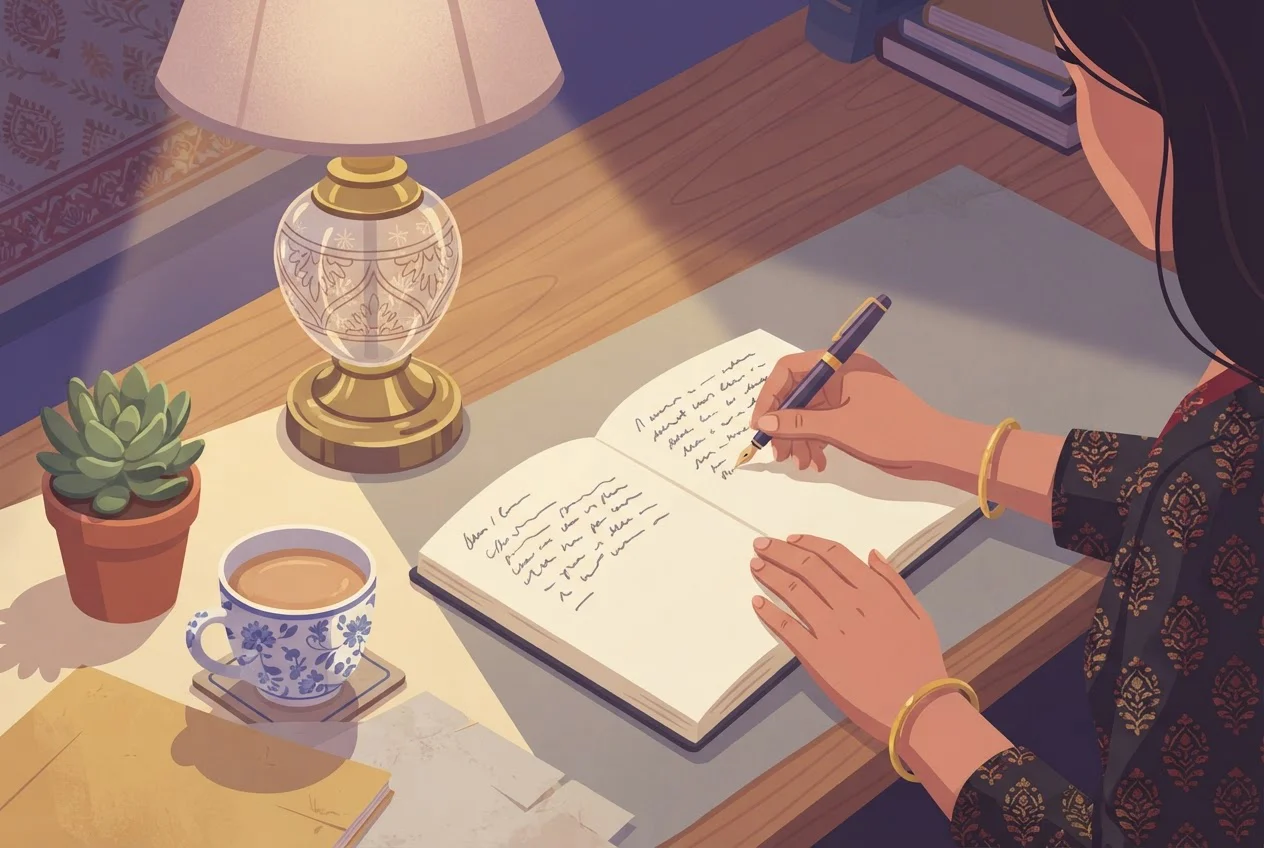
Each evening, write three things you did well that day. Each should be specific and within your control: "I replied to the client within the hour", not "I'm a good professional". If three feels impossible, make them smaller. "I started the report" counts.
Mind suggests celebrating your successes, however small, and saving what you like about yourself to look over when you are doubting yourself (Mind). These three daily lines serve the same purpose: they are your daily record, something to look back on when a day feels like a failure.
Step 3: Set one small boundary and say no once
Choose one small request this week and say no, or “not now”, without a long explanation. For example: “I can’t take that on this week. I can look at it on Monday.” Mind suggests practising saying no, and pausing to think about how you feel before you agree (Mind). The NHS says always saying yes can leave you overburdened and resentful, and that saying no does not usually upset relationships (NHS). A boundary this small lets you find out what actually happens when you say no.
The NHS suggests spending less time with people who bring you down (NHS). Mind suggests asking people what they like about you, if you feel comfortable (Mind). Write their answer in your log.
Pro Tip: If a flat “no” feels too hard, start with “not now”. The NHS says it can help to keep saying no, in different ways, until the message lands (NHS).
Step 4: Take one action you have been avoiding, sized small
Pick one task you have been putting off and cut it down until you can finish it in one sitting: send the first paragraph of the email, ask the question in the meeting, update one line of your profile.
Mind suggests setting small goals to make things feel more manageable (Mind). The NHS says avoiding difficult things may feel safe at first, but over time it can reinforce your doubts (NHS). A finished, avoided task is an entry in your log that is hard to argue with.
Step 5: Cut comparison triggers, on LinkedIn and at work
Mute the accounts and conversations that regularly leave you feeling behind, and compare yourself only with your own Day 1. Mind suggests limiting time on social media, because what people choose to share is not always the full picture.
On LinkedIn, open the app for a purpose (post, message, job search) rather than as a break. At work, when a colleague or batchmate announces a promotion, write it down as a fact about them, not a verdict on you, and go back to your own log. In our view this is a practical first move for self-esteem at work: it replaces a daily scorecard built from other people’s highlights with your own record.
Step 6: Move and sleep
- Move: do some movement every day. A walk counts (Mind).
- Sleep: keep a steady bedtime, because a short night makes your evening rating harder to read.
A 7-day plan and how to check it worked
The 7-day plan combines Steps 1 to 5 into one daily row, so you keep one evidence log and not two. Each evening, write three things you did well and rate the day from 1 to 5 by asking: how fairly did I treat myself today? A 1 means mostly harsh, a 5 mostly fair. Step 6 runs in the background every day and has no row.
Rate how you treated yourself, not how the day went. A bad day at work can still be a fair one. These self-esteem exercises are short by design, so you can finish them while the day is fresh. To see where self-esteem sits among your other life areas, score your wheel of life.
Your 7-day table
| Day | Step to do | Three things I did well | Evening rating (1-5) |
|---|---|---|---|
| 1 | Step 1: write one self-critical thought, one fact for it and one fact against it | 1 ___ 2 ___ 3 ___ | __ / 5 |
| 2 | Step 1 again, with the friend test: rewrite the thought as a fair sentence | 1 ___ 2 ___ 3 ___ | __ / 5 |
| 3 | Step 3: say no, or "not now", to one small request | 1 ___ 2 ___ 3 ___ | __ / 5 |
| 4 | Step 4: finish one small task you have been avoiding | 1 ___ 2 ___ 3 ___ | __ / 5 |
| 5 | Step 5: mute the accounts that leave you feeling behind; compare yourself only with Day 1 | 1 ___ 2 ___ 3 ___ | __ / 5 |
| 6 | Repeat whichever of Steps 3 to 5 felt hardest | 1 ___ 2 ___ 3 ___ | __ / 5 |
| 7 | Step 1 again: write a new thought, then compare it with Day 1's | 1 ___ 2 ___ 3 ___ | __ / 5 |
How to read your ratings
Add your Day 1 and Day 2 ratings and divide by two. Do the same for Day 6 and Day 7. Then compare the two averages. For example, ratings of 2 and 3 average 2.5, and ratings of 3 and 4 average 3.5. These numbers only show the arithmetic; yours will be your own.
If the later average is higher, that may mean the steps are helping how you treat yourself, though one week cannot prove it, so repeat the week to see if it holds. If the two averages are the same, repeat the week and compare again. If the later average is lower, that is information, not failure: read the next section.
The limits are real. You are comparing four ratings from one person after one week, and a hard week at work can pull the score down whatever you do. This is a personal self-check, not a clinical measure.
When is self-help not enough?
Self-help may not be enough when low self-esteem has become long-term, leads you to avoid situations, or goes with low mood or anxiety. In that case, talking to a doctor, psychiatrist or qualified counsellor can help more than adding more steps. Reaching out is a sensible next step, not a sign the steps failed.
If you are deciding between a coach and a clinician, life coach, therapist or mentor compared sets out the difference. If you are weighing paid help for feelings of being a fraud at work, this guide to your options shows the route.
Signs it is time to get support
The NHS says low self-esteem that becomes a long-term problem can harm your mental health and day-to-day life. It also says avoiding challenges can reinforce your doubts over time, and that low self-esteem can lead to problems such as depression and anxiety (NHS). If that sounds familiar, you do not need to finish all the steps before getting support.
Who to contact in India
Start with a doctor, a psychiatrist or a qualified counsellor. Ask any counsellor about their training and approach before the first session. Counselling and cognitive behavioural therapy (CBT), a structured talking therapy, are the talking therapies the NHS names for low self-esteem (NHS).
Tele-MANAS (Tele Mental Health Assistance and Networking Across States), India's free 24x7 national helpline, can be reached on 14416 or 1800-891-4416 (as of October 2026). If you are in distress right now, call the helpline before you finish this page.
If you are weighing paid help for feelings of being a fraud at work, paying for an imposter syndrome coach in India explains what to check first.
Where to go next
Improving self-esteem is rarely one big decision. It is a week of small, specific actions and an honest look at the numbers afterwards. Start tonight with Day 1 of the table. If your ratings rise, repeat the week. If they stay flat or fall, or if low self-esteem is getting in the way of your day-to-day life, talk to a doctor, psychiatrist or qualified counsellor.
For a different approach, see how to reprogram your subconscious mind.
We offer private coaching and group programmes. Coaching does not replace a doctor or counsellor. If you want to ask whether coaching suits where you are now, contact us.