Become a Life Coach in India Without Quitting Your Job
A narrow first coaching offer, a practice plan, a client agreement and a referral rule that can operate alongside a full-time job.
- Time
- At least 3 months
- Difficulty
- Moderate
- Cost
- Provider-dependent
- Steps
- 8
Before you start, have
- A calendar outside your employer's systems
- Your employment agreement and conflict-of-interest policy
- A private system for client notes and records
- A draft coaching agreement
- A referral and emergency-contact list
Heads up: Do not represent coaching as diagnosis, treatment or crisis care.
Heads up: Do not make income, healing or transformation guarantees.
Heads up: Use current written terms from any training provider before paying.

By Rohini Mundra, Founder · Updated 9 Sept 2026
In brief
Start with a narrow goal-and-action coaching scope, then choose training, practise, set client terms and invite first conversations outside your job. The optional International Coaching Federation Associate Certified Coach route provides a measurable framework for education, practice, mentoring, evaluation and an exam.
Set a coaching scope you can defend
Write down the client goals you can support through questions, action planning and accountability. Exclude analysis, diagnosis, treatment, care and rehabilitation for mental illness from your offer. You are ready to continue when your scope fits in one plain-language paragraph.
Choose training against published standards
Decide whether you want a provider-specific training route or the optional International Coaching Federation Associate Certified Coach route. Use the ICF Education Search Service to review accredited education, then compare delivery, practice and mentoring against your available time. You will have a named route and a written reason for choosing it.
Protect your job and schedule
Read your employment terms before you coach anyone. Block coaching, study and administration time outside employer systems, do not use work contacts, and keep coaching records separate. This step works when you can show where coaching fits in your week without conflicting with your job.
Practise and log each session
Start with practice conversations that stay inside your written scope. Record the date, client type, goal, coaching time and learning point after each session. If you pursue the Associate Certified Coach route, keep the log from the start because client-coaching experience is part of the application evidence.
Package one narrow first offer
Choose one audience and one practical goal. State the offer in one sentence, name what is included, and make clear what is outside scope. You have a usable first offer when a prospective client can repeat who it is for, what they will work on and what coaching will not provide.
Use an agreement and referral rule before accepting a client
Send the agreement before the first session. Cover goals, roles, confidentiality, payment and cancellation, then explain your referral rule for requests outside coaching or any imminent safety concern. Store records securely and keep Tele-MANAS and 112 in your referral list.
Check business compliance before taking payment
Track your aggregate turnover and get qualified tax advice before invoicing grows. The CBIC GST FAQ states an ordinary registration threshold above ₹20 lakh, with ₹10 lakh in special-category states and exceptions that may apply. This step is complete when you know who will review your tax position.
Invite first conversations with accurate claims
Invite people who match your narrow offer to a conversation. State your actual qualifications, experience and coaching scope, then explain the agreement before any paid engagement begins. You are ready for a first client when your invitation, agreement and referral rule all describe the same service.
You'll know it worked when
You have a written coaching scope, a named training or practice route, a separate work schedule, a session log, a narrow first offer, a ready client agreement, a referral list and an accurate first-client invitation.
Use an optional, measurable training route
The International Coaching Federation's current Associate Certified Coach requirements create a clear evidence trail for people who want to pursue that route. Its Education Search Service can help you find accredited education without treating one provider as the right choice for everyone.
The Associate Certified Coach evidence trail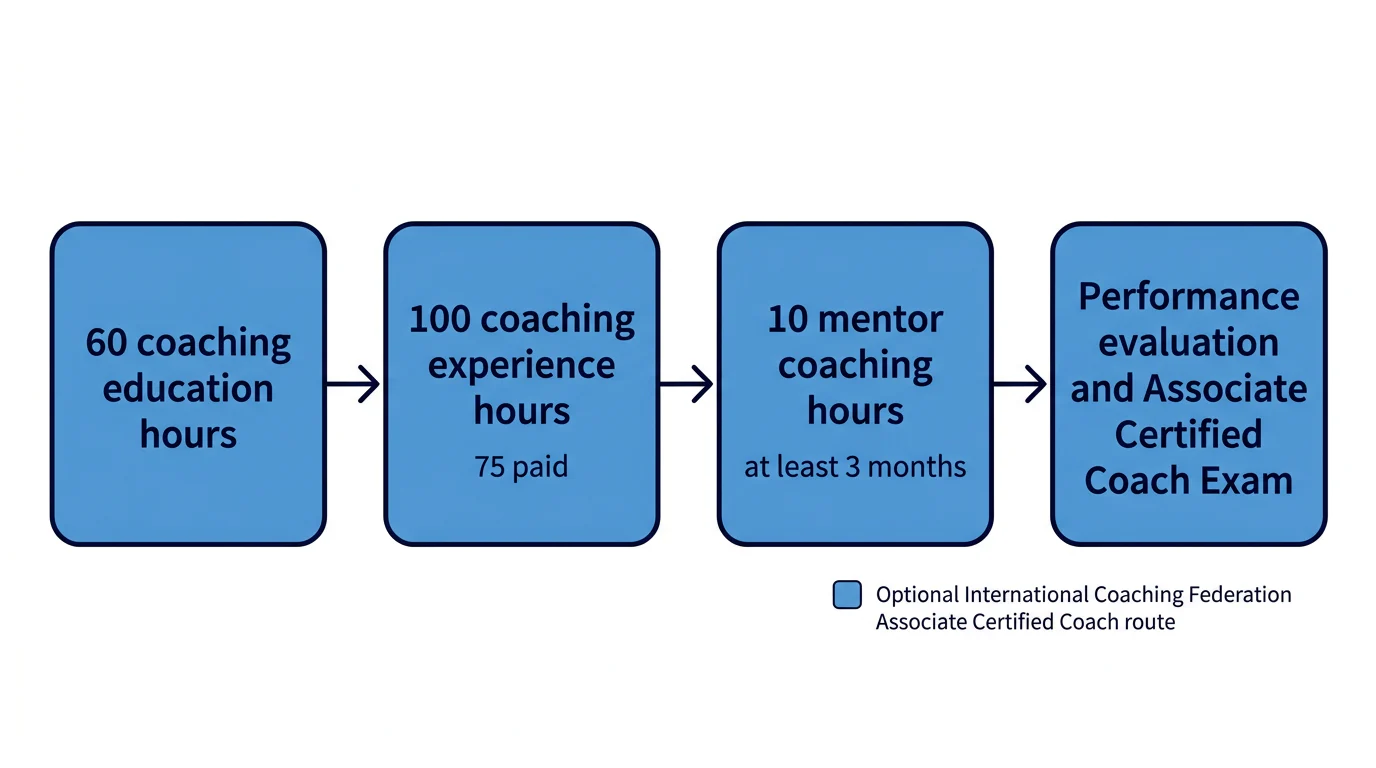
Keep the work inside coaching
Coaching can focus on a client's goals, choices, actions and accountability. Do not market your service as analysis, diagnosis, treatment, care or rehabilitation for mental illness, because the Mental Healthcare Act's definition of mental healthcare includes those activities. If a client needs mental-health support, refer them to appropriate care. Tele-MANAS is available on 14416 or 1800-89-14416, and 112 is India's emergency-response number for imminent emergencies.
Make your first offer narrow enough to explain
Write one sentence: “I help [a specific group] move from [a specific goal] to [a specific action plan] through goal-and-accountability coaching.” Keep the outcome within your experience and do not promise income, healing or a transformation. If positioning is the constraint, personal-branding coaching for consultants can help you compare the visibility work involved.
Treat client terms as part of the offer
Before accepting anyone, prepare a written agreement covering the goal, roles, session timing, confidentiality, payment, cancellation and each party's responsibilities. The ICF Code of Ethics uses those elements in its definition of a coaching agreement and asks its professionals to communicate the boundaries before coaching begins.
Build credibility with accurate claims
Describe only your actual training, experience and scope. ICF's ethics standards require its professionals to work within their competence and make accurate statements about qualifications and the potential value of coaching. For training-route context, see Life Coach Training in India Still Needs 100 Client Hours.