
Glossary
Social proof
Social proof is the habit of treating what other people do as evidence of what is right, especially when unsure. In business, it means showing buyers proof from people like them.

By Rohini Mundra, Founder · Updated 23 Oct 2026
On this page
- 01Definition
- 02Quick facts
- 03What is social proof, and where does the term come from?
- 04How does social proof work, and when does it backfire?
- 05How do Indian buyers and rules treat social proof?
- 06Where do experts' social proof claims fall short?
- 07How can you test your own social proof in five checks?
- 08What is social proof often confused with?
- 09How Rohini Mundra handles it
- 10Example
- 11Related terms
- 12Frequently asked
What is social proof?
Social proof is the tendency to treat what other people do or believe as evidence of the right choice.
Key takeaways
- Social proof is treating what others do or approve as evidence of the right choice. It is strongest when a person is unsure and the others look like them.
- In a field test of hotel guests, a message naming guests of the same room beat other norm messages (49.3% towel reuse against 42.8%).
- Proof can backfire when it advertises the wrong behaviour, and Indian online shoppers report doubting ratings.
- Test each claim on five points: who said it, whether they are like your buyer, what the number counts, how recent it is, and whether anyone has a connection to you.
Quick facts
- Named by
- Robert Cialdini, in his 1984 book Influence
- Strongest when
- The person is uncertain and the people they watch are similar to them
- Indian advertising rule
- CCPA guidelines of 9 June 2022, guidelines 13 and 14
- What to check
- Who said it, whether they resemble the buyer, what the number counts, how recent it is, and any connection
A buyer cannot try a coaching programme or a consulting engagement before paying, so they judge the people standing around it. That is where many experts reach for a big number, such as clients served or people trained, and hope it settles the question.
Because the service cannot be sampled first, a big headline number is easy to doubt. The buyer cannot tell what it counts, over which years, or whether the people behind it resemble them.
The research behind social proof points the other way. Proof persuades when it comes from people in the buyer's own situation, and when it is true. This entry defines the term, shows the studies, and gives five checks you can run on your own proof claims before a buyer does. A short spot check of six Indian coach websites shows where claims usually fail them.
How can you test your own social proof in five checks?
A claim that passes all five stays on the page. A claim that fails one gets fixed or removed.
Five checks every proof claim must pass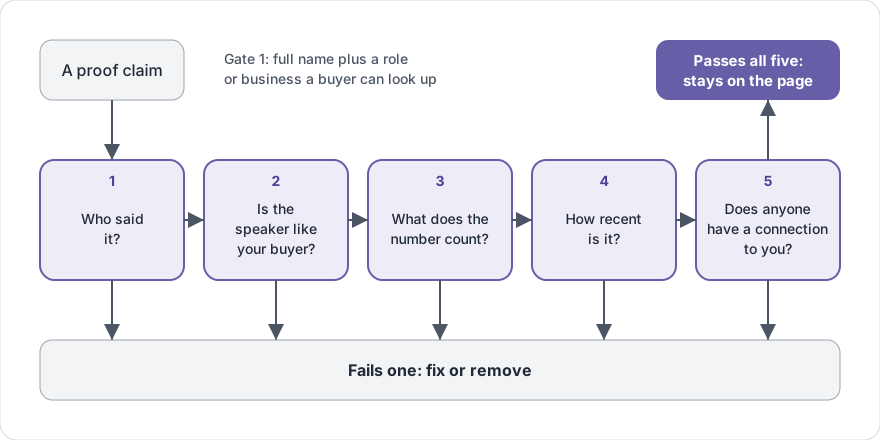
Who said it?
Pass: a full name plus a role or business a buyer can look up. Fail: a first name, or "a senior manager".
Is the speaker like your buyer?
Pass: at least half of the testimonials name the client's starting situation (role, business size or stage) and what they doubted before joining. Fail: fewer than half do, or all of them lead with the largest result. The story of someone who almost did not join persuades a hesitant buyer more than the biggest outcome.
What does the number count?
Pass: the claim names the unit (clients, sessions, attendees) and the years. Fail: "lives transformed" with no definition.
Is it recent?
Pass: each testimonial carries a date and describes the service you still deliver. Fail: undated praise for an old format. This follows the CCPA's "reasonably current" endorsement wording.
Is anyone connected to you?
Pass: a free seat, fee, affiliate link or family tie is stated beside the proof. Fail: it is left out. On ratings, a 4.x rating on a platform with a visible count is safer than a self-reported 5.0.
How Rohini Mundra handles it
Proof lands only on a clear brand: who you serve and what you promise. That is the ground Rohini Mundra's Brand New Brand You masterclass covers, helping individuals and businesses build a unique, authentic and memorable brand identity through personal branding, positioning, visual identity and audience connection. It is listed on the Projects page.
Collecting testimonials and booking proof is covered separately in How to Become a Thought Leader with Earned Proof. To ask about the masterclass, write to rohinimundra@rohinimundra.com, call +91 7760095707, or use the contact form.
Example
A coach's page says "lives transformed" with no definition, which fails the number check because it names no unit or years. A checkable form reads: "[number] one-to-one clients, [year] to [year], at least [number] sessions each".
Frequently asked
Sources
- 1.Social proof, Wikipedia
- 2.Social Proof, Cialdini Institute
- 3.Goldstein, Cialdini and Griskevicius (2008), A Room With a Viewpoint
- 4.Cialdini et al. (2006), Managing social norms for persuasive impact
- 5.How Online Reviews Influence Sales, Spiegel Research Center
- 6.56% of online shoppers experienced positively biased ratings, Business Today, 14 May 2024
- 7.Guidelines for Prevention of Misleading Advertisements and Endorsements for Misleading Advertisements, 2022, Central Consumer Protection Authority
- 8.Regulating Trust: India's legal response to fake online reviews, CAG, 9 August 2026