
Glossary
Core Values
Core values meaning: a small set of enduring principles that guide decisions and hold even when they cost you. A value is core only if you would keep it anyway.

By Rohini Mundra, Founder · Updated 23 Oct 2026
On this page
- 01Definition
- 02Quick facts
- 03What is the meaning of core values?
- 04How are core values different from goals, norms and practices?
- 05Do the words on a company values page prove anything?
- 06How can you test whether a value is core? Five questions with a pass or fail
- 07How do core values connect to purpose and brand?
- 08How Rohini Mundra handles it
- 09Example
- 10Related terms
- 11Frequently asked
What is the meaning of core values?
Core values are the few principles a person or organisation uses to decide what to do, and keeps even when keeping them costs something.
Key takeaways
- Keep three to five. In a 1996 Harvard Business Review study of enduring companies, none had more than five.
- A word on a values page proves nothing: four of the five large Indian company values pages in the table below name integrity, and Enron published it too.
- Run each value through the five questions below. A value you cannot tie to any real decision is a wish.
Quick facts
- Also known as
- Personal core values, company core values (one idea)
- Recommended number
- Three to five
- Research basis
- Collins and Porras, Harvard Business Review, 1996
- What to check
- Pass or fail on five questions
Open the values pages of several large Indian companies and the same words keep returning: integrity, excellence, the customer. A word on a page shows what a company wants to be known for. It does not show what the company does when the value becomes expensive.
That gap is why this search has two answers. The dictionary answer is short. The useful answer is a test: would you keep the value if it cost you a client, money or a launch date?
Below are the plain meaning, what five large Indian companies publish, and a five-question card for a founder, coach, consultant or team lead. It works for a personal list too. Values that fail it still matter, but they belong elsewhere, as goals or practices.
The card is for people who run a practice or a small business and must decide what they stand for before a client, a hire or a brand statement forces the question.
What is the meaning of core values?
Core values are the few principles a person or organisation uses to decide what to do, and keeps even when keeping them costs something. "Core" means they do not change with the market, the mood or the reward. Enduring companies hold them as a small set of timeless guiding principles that need no external justification (Harvard Business Review, 1996). The same test fits a company, a team and a person, so "personal core values" and "company core values" are one idea.
How are core values different from goals, norms and practices?
A goal is something you reach; a value is something you keep doing after you have reached it. Norms and practices are the habits and methods that express a value, and they can change when the situation does. Harvard Business Review's 1996 study found that none of the visionary companies it studied had more than five core values, and it warns against confusing values with operating practices, business strategies or cultural norms. If your list runs past five, you are probably mixing values with practices. Purpose is different again: it is why you work, and values are how you behave while pursuing it. The entries on purpose, passion and profit and how to find your purpose cover that side.
Do the words on a company values page prove anything?
No. The same words appear on very different companies' lists, so a value is shown by what it costs, not by what it says. In October 2026 the published values of five large Indian companies (Tata Group, Wipro, Infosys, Reliance Industries and Larsen & Toubro) were read and counted: 27 values in total, four to seven per company, median five.
Four of the five name integrity, four name the customer or client, and three name excellence. Reliance and Larsen & Toubro go past five. Enron's 2000 annual report lists Communication, Respect, Integrity and Excellence, and three of those words sit on the lists above. Five companies is a small sample, so treat it as an illustration, not a market average.
Two companies can hold the same values, so the words cannot be your proof. Belief is also thin: Gallup's 2016 survey found 27% of US employees strongly agree they believe in their organisation's values and 23% that they can apply them to their work every day, figures Gallup repeated in 2022.
- Company
- Tata Group
- Count
- 5
- Values as published
- Integrity, Responsibility, Excellence, Pioneering, Unity
- Company
- Wipro
- Count
- 4
- Values as published
- Be passionate about clients' success; Treat each person with respect; Be global and responsible; Unyielding integrity
- Company
- Infosys
- Count
- 5
- Values as published
- Client Value, Leadership by Example, Integrity & Transparency, Fairness, Excellence
- Company
- Reliance Industries
- Count
- 6
- Values as published
- Customer Value, Ownership Mindset, Respect, Integrity, One Team, Excellence
- Company
- Larsen & Toubro
- Count
- 7
- Values as published
- Professionalism, Customer focus, Trust, Care, Empowerment, Innovation, Learning
How can you test whether a value is core? Five questions with a pass or fail
A value is core if it passes five tests: you would keep it at a cost, hold it without reward, can name a decision it changed, can name what it makes you refuse, and live it now. Write up to seven candidate values and run each through these five questions. Keep only those that pass all five. Questions 1, 2 and 5 adapt the test in the 1996 Harvard Business Review study; questions 3 and 4 are recommended additions.
Five questions a core value must pass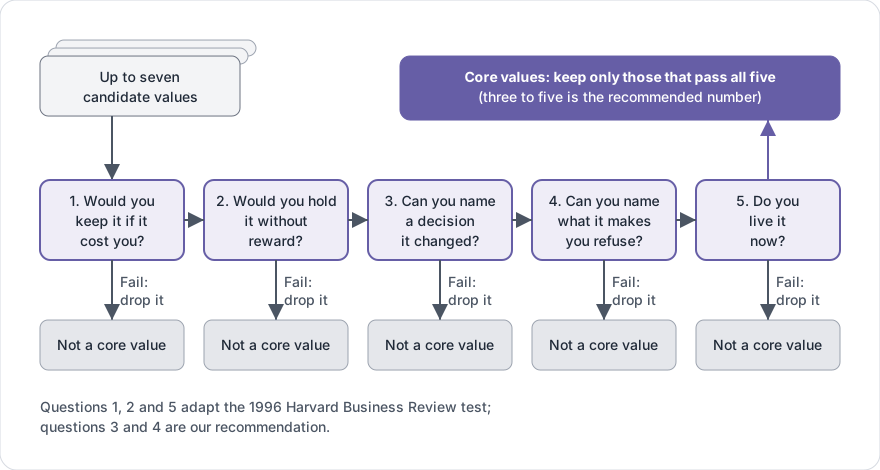
1. Would you keep it if it cost you?
If circumstances changed and penalised you for holding this value, would you still keep it? Pass: you can name the client, the rupee amount or the deadline you have already given up, or would give up, for it. Fail: you cannot name anything you have given up or would give up.
2. Would you hold it if nobody rewarded it?
Pass: you can name a time you acted on it with nobody watching and no reward. Fail: you can only point to cases where it also helped sales.
3. Which decision did it change, in the last 12 months or the last time it was under pressure?
Pass: you can name the decision and what you did differently. Fail: you cannot name any decision, or only decisions where the value cost nothing.
4. What does it make you refuse?
Pass: a specific no. Fail: nothing could ever breach it. "Honesty" fails. "Tell a client when the scope they asked for will not fix their problem, even if it loses the project" passes.
5. Do you do it now, or do you wish you did?
Pass: it describes current behaviour. Fail: it is an aspiration, so move it to your goals. Ask which values you truly hold, never which you should hold.
Fill one row per survivor. Example row, for an invented consultant:
- Value
- Candour
- Decision it changed in the last 12 months
- Told a client the scope they asked for would not solve their problem
- What it makes me refuse
- Projects that cannot solve the stated problem
How do core values connect to purpose and brand?
Values are what you keep, purpose is why you work, and both shape what you say about yourself. Once three to five values pass, they are raw material for a personal brand statement. They are easier to name if you can see how you actually behave.
How Rohini Mundra handles it
Private Coaching runs for three months, from Inner Awareness to Living the Wisdom.
Example
Wipro's published value "Treat each person with respect" passes question 4 only if it can be turned into a specific refusal. "Honesty", by contrast, fails because nothing could ever breach it.
Frequently asked
Sources
- 1.Collins and Porras, "Building Your Company's Vision", Harvard Business Review, September-October 1996, Harvard Business Review, 1996-09
- 2.Gallup, "Few Employees Believe in Their Company's Values", Gallup, 2016-09-13
- 3.Gallup, "Are Your Company Values More Than Just Words?", Gallup, 2022-12-14
- 4.Enron 2000 annual report, "Our Values", Enron
- 5.Tata Group, values and purpose, Tata Group
- 6.Wipro, about us, Wipro
- 7.Infosys Code of Conduct and Ethics, revised 23 April 2026 (Exhibit 11.2 to the company's filing with the US Securities and Exchange Commission), Infosys, 2026-04-23
- 8.Reliance Industries, life at Reliance, Reliance Industries
- 9.Larsen & Toubro, overview, Larsen & Toubro
Questions about core values?
To ask about fees or fit for Private Coaching, get in touch or email rohinimundra@rohinimundra.com.