
Glossary
Content Pillars
A content pillar is a topic you post about repeatedly, tied to something you sell. For coaches and speakers, three to five is a workable number, each passing five checks.

By Rohini Mundra, Founder · Updated 24 Oct 2026
On this page
- 01Definition
- 02What are content pillars, and how many do you need?
- 03Is a content pillar the same as a pillar page?
- 04Why do most content pillar lists fail?
- 05How do you pick a content pillar? Run five checks
- 06What does a set of content pillars look like for a speaker coach?
- 07How do content pillars relate to brand positioning and a personal brand statement?
- 08How Rohini Mundra handles it
- 09Example
- 10Related terms
- 11Frequently asked
What are content pillars?
A content pillar is a topic a person returns to repeatedly in their posts, chosen because it leads to something they sell.
Key takeaways
- For a solo expert, three or four pillars is the number to aim for, and five is the ceiling.
- A pillar page is a different thing: one long web page that links to shorter pages on its subtopics. A content pillar is a theme across everything you publish.
- Test every candidate on five checks: offer, buyer question, proof, ten posts, and topic rather than format. A pillar must pass all five.
- More pillars means thinner pillars, because your monthly posts are shared between them.
Search for content pillars and the top results hand you a list of post types: educational, promotional, inspirational, behind-the-scenes. The list helps with variety. It does not tell a coach, speaker or trainer what to be known for.
Educational is a post type. Stage confidence for first-time speakers is a pillar, and only the second tells a buyer what you can do for them. That difference decides whether your posts bring enquiries or only likes.
None of those tells a buyer what you know. That gap is where pillar lists go wrong, so this page starts there.
Below is a five-check test you can run on your own list, with a worked example and the arithmetic that limits how many pillars one person can realistically feed.
What are content pillars, and how many do you need?
A content pillar is a topic you return to repeatedly, chosen because it leads to something you sell. For a solo coach, speaker or trainer, three or four pillars is the recommended number, with five as the ceiling.
Your output sets the limit. The model here assumes 3 posts a week for 4 weeks, which is 12 posts a month. Four pillars gets 3 posts each, five gets 2.4 and seven gets about 1.7. The recommendation is to keep each pillar at two posts a month or more, so readers see it often enough to link it to your name.
Is a content pillar the same as a pillar page?
No. A pillar page is one long web page on a broad topic that links to shorter pages on its subtopics. Together they form a topic cluster, a structure used in search engine optimisation (SEO), which means making web pages easier to find on Google. A content pillar is a theme across everything you publish: LinkedIn, Instagram, talks, email. If your question is how to organise pages on a website, you want the first. If it is what to talk about, you want the second.
Why do most content pillar lists fail?
Most lists fail because they name post types instead of topics. A post type describes how you say something. It cannot tell a buyer what you know.
A reader scrolling past "motivation" learns nothing. "Stage confidence for first-time speakers" tells them whom you help. Two more failures follow: a topic with no offer behind it, and a topic you have no proof for.
How do you pick a content pillar? Run five checks
Score each candidate on the five checks below. A pillar must pass all five.
Five checks every content pillar must pass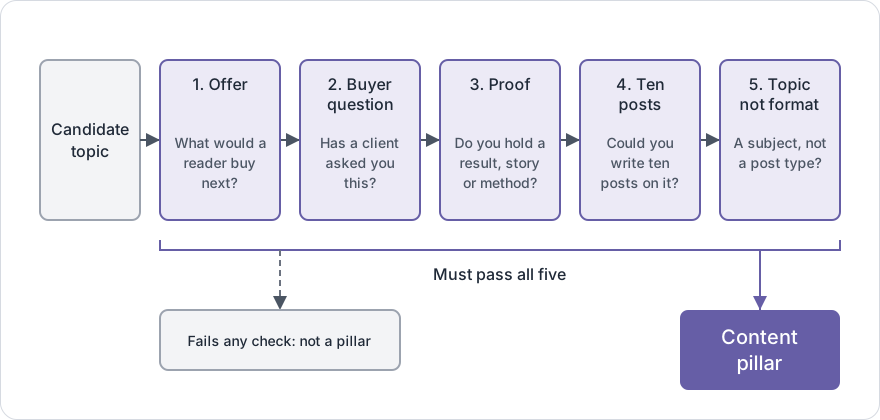
Does it lead to something you sell?
Yes, when you can name the session, programme or service a reader of this pillar would buy next. Fail: the nearest answer is "more followers".
Is it a question your buyers already ask?
Yes, when you can write it as a question a client has put to you in a message or on a call. Fail: you only know it as a subject you enjoy.
Do you hold proof for it?
Yes, when you have one client result, story or method you have used with real people. Fail: you would have to borrow someone else's. Google's guidance on helpful content asks whether content shows first-hand expertise (page updated 5 October 2026). The same test applies to posts. So give each pillar one client result or story inside it, rather than making social proof a pillar of its own.
Can you name ten posts for it?
Yes, when you can write ten titles in 20 minutes, each with a different angle (a story, a mistake, a how-to, a client question). Fail: fewer than ten, or any two titles that could be one post.
Is it a topic rather than a format?
Yes, when the name still makes sense if you swap video for text. Fail: "tips", "motivation", "behind-the-scenes".
What does a set of content pillars look like for a speaker coach?
The example below is hypothetical, built to show the checks passing. Four pillars at 3 posts each fits the model above.
Client stories appear inside each pillar as proof. Keeping that rhythm going without a treadmill is a separate question, covered in Personal Branding for Founders Without the Content Treadmill.
- Pillar
- Stage confidence for first-time speakers
- Offer it leads to
- Confidence workshop
- Buyer question
- How do I stop freezing on stage?
- Proof held
- One participant's before-and-after
- Pillar
- Building a speaker brand
- Offer it leads to
- Brand programme
- Buyer question
- What do I say I am?
- Proof held
- A speaker whose rewritten bio led to a booking
- Pillar
- Getting booked
- Offer it leads to
- Booking support
- Buyer question
- Who do I pitch?
- Proof held
- A booking won
- Pillar
- Pricing talks
- Offer it leads to
- Packaged talk
- Buyer question
- What do I charge?
- Proof held
- A client who raised her talk fee after a pricing session
How do content pillars relate to brand positioning and a personal brand statement?
Content pillars sit downstream of brand positioning. Positioning says whom you serve and why you; pillars turn that into topics. A personal brand statement is the single line every pillar should support. For platform detail, see Build a Personal Brand on LinkedIn That Creates Demand. A content calendar is the schedule of posts; pillars decide what goes in it.
How Rohini Mundra handles it
Rohini Mundra runs the five checks first. If a pillar fails the first or third check because you are new and have no clients yet, Brand New Brand You is built for that stage. It is a 40-day programme for speakers, trainers and coaches. It covers finding clients, winning your first ones and building trust when your experience is limited. As of October 2026 it is listed at ₹1,50,000.
A Brand New Brand You masterclass is also run; contact us for details.
Example
Take a speaker coach whose pillar is "Pricing talks". It leads to a packaged talk, answers the buyer question "What do I charge?", and is backed by a client who raised her talk fee after a pricing session. At 3 posts a month in a 12-post plan across four pillars, it passes all five checks once ten post titles are written.
Frequently asked
Sources
- 1.Google Search Central, Creating helpful, reliable, people-first content, Google, 5 October 2026
- 2.Brand New Brand You programme page, Rohini Mundra, October 2026