Fear of Judgement at Work: A Three-Act Visibility Test
Fear of judgement at work is a forecast about what colleagues will think, and research shows such forecasts run high. A three-act visibility test lets you check yours against what actually happens.

By Rohini Mundra, Founder · Updated 9 Nov 2026

Key takeaways
- Fear of judgement at work is a forecast, not a fact. You can check yours in two weeks with three acts: one comment, one post and one pitch.
- Two separate studies, on the spotlight effect and the liking gap, found that people overestimate how much others notice them and underestimate how much others like them. Those results come from the studies, not from your office, which is why you test your own.
- For each act, name one real person as the judge, write a 0 to 10 prediction before you act, and score what actually happened 48 hours later.
- If you cannot complete the first act within two weeks, or the fear brings physical symptoms and avoidance of meetings or calls, see a doctor. That threshold is our recommendation; the NHS advises seeing a general practitioner (GP, the family doctor) when social anxiety has a big impact on your life.
In this article
- 1What is fear of judgement at work, and why does it feel like a fact?
- 2How do you test your fear of being judged in two weeks?
- 3Which three acts make up the visibility test?
- 4How do you fill in the sheet without fooling yourself?
- 5How do you read the result: pass, fail or stuck?
- 6Why does the fear forecast so much more judgement than arrives?
- 7When is fear of judgement more than a forecast problem?
- 8Where does coaching fit when fear of judgement keeps showing up?
- 9Frequently asked questions
The comment you swallow in a meeting rarely gets a cool reply, because it never gets made. The post you delete never meets the colleague who would have scrolled past it, and the price you soften never meets the client who would have gone quiet.
Each of those silences is a decision made on a guess about someone else's mind, and nobody has checked the guess. Guesses can be checked. Checking takes two weeks and three small actions: one comment, one post and one pitch, and the result belongs to you, not to the room.
Telling yourself to stop caring rarely works. A smaller step does: write the forecast down, take one action, and compare it with what happened. This page gives you a one-page test to run over two weeks, the evidence for why the forecast runs high, and the point where the fear needs a doctor rather than a worksheet.
What is fear of judgement at work, and why does it feel like a fact?
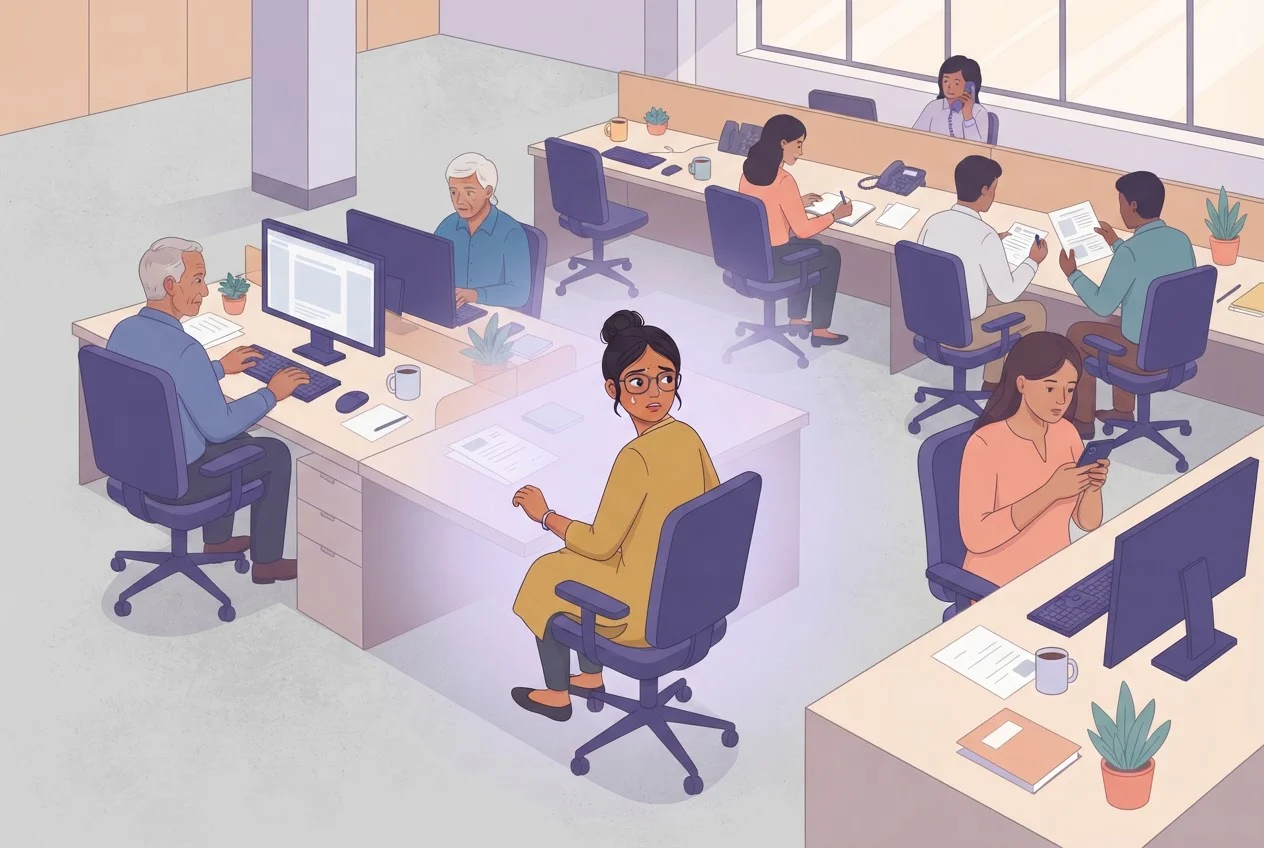
Fear of judgement is a prediction that people are privately thinking less of you, made before they have said or done anything. It feels like a fact because it arrives with a body reaction and a vivid scene. At work it shows up in three places: the comment you swallow, the post you delete, and the pitch you soften.
"Everyone will think I'm showing off" cannot be checked. "My reporting manager will think I'm showing off" can. That is the whole idea of the test below: swap the crowd for one named person, and swap dread for something you can count.
You do not need to stop caring what people think. Caring is how you work with others. The aim is for evidence, not dread, to set how much weight a reaction gets.

How do you test your fear of being judged in two weeks?
Run three acts of rising exposure, and for each one write a prediction before you act and a score 48 hours after. In our estimate, the sheet takes about five minutes per act. It turns "I'm sure they'll judge me" into a gap you can read. The habit behind it is the one in How to Step Out of Your Comfort Zone: Predict, Do, Score. This version adds a named judge and three work-specific acts.
Which three acts make up the visibility test?
Each act is small on purpose. A named judge is the one real person whose opinion you fear most for that act.
| Act | What you do | Your named judge | Predict (0 to 10) | Actual after 48 hours (0 to 10) | Gap |
|---|---|---|---|---|---|
| 1. Comment | One question or added point in a meeting or team chat | Whoever you expect to react worst | Write it before | Write it after | Predicted minus actual |
| 2. Post | One short post (3 to 4 sentences) about work you have actually done, on LinkedIn or in a colleagues' group | Your manager, or the colleague you most want to impress | Write it before | Write it after | Predicted minus actual |
| 3. Pitch | One idea to your manager, one price to a client, or one request for a meeting about your role | The person who decides | Write it before | Write it after | Predicted minus actual |
Do Act 1 in the first three days, Act 2 by the end of week one, and Act 3 in week two. Do not skip ahead; each act earns the next.
An invented row, only to show how the sheet is filled in and not a result: Act 2, judge my manager, predicted 7, expecting the manager to think she was showing off, actual 1 (four likes, one positive comment, no reaction from the manager), gap 6.
This test covers comments, posts and pitches. Standing in front of a room is a separate problem; for that, start with Public Speaking for Introverts: Tired or Scared? A 6-Question Check.
How do you fill in the sheet without fooling yourself?
Follow four rules, each of which you can check.
- Predict first, in writing. Write one sentence and a number before you act. If you fill the prediction in afterwards, the test is void.
- Use one scale. 0 means nothing negative happened. 5 means a visible cool or critical response, such as a frown, a correction in front of others or a sharp reply. 10 means open ridicule or a lasting break.
- Score only what you can see or hear. Count words, replies, reactions and actions. Silence is not a verdict: score it 0 and note it. You cannot read minds, and neither can your forecast.
- In Act 3, score the proposal and the person separately. A "no" to your price is information about the price. Only a reaction aimed at you, such as a put-down or being left out afterwards, goes in the score.
How do you read the result: pass, fail or stuck?
Read the outcomes in this order. These thresholds are our recommendation, a rule of thumb and not a clinical measure.
- Fail: your forecast was right. Any actual score is 7 or more. The fear may be picking up something real in that team. Change the audience (a smaller group, a different manager), change the format (write first, speak one to one) or ask a trusted senior what the norm is. This result says something about the room, not about your worth.
- Pass: your forecast runs high. No actual score is 7 or more, and at least two acts have an actual at or below your prediction minus 2, or a prediction of 2 or less matched by an actual of 0 to 2. Next step: repeat Act 1 twice a week for another fortnight, and move your next post or pitch up a notch.
- Inconclusive: otherwise. Repeat Act 1 and Act 2 for another week, then read the sheet again.
- Stuck: Act 1 is not done by day 14. Read the section on when the fear needs more than a worksheet below.
If you want the same habit stretched over longer, How to Build Confidence at Work: A 14-Day Prediction Log is the companion.
Why does the fear forecast so much more judgement than arrives?
People systematically overestimate how closely others watch them and underestimate how much others like them. Two studies, run independently, found this. That is why the first result often surprises people, though your office may differ from the laboratory.
The spotlight effect is the tendency to overestimate how much other people notice your actions and appearance. Gilovich, Medvec and Savitsky named it in a 2000 paper in the Journal of Personality and Social Psychology. In their T-shirt experiment, wearers of an embarrassing shirt predicted that 46% of observers would identify the face on it. In fact 23% did, half the predicted figure. As our own illustration of the arithmetic, not a forecast: if you expect 10 of 20 colleagues to notice a slip, a halving suggests about 5. The study measured noticing, not judging, so use it as a reason to test, not as a promise.
The liking gap is the tendency to underestimate how much a conversation partner liked you. Boothby, Cooney, Sandstrom and Clark reported it across five studies in Psychological Science in 2018: after conversations, people consistently rated their partners' liking as lower than the partners reported.
The fear is also common. LinkedIn's 2026 survey, as BusinessToday reported on 2 September 2026, found that 44% of Gen Z professionals in India (the youngest generation of working adults) named fear of being judged as their biggest barrier to networking, ahead of worrying about bothering people (39%) and sounding inauthentic (37%). It is LinkedIn's own survey, it covers one generation, and it is about networking, so it shows how widespread the fear is, not whether the forecast is right.
The fear also has a real source at work. Harvard Business School researchers Amy Edmondson and James Detert wrote in 2006 that the degree to which "fear appears to be a feature of modern work life" was the most surprising thing they found, in Harvard Business School's Working Knowledge. Edmondson and Detert's research suggests fear of speaking up is common at work. That is why a failed test is useful too. In the same LinkedIn survey, 59% of India's Gen Z professionals said nobody had shown them how to build professional relationships, so a lot of this fear is simply untrained, not a flaw.
When is fear of judgement more than a forecast problem?
When the fear is intense and constant, it can be social anxiety disorder, a medical condition and not a habit of thought. The US National Institute of Mental Health (NIMH) defines it as fear or anxiety in situations where a person may be scrutinised, evaluated or judged. See a doctor if it significantly affects your daily life.
NIMH lists the symptoms as blushing, sweating, trembling, a rapid heartbeat, a mind going blank, and avoiding social situations. It describes cognitive behavioural therapy (CBT), a structured talking therapy, as the gold standard treatment. The UK's National Health Service (NHS) advises seeing a general practitioner (GP, the family doctor) when anxiety significantly affects your life (last reviewed 17 May 2023, as read in November 2026). It also suggests keeping a diary and breaking hard situations into steps, which is close to what the visibility test asks you to do.
Our recommendation, drawn from those two lists: speak to a doctor or a qualified mental health professional if any of these is true.
- You still cannot do Act 1 after two weeks.
- You avoid meetings or calls altogether.
- Physical symptoms hit every time you face a colleague.
The test is a good first step either way, and the sheet gives a professional something concrete to read. In India you can call Tele-MANAS, the government's free 24-hour mental health helpline, on 14416 (Press Information Bureau release).
Where does coaching fit when fear of judgement keeps showing up?
If the test shows the forecast runs high but the fear still wins, a coach and a group can give you structure. That is how we work. Our three-month programme is group coaching with one-on-one hand-holding sessions. Month 1, Inner Awareness, is about understanding your nature and quieting overthinking. Months 2 and 3 are Soul and Karma, and Living the Wisdom.
Two other formats may suit you. The Heart of Business is a group programme with interactive sessions and step-by-step hand-holding, built for career shifts and the inner blocks that hold people back. Our workshops and seminars cover communication and leadership.
The entry point is a three-day webinar. See programme prices and the refund terms, which allow refunds within three days. Then enquire through our contact page.
Work through your fear of judgement with a coach
Frequently asked questions
Replaying is the mind rehearsing the worst reading of an event; writing the one sentence down and scoring what actually happened interrupts it. For a short method, try How to Stop Overthinking: A 15-Minute Card and a 7-Day Test.
Sources
- 1.83% of Gen Z professionals are afraid to network, LinkedIn research, as reported by BusinessToday, 2 September 2026
- 2.The spotlight effect in social judgment, Gilovich, Medvec and Savitsky, Journal of Personality and Social Psychology 78(2), 211 to 222, 2000
- 3.The liking gap in conversations, Boothby, Cooney, Sandstrom and Clark, Psychological Science, 2018
- 4.Do I Dare Say Something?, Harvard Business School Working Knowledge, 20 March 2006
- 5.Social Anxiety Disorder: More Than Just Shyness, US National Institute of Mental Health, revised 2025
- 6.Social anxiety (social phobia), UK National Health Service, last reviewed 17 May 2023
- 7.Tele-MANAS release, Press Information Bureau, Government of India