How to Build Confidence at Work: A 14-Day Prediction Log
To build confidence at work, treat it as a record of actions you completed and can prove. Log one small task a day for 14 days, score your confidence before and after.
By Rohini Mundra, Founder · Updated 25 Oct 2026

Key takeaways
- Build confidence by completing one small, checkable action a day and recording proof. The belief follows the record, not the other way round.
- Score your confidence before and after each action. Our pass marks after 14 days are at least 10 actions done and an average before-score up by 10 points or more. These are our recommendation, not validated cut-offs.
- Repeating positive statements can make people with low self-esteem feel worse, so use proof instead.
- Low mood, panic or poor sleep lasting weeks needs a doctor or clinical psychologist, not a log. In India, Tele-MANAS (Tele Mental Health Assistance and Networking Across States), the free national mental health helpline, is on 14416.
In this article
- 1How to build confidence: what do you do each day for 14 days?
- 2How do you read your day-14 result?
- 3Why does confidence follow action, and why have positive thoughts not worked?
- 4Is it low confidence, imposter syndrome or fear of speaking?
- 5When does low confidence need a clinician rather than a log?
- 6What should you check before paying for confidence coaching?
- 7What does Private Coaching with us involve?
- 8Frequently asked questions
Confidence advice usually asks you to feel differently first: think positively, stand taller, believe in yourself. If you have already tried that and still feel behind everyone around you, the advice was pointing at the wrong end of the problem.
Confidence is the belief that you can get a particular thing done. That belief is built from evidence, and the strongest evidence is something you did, finished and can show. A feeling you generate on demand is the weakest.
This page gives you a way to build that evidence at work and to see whether it is working. Each day you pick one small, checkable action and, on day 14, you count what happened.
The log does not promise that 14 days is enough. It lets you find out with your own numbers, instead of waiting to feel ready.
How to build confidence: what do you do each day for 14 days?
Each day, choose one small action from your own work, score how sure you are that you can do it, do it, and write down proof that it happened. Fourteen days gives you a record you can count, which a feeling cannot give you.
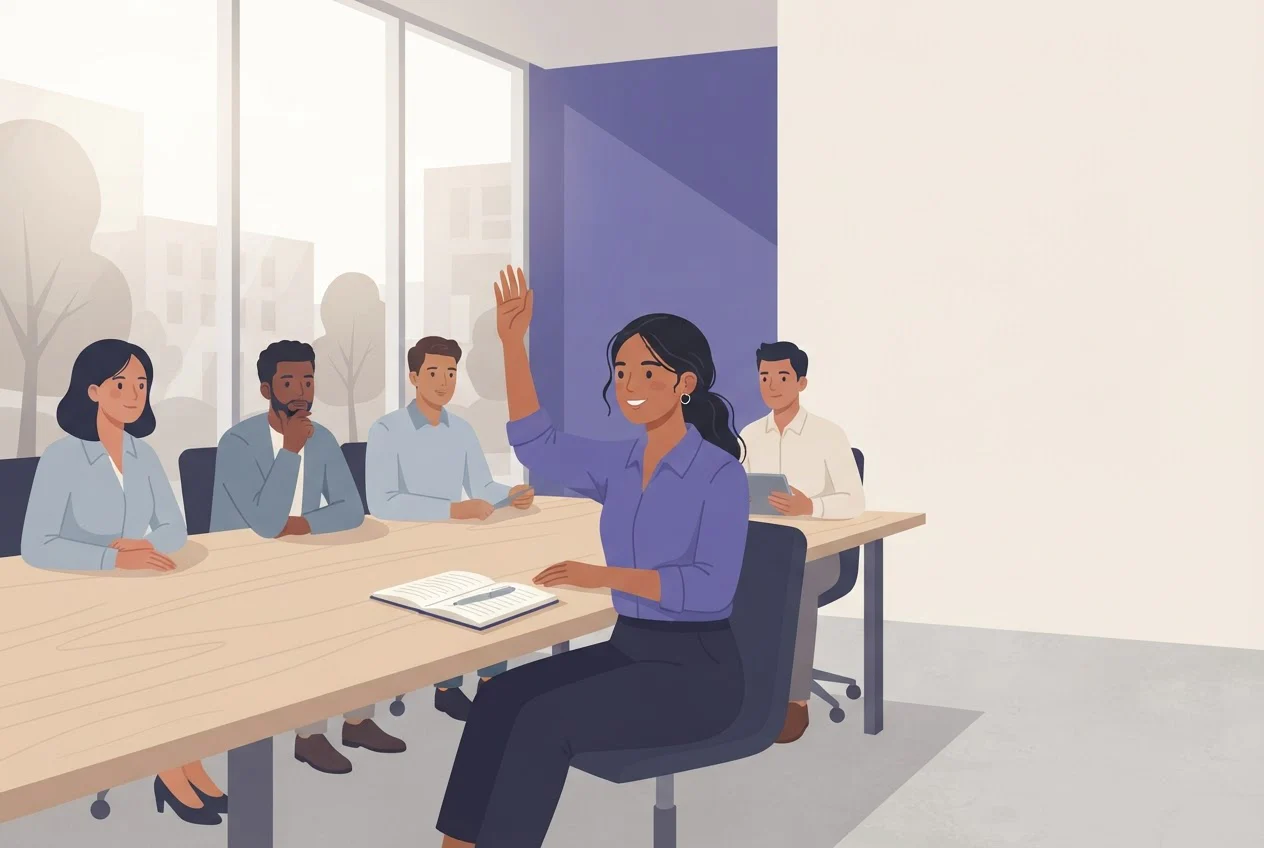
- Pick an action that takes 10 to 20 minutes and that someone else could check.Examples: a message sent, a question asked in a named meeting, a draft shared with a colleague.
- Before you do it, score "I can do this the way I planned" from 0 to 100.Write the score down before you start the action.
- Aim for a before-score between 40 and 70.Below 30, shrink the task. Above 80, make it harder. This band is our recommendation: the task is hard enough to carry real doubt and small enough to finish.
- Do it.If you do not, write one line on what stopped you.
- Write the proof and an after-score.Then mark whether it went better, the same or worse than you predicted. Better means the after-score is at least 10 points above the before-score. Same means within 9 points. Worse means lower by 10 or more.
- Take your actions from the work where you feel least sure.Confidence is a belief about particular tasks, so we recommend practising where the doubt is.
| Day | Action | Before (0–100) | Done? Proof | After (0–100) | Better / same / worse than predicted |
|---|---|---|---|---|---|
| 1 |
Copy the row for days 1 to 14.
Worked example (invented, to show the arithmetic, not real data). Days 5 to 10 are left out.
| Day | Action | Before | Done? Proof | After | vs prediction |
|---|---|---|---|---|---|
| 1 | Ask one question on the weekly team call | 40 | Yes, asked about the deadline; manager replied | 65 | Better |
| 2 | Send a status update to my manager unprompted | 45 | Yes, email sent 11:20 | 60 | Better |
| 3 | Give my view first in a meeting | 35 | No, meeting ended before my turn | n/a | n/a |
| 4 | Ask a colleague for feedback on a draft | 50 | Yes, two comments received | 65 | Better |
| 11 | Raise a different deadline on the call | 60 | Yes, deadline moved | 70 | Better |
| 12 | Present the first slide of the update | 55 | Yes, colleague saw it on the call | 60 | Same |
| 13 | Disagree politely in a meeting | 65 | Yes, order of tasks changed | 75 | Better |
| 14 | Ask for a stretch task | 60 | Yes, task assigned | 70 | Better |
The average before-score for days 1 to 4 is (40 + 45 + 35 + 50) ÷ 4 = 42.5. For days 11 to 14 it is (60 + 55 + 65 + 60) ÷ 4 = 60. That is a rise of 17.5 points.
How do you read your day-14 result?
Count three things: the days you did the action, the days it went better than you predicted, and the change in your average before-score between days 1 to 4 and days 11 to 14. Our pass marks are at least 10 of 14 days done and a rise of 10 points or more. Both are our recommendation, not clinical thresholds.
| What your log shows | What it means | Next step |
|---|---|---|
| 10 or more days done, rise of 10 or more | Your forecasts are catching up with your record | Repeat for another 14 days with harder actions |
| 10 or more days done, rise under 10 | The actions may be too similar or too easy | Change the type of action, and use our seven-day self-awareness test to see how you come across |
| Fewer than 10 days done | The tasks are too big, or one task keeps getting skipped | Read your "what stopped me" lines. If the same task or fear repeats, run our 14-day self-sabotage log |
| Most before-scores above 80 from day 1 | The tasks are too easy to carry doubt | Choose tasks you would score 40 to 70 |
The better-than-predicted count shows how often your forecast was too pessimistic. If it is high, your doubt was a forecast that kept being wrong, not a fact about you.
Why does confidence follow action, and why have positive thoughts not worked?
Self-efficacy, the belief that you can complete a particular task, is built mainly by mastery experience, meaning having done similar things (see the two studies below). Waiting to feel confident before you act reverses the order.
Two separate studies point the same way:
- In a study of preservice teachers (359 beginning and 395 advanced at the start; 226 and 223 measured again after the placement; Frontiers in Psychology, 2016), changes in teaching self-efficacy over a school placement were significantly predicted by mastery experiences. The link was stronger in the advanced group.
- In a study of 335 German adults (2025), mastery experience was the most important source of self-efficacy for physical activity. All four sources together explained about 60% of the variance, meaning the share of differences between people that the model accounts for.
The samples are teachers in training and adults rating physical-activity self-efficacy, not office workers, so applying the finding to your job is our inference that the same mechanism holds. The log turns each completed action into a mastery experience you can see.
Repeating reassuring phrases is a different matter. In experiments on positive self-statements (Psychological Science, 2009), people with low self-esteem who repeated "I'm a lovable person" felt worse than those who did not. People with high self-esteem felt somewhat better. If affirmations have left you feeling worse, the research says that is a known pattern.
Cognitive behavioural therapy (CBT, a talking therapy) works from the idea that thoughts, feelings and actions are connected. Its self-help guidance suggests gradually facing your fears to build confidence. The NHS low self-esteem guidance advises writing down positive things about yourself. The proof column does the same with completed actions.
The before-score also exposes guesswork. In our view, guessing what colleagues think of you tends to push doubt up, because the guess usually assumes the worst. Proof that a third party could check replaces the guess.

Is it low confidence, imposter syndrome or fear of speaking?
Low confidence is doubting you can do a task. Imposter syndrome is feeling your success is undeserved despite clear evidence. Fear of speaking is a narrower, task-specific fear. The log fits the first best, and the others need a different tool.
- You have a strong record and still feel like a fraud. More actions will not help, because you discount the evidence you already have. Read our guide to an imposter syndrome coach in India, which includes a seven-day evidence log.
- The doubt is mostly about speaking in front of people. Use graded steps with fear ratings. Our fear ladder for public speaking does this.
When does low confidence need a clinician rather than a log?
See a doctor or licensed clinical psychologist if low mood, panic or poor sleep has lasted weeks, or if you are avoiding work or people. The log cannot rule out depression or anxiety. In India, Tele-MANAS offers free 24-hour support on 14416 or 1-800-891-4416.
Our recommendation on stopping: if on most of the days you completed, the after-score is lower than the before-score, pause the log and talk to a professional before continuing. A log is a self-check, not treatment.
What should you check before paying for confidence coaching?
Before you pay anyone for confidence coaching, run four checks:
- Is the total price in rupees given in writing, with the number of sessions? Pass: yes. Fail: the price appears only after you describe your problems.
- Are the stop and refund terms written before payment? Pass: yes. Fail: full payment up front and no way out.
- What will you check together at session four? Pass: something observable, like your log. Fail: "you will feel more confident".
- What happens if you mention low mood or panic? Pass: a named referral route to a clinician. Fail: a promise to fix it.
Our own prices are on our programme prices page.
What does Private Coaching with us involve?
Our Private Coaching runs for three months. Month 1, Inner Awareness, is about understanding your nature and quietening overthinking. Month 2, Soul and Karma, explores deeper patterns and finds connection. Month 3, Living the Wisdom, applies peace in real life, under real pressure.
If your 14-day log shows you finish the actions and the doubt stays loud, overthinking is where we would begin, and that is Month 1. You are welcome to share your completed log when you get in touch.
See the programme prices and the cancellation and refund terms before you commit. Write to rohinimundra@rohinimundra.com, call +91 7760095707, or send us your details.
Share your completed log with Rohini Mundra
Frequently asked questions
No. Grounded confidence is a quiet sense of trusting yourself. Cockiness is often overcompensation for a lack of self-efficacy, according to the therapist and psychologist quoted in The Guardian. A quiet person who finishes what they plan is showing confidence.
Sources
- 1.How to start building confidence, The Guardian, 26 May 2026
- 2.Why Do I Feel More Confident? Bandura's Sources Predict Preservice Teachers' Latent Changes in Teacher Self-Efficacy, Frontiers in Psychology, 2016
- 3.An empirical ranking of the importance of the sources of self-efficacy for physical activity, 2025
- 4.Positive Self-Statements: Power for Some, Peril for Others, Psychological Science, 2009
- 5.NHS Every Mind Matters: CBT self-help techniques
- 6.NHS: Raise low self-esteem (last reviewed 11 April 2023; the page's next review date of 11 April 2026 has passed)
- 7.Press Information Bureau: Tele-MANAS launch